Sisyphus and the Boulder
Sisyphus pushes a boulder uphill in Hades, and it rolls back each time, as Odysseus sees in Homer's Odyssey. Apollodorus and Pausanias say the punishment follows his telling the river god Asopus that Zeus had carried off Aegina. Later scholia add that he chained Death, and Theognis says he talked Persephone into letting him return from Hades.
Sections on this page
What Led To It
Sisyphus is the founder of Ephyra, later Corinth, and Homer's Iliad calls him the craftiest of men. That reputation is the setting for every episode here. Zeus's abduction of Aegina is the event that starts the chain, and the informing that follows is what the mythographers call the crime. In the Greek sense, exposing a god's secret is an act of hubris, though no ancient source uses that word for it.
The boulder itself is the oldest piece. Homer's Odyssey has it, and no source before Apollodorus says why. The rest of the story is gathered from later or secondary witnesses, and this page keeps them apart.
The Myth
Sisyphus is punished in Hades because he crossed Zeus. The ancient sources tell the road there in pieces: he informs on a god, he outwits Death, he talks his way back from the dead, and at the end he pushes a stone. This page lays the pieces in that order and says which writer supplies each one. For the king himself, his family and his city, see the Sisyphus page.
The first crime is the one the mythographers name. In Apollodorus's Library, Zeus secretly carries off Aegina, daughter of the river god Asopus. Asopus goes looking for her, and Sisyphus betrays the secret to him. Apollodorus says outright that this is the reason for the punishment in Hades.
Pausanias adds a price. On the summit of Acrocorinth, he says, a spring rises behind the temple of Aphrodite. Sisyphus knew that Zeus had ravished Aegina, but he would not tell Asopus until the river god gave him a spring on the Acrocorinthus. Once Asopus agreed, Sisyphus turned informer. Pausanias closes with a hedge: he is punished in Hades, "if anyone believes the story."
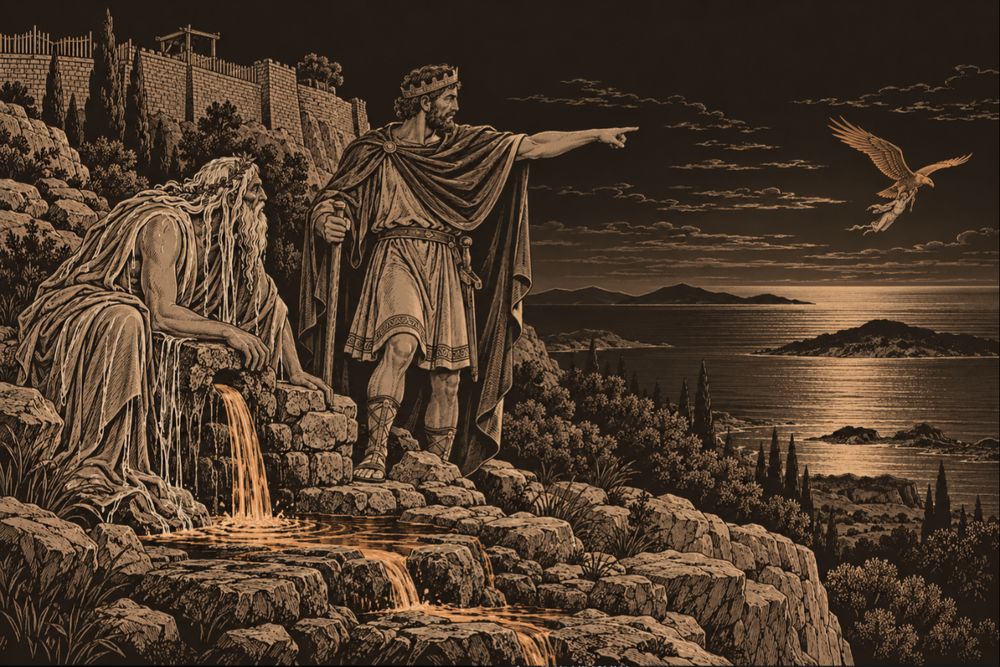
Sisyphus tells Asopus where Aegina went
Generated by AI from this page's own facts, not an ancient image or evidence of anything. How this site uses generated images
What happens next is not in Homer, Apollodorus or Pausanias. It comes from a scholion, an ancient marginal note, on Iliad 6.153. The scholiast cites the mythographer Pherecydes, a writer of the fifth century BCE, but the note itself was gathered much later, so treat it as secondary evidence for an old tale.
According to the note, Zeus carried Aegina away from Phlius to Oenone by way of Corinth. When Asopus came searching, Sisyphus told him about the abduction, and Zeus's anger fell on Sisyphus. Zeus sent Thanatos, Death, to fetch him. Sisyphus saw Death coming and bound him in strong chains. So no human being died, until Hades freed Death and delivered Sisyphus into his hands.
The sources disagree on who ends the stoppage. J. G. Frazer's note to Apollodorus says the story has Ares release Death. The scholion as published on Topos Text has Hades do it. Both agree that Death is set free and Sisyphus is taken.
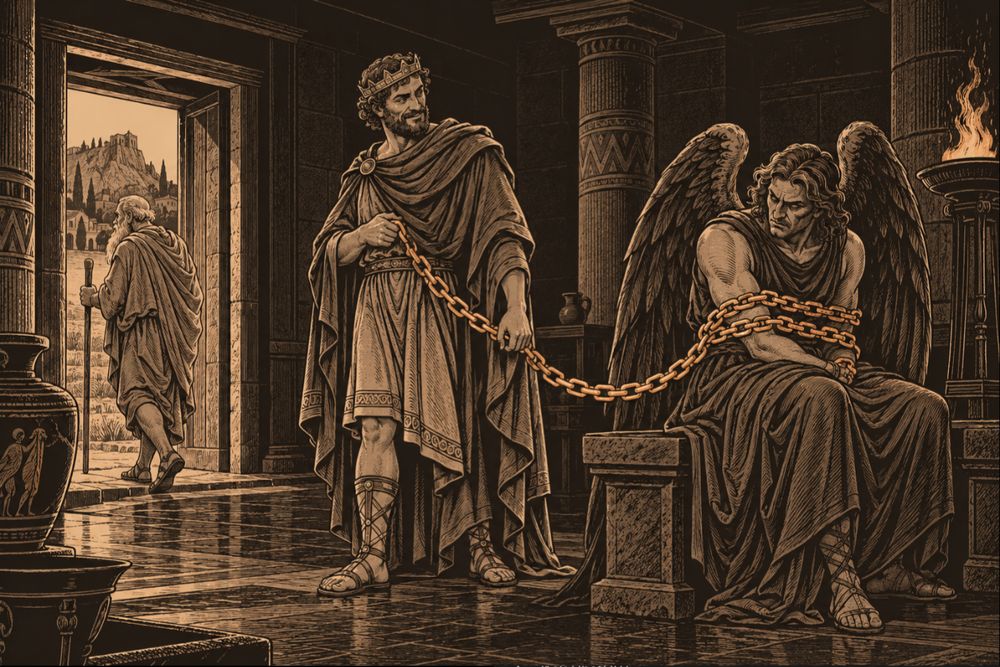
Sisyphus chains Death
Generated by AI from this page's own facts, not an ancient image or evidence of anything. How this site uses generated images
The scholion has Sisyphus escape once more before the end. Before he dies, he tells his wife Merope not to send the customary gifts to Hades for him. Hades notices the omission and lets Sisyphus go back to reprimand her. Sisyphus refuses to return. He lives to old age, and then Hades forces him to roll a rock into the underworld so he cannot flee again.
The elegies of Theognis tell a different escape. In a poem about wealth, Theognis says that a man might be wiser than Aeolus's son Sisyphus, whose wheedling words persuaded Persephone, and still be worth nothing without riches. Sisyphus returned even from Hades by his wiliness, a thing contrived by no one else. He is the one man who has seen the black portal and come back to the light of the sun. The Theognis lines read here do not mention Death in chains, and the scholion does not mention Persephone. These are two stories about the same trickster, not one story told twice.
Homer knows none of this. In Book 11 of the Odyssey, Odysseus has sailed to the edge of the world to question the dead, and he watches the great sinners suffer in the underworld. After Tantalus and his vanishing water, he sees Sisyphus. Homer names no crime and no judge. He shows only the labor, in the words of A. T. Murray's translation.
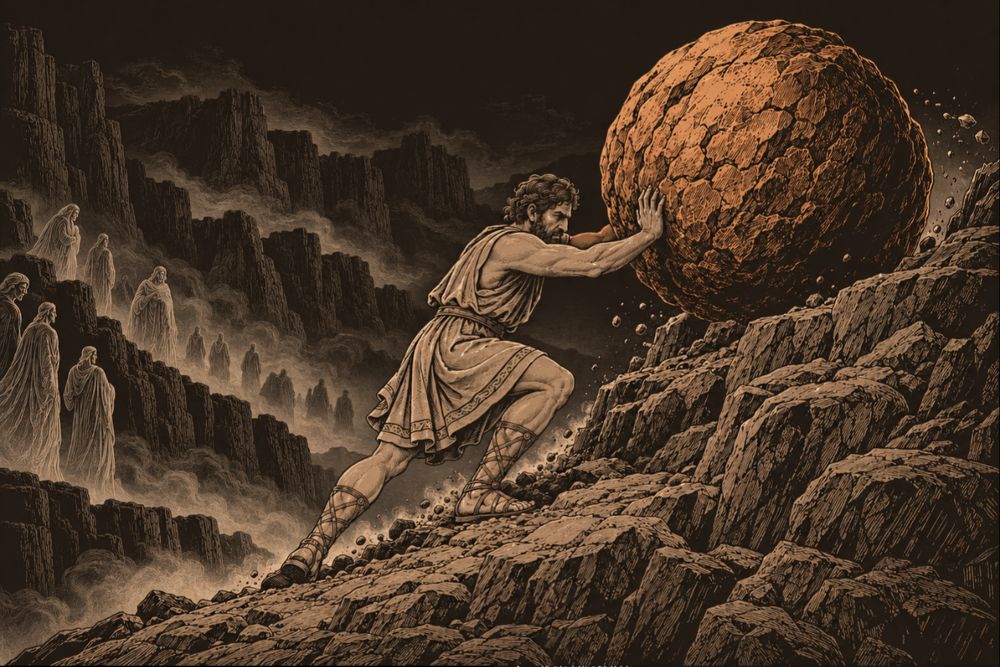
Sisyphus and the boulder
Generated by AI from this page's own facts, not an ancient image or evidence of anything. How this site uses generated images
Aye, and I saw Sisyphus in violent torment, seeking to raise a monstrous stone with both his hands. Verily he would brace himself with hands and feet, and thrust the stone toward the crest of a hill, but as often as he was about to heave it over the top, the weight would turn it back, and then down again to the plain would come rolling the ruthless stone. But he would strain again and thrust it back, and the sweat flowed down from his limbs, and dust rose up from his head.
Apollodorus gives the same picture in a line. Sisyphus is punished in Hades by rolling a stone with his hands and head in the effort to heave it over the top, but push it as he will, it rebounds backward. Apollodorus is the writer who ties the stone to Aegina. That link turns a scene from a poem into an ending to a plot: the king who could not keep a secret, and who beat Death, is given a task he can never finish.
The Tartarus page lists Sisyphus among the prisoners of that deepest pit. The Homeric passage does not use the name. It says only that Odysseus saw him among the dead.
What Followed
Ancient writers do not give Sisyphus a release. The Odyssey shows the work as continuing, and Apollodorus says he goes on rolling the stone. In the scholion, Hades sets the stone for him so he cannot flee again. Theognis, by contrast, remembers only the escape, and uses Sisyphus as a figure of cunning that wealth still outweighs.
Afterlife and Modern Influence
"Sisyphean" is an English adjective built from his name. Dictionary.com defines it as endless and unavailing, as labor or a task, and adds that it describes a task as seemingly endless and futile, one you keep doing but never finish. The adjective is modern English use of the myth, not an ancient idea.
Albert Camus's essay The Myth of Sisyphus, published in 1942, reads the boulder as an image of the absurd. Its closing lines say that the struggle itself toward the heights is enough to fill a man's heart, and that one must imagine Sisyphus happy. That is a philosophical reading of the punishment, not a report of what any ancient source says. No ancient source describes his feelings.
What is the story of Sisyphus and the Boulder?
Sisyphus, a crafty king of Corinth, betrays Zeus's secret to the river god Asopus, cheats Death, and is finally made to push a boulder up a hill in Hades. Each time it nears the top, it rolls back down. Homer describes the labor; Apollodorus and Pausanias give the reason; a scholion on the Iliad adds the chaining of Death.
Apollodorus, Library 1.9.3
Why does Sisyphus push a rock?
Apollodorus says it is his punishment for telling Asopus that Zeus had secretly carried off Aegina. Pausanias tells the same story and says Sisyphus first bargained for a spring on Acrocorinth, though he adds that he reports it only if anyone believes the story. Homer's Odyssey shows the labor and names no crime.
Pausanias, Description of Greece 2.5.1
What does 'sisyphean' mean?
Dictionary.com defines Sisyphean as endless and unavailing, as labor or a task, and as seemingly endless and futile. It comes from the labor of Sisyphus in Hades. The definition is a modern English one built on the Odyssey's picture of a stone that always rolls back.
Why did Camus say Sisyphus was happy?
No ancient source reports it. Camus ends The Myth of Sisyphus (1942) with the lines that the struggle itself toward the heights is enough to fill a man's heart, and that one must imagine Sisyphus happy. The verb matters: he asks the reader to imagine it. It is his reading of the boulder as a labor with no final result, not a fact from the myth.
Where Accounts Differ
- why-sisyphus-is-punished
- who-freed-death
- how-sisyphus-left-hades
- camus-happiness-is-modern
- The reason for the boulder differs by source. Homer (Odyssey 11.593-600) gives none. Apollodorus (Library 1.9.3) says Sisyphus betrayed to Asopus that Zeus had secretly carried off Aegina. Pausanias (2.5.1) adds that he first got a spring on Acrocorinth in return, and reports the punishment only if anyone believes the story.
- The chaining of Death comes from the D scholia to Iliad 6.153, which cite Pherecydes (fr. 119 Fowler). This is a late compilation citing an earlier writer, so it is later, secondary evidence. It does not appear in Homer, Apollodorus or Pausanias.
- Who frees Death differs. Frazer's note to Apollodorus 1.9.3, summarizing the scholion, has Ares release Death. The Topos Text translation of the scholion says Hades delivered Sisyphus to Death and freed him from his chains.
- Sisyphus's return from the dead has two forms. Theognis (699-718 in Edmonds's numbering) says his wheedling words persuaded Persephone. The scholion says Hades let him go back to reprimand his wife Merope, and he refused to return. The two do not mention each other.
- Camus's reading of the myth is a modern philosophical one. No ancient source states whether Sisyphus was happy or unhappy.
Read the full source verification →
Mythology
Figures In This Myth
Also Connected
Related Terms
Referenced By
Sources
- Homer, Odyssey 11.593-600
- Apollodorus, Library 1.9.3
- Pausanias, Description of Greece 2.5.1
- Theognis, Elegiac Poems 699-718
- D Scholia to the Iliad 6.153
- J. G. Frazer, notes to Apollodorus, Library 1.9.3 (Loeb, 1921), Perseus Digital Library
- Theognis, Elegiac Poems 699-718, in J. M. Edmonds, Elegy and Iambus, vol. 1 (Loeb, 1931), Perseus Digital Library
- D Scholia to the Iliad 6.153 (Pherecydes fr. 119 Fowler), trans. R. Scott Smith, Topos Text
- Dictionary.com, entry "Sisyphean" (American definition; Collins English Dictionary, British definition)
- Albert Camus, The Myth of Sisyphus (1942), trans. Justin O'Brien