Bellerophon
Bellerophon was a Greek hero from Ephyre, son of Glaucus in Homer's Iliad. Falsely accused by King Proetus's wife, he was sent to Lycia carrying tablets that asked for his death. There he killed the fire-breathing Chimera, fought the Solymi and the Amazons, and married the king's daughter. Pindar adds that he tamed Pegasus with Athena's golden bridle and was thrown trying to reach Olympus.
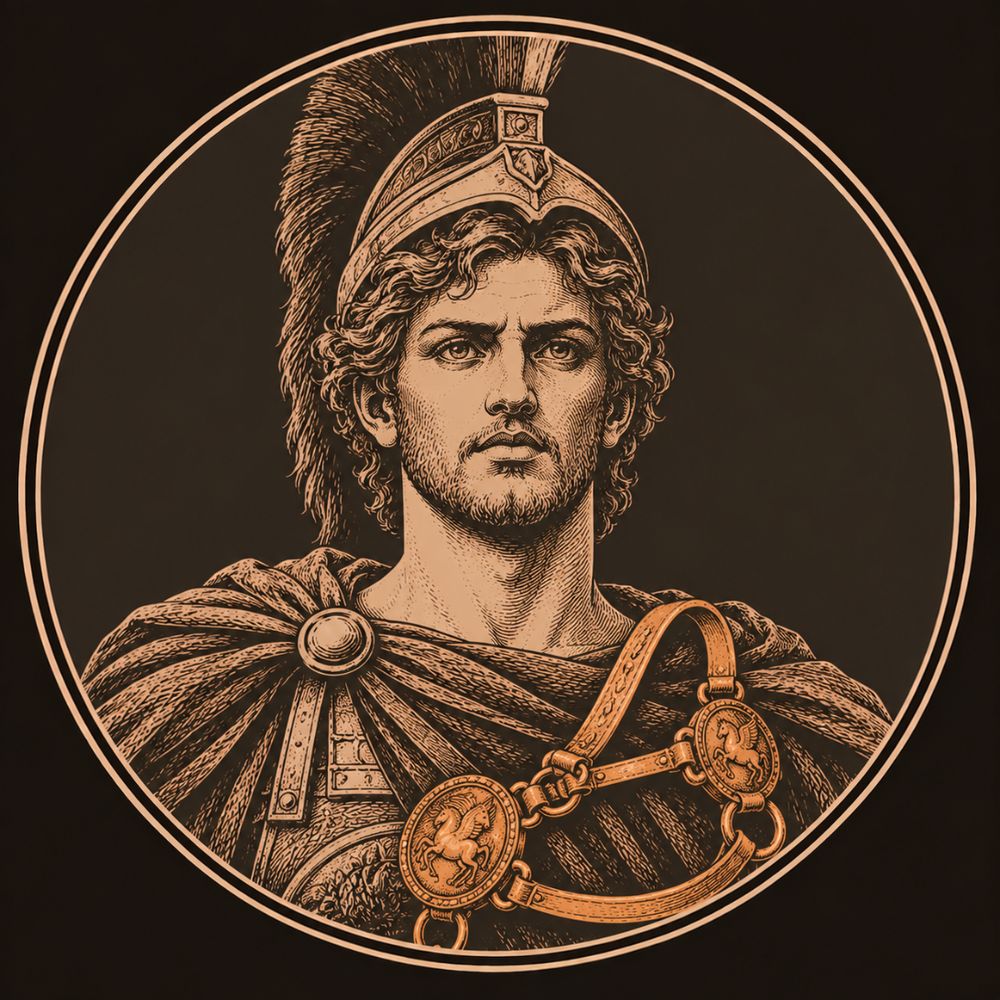
Bellerophon, bronze medallion illustration
Generated by AI from this page's own facts, not an ancient image or evidence of anything. How this site uses generated images
Sections on this page
Core Myth
Homer's Iliad tells Bellerophon's story through his grandson Glaucus, a Lycian fighting for Troy. In Book 6, Diomedes asks Glaucus who he is, and Glaucus answers with his family. Sisyphus, son of Aeolus, lived at Ephyre in Argos. Sisyphus fathered Glaucus, and that Glaucus fathered Bellerophon. The gods gave Bellerophon beauty and a man's courage.
Proetus, who ruled the Argives, drove him from the land. Proetus's wife Anteia wanted to lie with Bellerophon in secret, and he refused her. So she lied to her husband: die yourself, she told Proetus, or kill Bellerophon, who tried to force me. Proetus shrank from killing him. Instead he sent him to Lycia with a folded tablet of deadly signs, to show to Anteia's father, the Lycian king.
The king feasted him for nine days before he asked to see the token. After reading it, he sent Bellerophon to kill the Chimera. Homer says he killed her trusting in the signs of the gods. Next he fought the Solymi, the fiercest battle he ever entered, and third he killed the Amazons. On his way back, the king set the bravest men of Lycia in ambush. Bellerophon killed every one of them.
Then the king knew him for the offspring of a god. He kept Bellerophon in Lycia, gave him his daughter and half his royal honour, and the Lycians marked out an estate for him. His children were Isander, Hippolochus and Laodameia. Laodameia lay with Zeus and bore Sarpedon, a warrior armed in bronze. Hippolochus was the father of Glaucus, the man telling the story.
Glaucus ends it darkly. Bellerophon came to be hated by all the gods and wandered alone over the Aleian plain, eating out his heart and shunning the paths of men. Ares killed his son Isander in battle with the Solymi, and Artemis killed his daughter in anger. Homer gives no reason for the gods' hatred. Diomedes, hearing the story, remembers that his grandfather Oeneus once hosted Bellerophon for twenty days, and the two warriors agree not to fight.
What monster did Bellerophon slay?
The Chimera, a fire-breathing beast of Lycia. In Homer's Iliad, the Lycian king orders the killing as the first of several tasks meant to get Bellerophon killed. The same passage lists what came next: a battle with the Solymi then the Amazons, then an ambush of the best Lycian warriors. Bellerophon survived all four. Apollodorus's Library keeps the same order and names the king Iobates.
Homer, Iliad 6.178-190
How did Bellerophon slay the Chimera?
It depends on the source. Homer's Iliad names no horse and no weapon: Bellerophon killed her trusting in the signs of the gods. Hesiod's Theogony credits Pegasus and Bellerophon together. Pindar's Olympian Ode 13 has him attack from the air on Pegasus, armoured in bronze. Apollodorus's Library is the most specific. Mounted on Pegasus, Bellerophon soared up and shot the Chimera down from the height.
Apollodorus, Library 2.3.2
Why did Zeus punish Bellerophon?
Because he tried to ride up to the gods, in Pindar's telling. Isthmian Ode 7 says winged Pegasus threw his master when Bellerophon wanted to reach the dwellings of heaven and the company of Zeus. Pindar does not say Zeus struck him; the horse does it. Homer's Iliad gives no reason at all. It says only that Bellerophon came to be hated by all the gods and wandered alone over the Aleian plain.
Pindar, Isthmian Ode 7.44-47
Was Bellerophon a demigod?
Not in Homer's family tree, which makes him the grandson of Sisyphus, son of Aeolus. Yet the same passage of the Iliad says the Lycian king recognised him as the offspring of a god once he survived every task. Pindar goes further. In Olympian Ode 13, Athena tells him to show the bridle to Poseidon the Tamer, whom the Greek calls his father. The English translation on Perseus softens this to ancestor.
Pindar, Olympian Ode 13.63-90
Did Bellerophon have a wife?
Yes, the daughter of the Lycian king who had tried to kill him. Homer's Iliad does not name her, but says she bore him three children: Isander, Hippolochus and Laodameia. Laodameia became the mother of Sarpedon by Zeus. Apollodorus's Library names the wife Philonoe, daughter of Iobates. Hyginus's Fabulae calls her the other daughter of the king, and says her sister Stheneboea killed herself on hearing of the marriage.
Homer, Iliad 6.191-199
Who is the father of Bellerophon?
Homer's Iliad names Glaucus, son of Sisyphus of Ephyre. Apollodorus's Library gives the same line: Bellerophon, son of Glaucus, son of Sisyphus. Pindar's Olympian Ode 13 points to a divine father instead. Athena there calls Poseidon the Tamer his father, in the Greek, and tells him to sacrifice a bull to the god. The two claims sit side by side in the sources without either one being withdrawn.
Homer, Iliad 6.152-155
Later Traditions
Hesiod's Theogony adds the winged horse that the Iliad's account never mentions. In its catalogue of monsters it says that Pegasus and noble Bellerophon slew the Chimera, and says nothing more about the fight.
Pindar's Olympian Ode 13 tells how he got the horse. Bellerophon struggled to harness Pegasus beside a spring until Pallas Athena brought him a golden bridle in a dream. He had slept on her altar at the bidding of a seer, the son of Coeranus, and woke to find the bridle beside him. Athena told him to sacrifice a white bull to Poseidon the Tamer. Then he bridled the horse, and from the air he attacked the Amazons, the Chimera and the Solymi. The full arc, from exile to fall, is told in Bellerophon and Pegasus.
The same ode refuses to tell his death, saying only that Pegasus now lives in the ancient stables of Zeus on Olympus. Pindar's Isthmian Ode 7 is blunter. Winged Pegasus threw his master, it says, when Bellerophon tried to reach the dwellings of heaven and the company of Zeus. Pindar gives the fall as a warning: a sweetness beyond measure waits for a bitter end.
Apollodorus's Library follows Homer's outline with new names and a new beginning. Bellerophon comes to Proetus to be purified after accidentally killing his brother, called Deliades, Piren or Alcimenes. The queen is Stheneboea and the Lycian king is Iobates. Bellerophon mounts Pegasus, offspring of Medusa and Poseidon, and shoots the Chimera down from the height. After the ambush, Iobates shows him the letter, gives him his daughter Philonoe, and leaves him the kingdom when he dies.
Hyginus's Fabulae also names the queen Stheneboea and makes Iobates her father. Bellerophon kills the Chimera riding Pegasus and is said to have fallen on the Aleian plain and dislocated his hip. When the king gives him his other daughter, Stheneboea kills herself. Hyginus's Astronomica says he fell from fear, looking down at the earth as he flew toward the sky, and that Jupiter set the horse among the stars. Euripides wrote two tragedies on the story, Stheneboea and Bellerophon, which survive only in fragments.
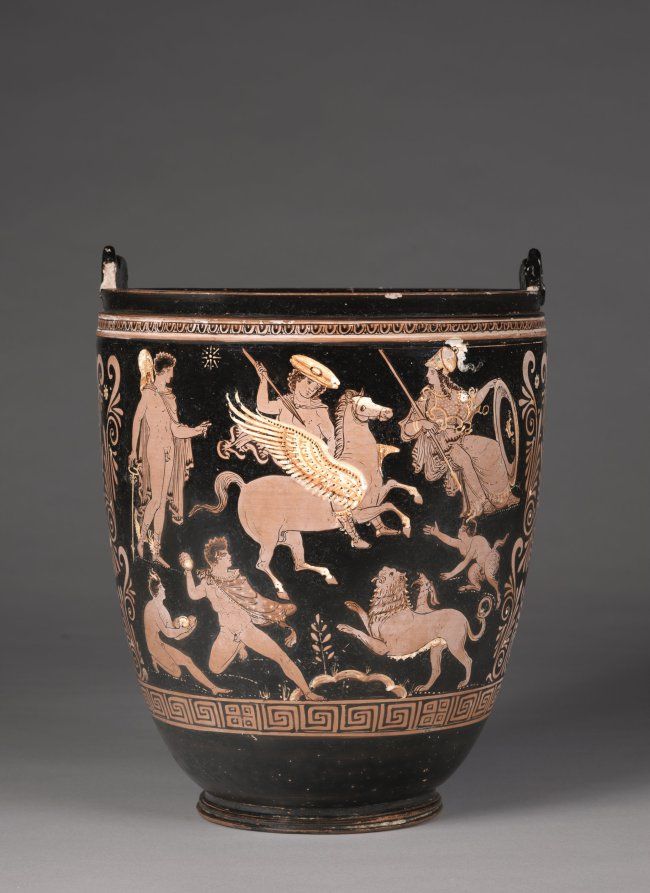
Red-Figure Situla (Deep Bucket): Bellerophon Slaying Chimaera (A); Dionysos, Maenads, Eros (B) - South Italian, Apulian, c. 350 BCE, ceramic
The Cleveland Museum of Art, Cleveland, OH, 1977.179. CC0
Also Connected
5 recorded connections, each with the ancient line behind it.
Allies
-

Athena brought Bellerophon the golden bridle in a dream so he could tame Pegasus.
-

Bellerophon bridled Pegasus with Athena's golden bridle and fought from his back; in Pindar's Isthmian Ode 7 the horse later throws him.
Enemies
-

Sent by the Lycian king to kill the Chimera, Bellerophon slew her; Homer says he trusted in the signs of the gods, later sources put him on Pegasus.
Connected
-
Diomedes's grandfather Oeneus hosted Bellerophon for twenty days, a guest-friendship that stops Diomedes and Bellerophon's grandson Glaucus from fighting at Troy.
-

Pindar's Athena calls Poseidon the Tamer Bellerophon's father in the Greek and has him sacrifice a bull to the god; Homer and Apollodorus make Glaucus, son of Sisyphus, his father.
Where Accounts Differ
- who was Bellerophon's father
- Anteia or Stheneboea
- how Bellerophon killed the Chimera
- how Bellerophon's life ended
- the names of the Lycian king and his daughter
- Bellerophon's father is given two ways. Homer (Iliad 6.152-155) and Apollodorus (Library 2.3.1) make him the son of Glaucus, son of Sisyphus. Pindar (Olympian Ode 13.63-90) has Athena call Poseidon his father; the Greek word is father, which the Perseus English translation renders as ancestor.
- The queen who accuses him is Anteia in Homer (Iliad 6.160). Apollodorus (Library 2.3.1) and Hyginus's Fabulae 57 call her Stheneboea, and Hyginus's Astronomica gives both names. Euripides titled one of his lost tragedies Stheneboea.
- How the Chimera died differs by source. Homer (Iliad 6.178-183) mentions no horse or weapon. Hesiod (Theogony 319-325) names Pegasus beside Bellerophon, Pindar (Olympian Ode 13.63-90) has him fight from the air, and Apollodorus (Library 2.3.2) has him shoot her down from Pegasus's back.
- His end is told three ways. Homer (Iliad 6.200-205) has him hated by the gods and wandering alone over the Aleian plain, with no reason given. Pindar (Isthmian Ode 7.44-47) has Pegasus throw him as he tries to reach Zeus. Hyginus's Fabulae 57 has him fall on the Aleian plain and dislocate his hip, and the Astronomica has him fall from fear while flying toward the sky.
- The Lycian king and the wife he gives Bellerophon are unnamed in Homer. Apollodorus (Library 2.3.1-2.3.2) calls the king Iobates and the wife Philonoe; Hyginus's Fabulae 57 says only that she was Stheneboea's sister.
Read the full source verification →
Mythology
Appears In
Referenced By
Sources
- Homer, Iliad 6.152-155
- Homer, Iliad 6.156-170
- Homer, Iliad 6.171-190
- Homer, Iliad 6.178-190
- Homer, Iliad 6.191-199
- Homer, Iliad 6.200-205
- Homer, Iliad 6.215-221
- Hesiod, Theogony 319-325
- Pindar, Olympian Ode 13.63-90
- Pindar, Olympian Ode 13.91-92
- Pindar, Isthmian Ode 7.44-47
- Apollodorus, Library 2.3.1
- Apollodorus, Library 2.3.2
- Hyginus, Fabulae 57