Euryale
Euryale is one of the three Gorgons, the sisters Stheno, Euryale and Medusa. Hesiod's Theogony makes her a daughter of Phorcys and Ceto and says that she and Stheno were undying and never grew old, while Medusa was mortal. Ancient texts give her no story of her own beyond her name, her sisters and one cry that Pindar describes.
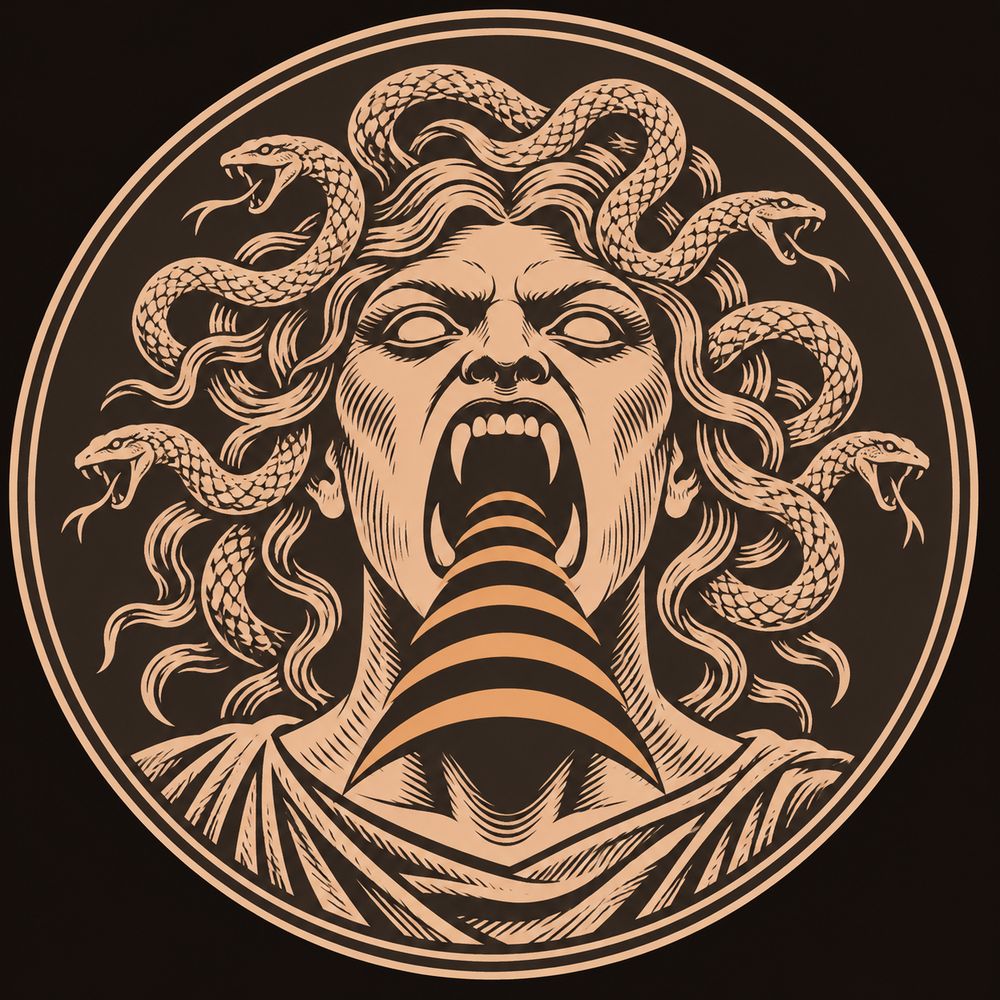
Euryale's cry rising from open jaws
Generated by AI from this page's own facts, not an ancient image or evidence of anything. How this site uses generated images
Sections on this page
See Euryale in the Greek family tree.
Core Myth
Hesiod's Theogony names Euryale in the passage on the children of the sea-deity Phorcys and his sister Ceto. Ceto bore the grey-haired Graiae and the Gorgons, who dwell beyond glorious Ocean in the frontier land towards Night, where the clear-voiced Hesperides are. Hesiod calls the three Sthenno, Euryale and Medusa. He says Medusa was mortal, but the other two were undying and grew not old (Hesiod, Theogony 270-283). That is the whole of his account of Euryale. He gives her no separate deed, no description and no speech.
Apollodorus repeats the three names and the same division. He says the Gorgons were Stheno, Euryale and Medusa, and that Medusa alone was mortal, which is why Perseus was sent to fetch her head (Apollodorus, Library 2.4.2). When Perseus has beheaded Medusa, Apollodorus says the other Gorgons woke and pursued him. They could not see him because the cap of Hades hid him (Apollodorus, Library 2.4.3). He does not say which of the two sisters did what. The full sequence is told in Perseus and Medusa.
Where does Euryale live?
Hesiod places the Gorgons beyond glorious Ocean, in the frontier land towards Night, where the clear-voiced Hesperides are. That is the only location the Theogony gives for her and her sisters. Apollodorus has Perseus fly to the ocean to find them asleep, which agrees with a home at the edge of the world, though he names no more exact place.
What happened to Euryale and Stheno?
The sources checked here record no death or punishment for either sister. Hesiod calls them undying and ageless. Apollodorus says they woke after Medusa was beheaded and chased Perseus but could not see him in the cap of Hades. After that scene neither text follows them, so the surviving texts leave them alive and unchanged.
What was Euryale known for?
Pindar is the source checked here that gives her a distinct trait. He names her jaws as a source of the Gorgons' dirge, which Athena wove into the music of the flute. Otherwise she is known only as one of three sisters, the one of two immortal Gorgons who is named next to Stheno.
Who are Euryale and Stheno in Greek mythology?
They are the two immortal Gorgons, sisters of the mortal Medusa. Hesiod makes all three children of Phorcys and Ceto, living beyond Ocean near the Hesperides. Apollodorus lists the same three names. Stheno and Euryale matter to the plot only because their immortality makes Medusa the sister a hero could kill.
Later Traditions
Pindar gives Euryale the one detail that sets her apart from Stheno. In his twelfth Pythian ode he says Athena wove into music the dirge of the Gorgons, which Perseus heard when he did away with the third sister. Pindar names Euryale as the source of part of that sound, which comes from her jaws (Pindar, Pythian Ode 12.6-24).
The sources checked here do not split Euryale from her sister Stheno in any other way. Neither is said to be killed, and neither is given a lover or a child. The page on the monsters of Greek myth places the Gorgons among creatures who mostly descend from Typhon and Echidna, but the Gorgons come from a separate sea lineage, that of Phorcys and Ceto.
Lineage
See the full family tree2 recorded relations, each with the ancient line behind it.
Parents
-

Hesiod says Ceto bore the Graiae to Phorcys and names the Gorgons, Euryale among them, in the same passage.
Siblings
-

Hesiod lists Sthenno, Euryale and Medusa together as the Gorgons, and says Medusa was mortal while the other two were undying.
Also Connected
1 recorded connection, each with the ancient line behind it.
Connected
-

Apollodorus lists Euryale among the Gorgons whose sister Medusa Perseus was sent to kill.
Read the full source verification →