Ceto
Ceto is a Greek sea goddess, a daughter of Sea and Earth in Hesiod's Theogony. She is the wife of her brother Phorcys and the mother of the Graeae, the Gorgons and the snake that guards the golden apples. Hesiod gives her no deeds and no speech. She appears in the poem only as the mother of dangerous children.
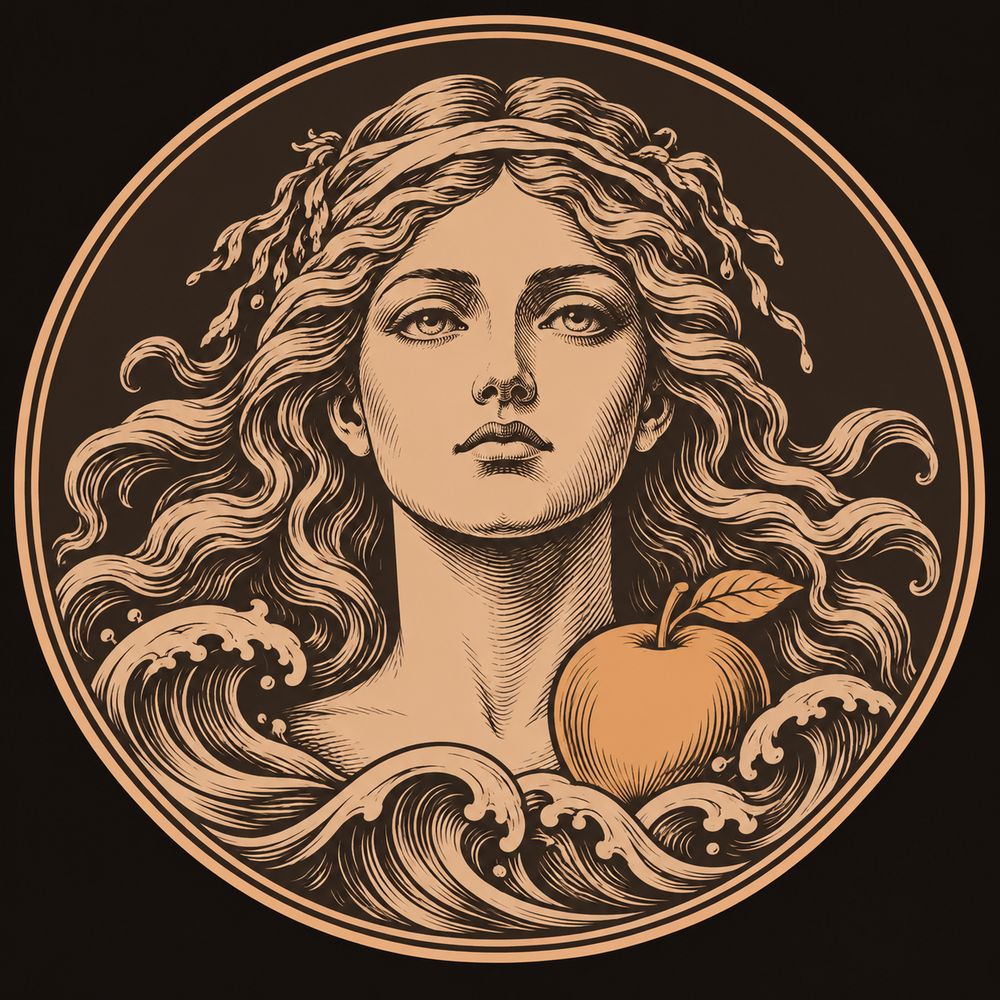
Ceto, sea goddess, with a golden apple
Generated by AI from this page's own facts, not an ancient image or evidence of anything. How this site uses generated images
Sections on this page
See Ceto in the Greek family tree.
Core Myth
Hesiod's Theogony lists Ceto among the children of Pontus, the Sea. He says the Sea begat Nereus first. Then he got great Thaumas and proud Phorcys, being mated with Earth, and fair-cheeked Ceto and Eurybia (Hesiod, Theogony 233-239). Ceto is therefore a sister of Nereus, Thaumas, Phorcys and Eurybia. The poem gives her no title, no cult and no named domain.
Her marriage is to her brother. Hesiod says Ceto bore to Phorcys the fair-cheeked Graiae, sisters grey from their birth. He names two of them, Pemphredo and Enyo. The same passage names the Gorgons Sthenno, Euryale and Medusa, and says Medusa was mortal (Hesiod, Theogony 270-283). Hesiod does not say how many Graiae there were, or that Ceto bore the Gorgons as a separate birth.
Hesiod gives Ceto one more child. He says she was joined in love to Phorcys and bore her youngest, the awful snake that guards the apples all of gold in the secret places of the dark earth at its great bounds. He closes the passage by calling this the offspring of Ceto and Phorcys (Hesiod, Theogony 333-336). He gives the snake no name. The page on the serpent Ladon covers the name and a rival parentage.
What was Ceto the goddess of?
The sources checked here give her no office. Hesiod lists her as a child of the Sea and shows her only as a mother, never as a ruler of waves or winds. Calling her the goddess of sea monsters is a modern summary of her children, not a title the poet gives her.
Is Ceto Medusa's mom?
Yes, in Hesiod. He says Ceto bore the Graiae to Phorcys and then names the Gorgons Sthenno, Euryale and Medusa in the same passage. That makes Phorcys the father and Ceto the mother of Medusa, who alone among the Gorgons was mortal. Later writers such as Aeschylus name Phorcys as the father of the Graeae.
Were Ceto and Phorcys siblings?
They were siblings and also husband and wife. Hesiod lists both among the children of the Sea, together with Nereus, Thaumas and Eurybia. Later in the poem he says Ceto was joined in love to Phorcys and bore her youngest child to him. The poet does not comment on the closeness of the pair.
Where do Ceto's children live?
Hesiod places the Gorgons beyond glorious Ocean, in the frontier land towards Night, where the clear-voiced Hesperides are. He places the golden-apple snake in the secret places of the dark earth at its great bounds. He gives no home for the Graiae. All the places he names lie at the edge of the known world.
Is Ceto the mother of Scylla?
Not in Homer. In the Odyssey Circe tells Odysseus to call on Crataeis, the mother of Scylla, and she does not call Crataeis Ceto. Apollonius of Rhodes names Phorcys as Scylla's father, but he also gives the mother as Crataeis. The sources checked here do not make Ceto the mother of Scylla.
Later Traditions
Aeschylus names the Graeae by their father. His Prometheus tells Io that the daughters of Phorcys live on the Gorgonean plains of Cisthene, three old maids shaped like swans, with one eye and a single tooth between them (Aeschylus, Prometheus Bound 790-800). The passage in the sources checked here does not name Ceto. Her place among the sea-born monsters of Greek myth rests on Hesiod's account.
5 recorded relations, each with the ancient line behind it.
Parents
-

Hesiod lists fair-cheeked Ceto among the children the Sea got, beside Nereus, Thaumas, Phorcys and Eurybia.
Siblings
-

Hesiod makes Nereus the eldest child of the Sea and names Ceto among the later children of the same father.
Children
-
Hesiod says Ceto bore the Graiae to Phorcys and names the Gorgons, Euryale among them, in the same passage.
-
disputed
Hesiod gives Ceto and Phorcys a youngest child, the snake that guards the golden apples, but does not name it. Later sources call that snake Ladon and give it other parents.
-

Hesiod says Ceto bore the Graiae to Phorcys and names the Gorgons, Medusa among them, in the same passage.
Where Accounts Differ
- Scylla's mother: Crataeis in Homer, not Ceto
- Scylla's parents are given differently. Homer names only her mother Crataeis (Odyssey 12.124-126), and Apollonius of Rhodes names Crataeis as mother and Phorcys as father (Argonautica 4.783-832). Neither makes Ceto her mother.
Read the full source verification →
Mythology
Related Terms
Referenced By
Sources
- Hesiod, Theogony 233-239
- Hesiod, Theogony 270-283
- Hesiod, Theogony 333-336
- Aeschylus, Prometheus Bound 790-800
- Homer, Odyssey 12.124-126
- Apollonius of Rhodes, Argonautica 4.783-832