Hesperides
The Hesperides are Greek nymphs who guard the golden apples in a garden at the far western edge of the world. Hesiod's Theogony makes them daughters of Night and gives neither a number nor names. Apollonius of Rhodes names three, Hespere, Eretheis and Aegle. Apollodorus names four, Aegle, Erythia, Hesperia and Arethusa.
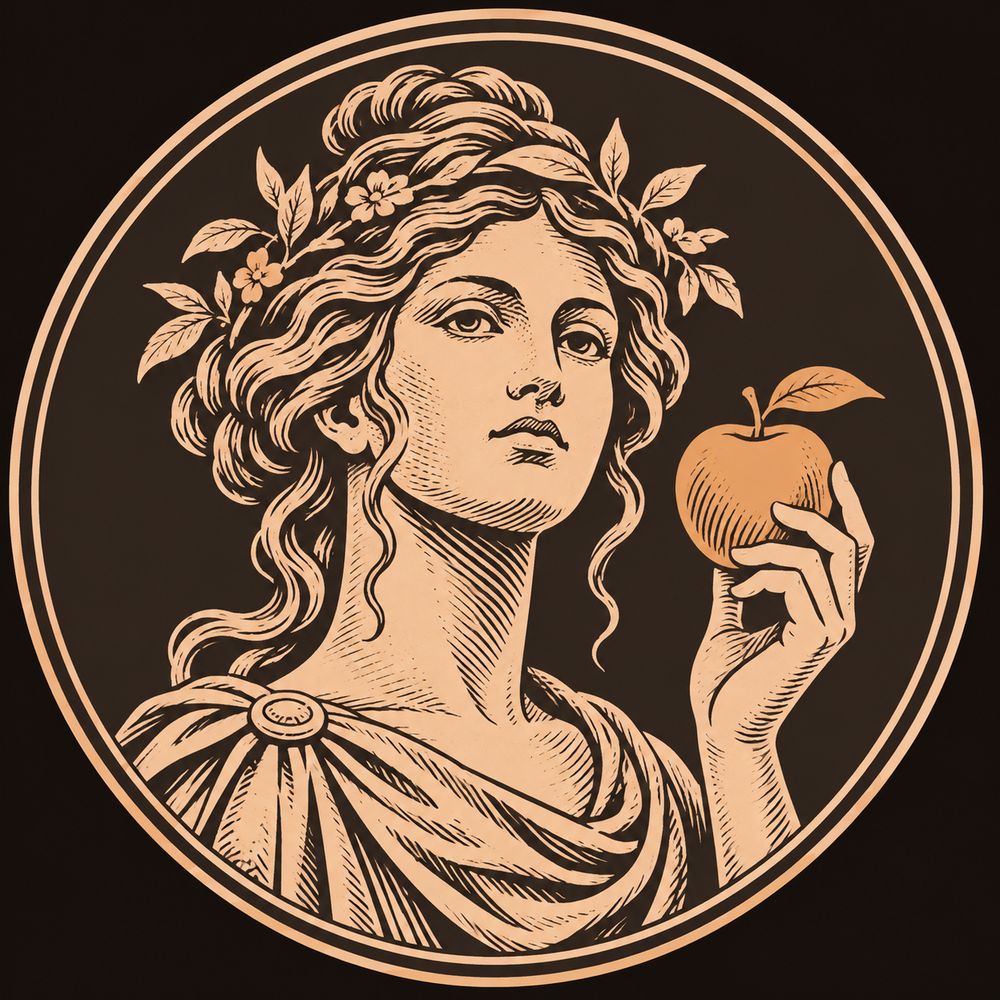
Hesperide Holding a Golden Apple
Generated by AI from this page's own facts, not an ancient image or evidence of anything. How this site uses generated images
Sections on this page
See Hesperides in the Greek family tree.
Core Myth
Hesiod's Theogony lists the Hesperides among the children of Night. He says she also bore the Hesperides, who guard the rich golden apples and the fruit-bearing trees beyond glorious Ocean (Hesiod, Theogony 211-225). He gives no number and no names. He places them again in the same poem, when he says the Gorgons dwell beyond Ocean in the frontier land towards Night, where the clear-voiced Hesperides are (Hesiod, Theogony 270-279).
Hesiod also puts the Titan Atlas in their neighbourhood. He says Atlas stands at the borders of the earth before the clear-voiced Hesperides, holding up the broad sky (Hesiod, Theogony 517-520). The poem does not call the Hesperides his daughters. The link between the nymphs and Atlas is a matter of place in this passage, not of descent.
Apollodorus gives the fullest account of the garden. He says the apples were presented to Zeus by Earth after his marriage to Hera. They lay with Atlas among the Hyperboreans, not in Libya, guarded by an immortal hundred-headed dragon, the offspring of Typhon and Echidna, which spoke with many kinds of voices. He names four Hesperides: Aegle, Erythia, Hesperia and Arethusa (Apollodorus, Library 2.5.11). The dragon is the serpent that the page on Ladon treats.
In Apollodorus the nymphs matter because of the eleventh labour of Heracles. He is told to send Atlas for the apples. Atlas takes them from the Hesperides, and Heracles tricks him into taking the sky back and walks away with the fruit. Apollodorus adds that some say Heracles plucked the apples himself after killing the guardian snake (Apollodorus, Library 2.5.11). The full sequence of tasks is told in the labours of Heracles.
How many Hesperides are there in Greek mythology?
The sources checked here do not agree. Hesiod gives no number. Apollonius of Rhodes names three nymphs, Hespere, Eretheis and Aegle, while Apollodorus names four, Aegle, Erythia, Hesperia and Arethusa. Only Aegle appears in both lists. No ancient text checked here settles the count, so any single number is the choice of one author.
Who are the three Hesperides?
Apollonius of Rhodes gives the best-known three: Hespere, Eretheis and Aegle. In his Argonautica they are changed into a poplar, an elm and a willow, and Aegle speaks for them. Apollodorus lists four names instead, so the trio is Apollonius's version and not a fixed canon.
Apollonius of Rhodes, Argonautica, Book 4
Who are the daughters of Atlas?
Among the sources checked here, none states that the Hesperides are daughters of Atlas. Hesiod makes them children of Night and only places Atlas before them. Apollonius calls the garden the garden of Atlas, and Apollodorus says the apples lay with him. Those passages tie the nymphs to Atlas by place, not by parentage.
Where are the Hesperides located?
Hesiod puts them beyond glorious Ocean, in the frontier land towards Night, and at the borders of the earth where Atlas stands. Apollodorus places the apples among the Hyperboreans and rejects Libya, while Apollonius sets the dead dragon near the Tritonian lake in Libya. The authors disagree, and the garden is always at the edge of the known world.
What is the Greek myth about the golden apples?
In Apollodorus the apples were a gift from Earth to Zeus at his marriage to Hera, kept in a garden watched by a hundred-headed dragon and the Hesperides. Heracles needs them for his eleventh labour. He gets them by sending Atlas, or in another version by killing the dragon himself. The page on the labours covers the full list of tasks.
Later Traditions
Apollonius of Rhodes shows the Hesperides after Heracles has been and gone. The Argonauts reach the plain where Ladon, the serpent of the land, had kept watch over the golden apples in the garden of Atlas until the day before. The serpent lies dead from the arrows of Heracles. The nymphs lament, then turn to dust and earth when the heroes approach. After a prayer from Orpheus they become a poplar, an elm and a willow, named Hespere, Eretheis and Aegle. Aegle then speaks and tells the heroes where Heracles struck the rock for water (Apollonius of Rhodes, Argonautica book 4).
Ovid tells a related story of Atlas without naming the nymphs in the passage checked here. His Atlas owns a tree with golden leaves and golden apples, guarded by a huge dragon. Themis once warned him that a son of Jupiter would come to strip it. When Perseus asks for shelter, Atlas remembers the warning, refuses him and is turned into a mountain by the head of Medusa (Ovid, Metamorphoses 4.628-662).
Lineage
See the full family tree1 recorded relation, each with the ancient line behind it.
Parents

Also Connected
3 recorded connections, each with the ancient line behind it.
Connected
-

Hesiod stands Atlas at the borders of the earth before the Hesperides. Apollonius calls their garden the garden of Atlas. Neither passage makes them his daughters.
-

Heracles's eleventh labour takes him to the apples the Hesperides tend, which Atlas fetches for him in Apollodorus.
-
Apollodorus names Hesperia among the four Hesperides who guard the golden apples with the dragon. Ovid's Hesperia, the daughter of Cebrenus, is not called a Hesperid in the passage checked here.
Where Accounts Differ
- Number and names: three in Apollonius, four in Apollodorus
- Location: Hyperboreans in Apollodorus, Libya in Apollonius
- The number and names of the Hesperides differ. Apollonius of Rhodes names three, Hespere, Eretheis and Aegle (Argonautica book 4), and Apollodorus names four, Aegle, Erythia, Hesperia and Arethusa (Library 2.5.11). Hesiod names none.
- The location of the garden differs. Apollodorus puts the apples among the Hyperboreans and rejects Libya (Library 2.5.11), while Apollonius sets the scene in Libya by the Tritonian lake (Argonautica book 4). Hesiod places the nymphs only beyond Ocean towards Night (Theogony 270-279).
Read the full source verification →
Mythology
Appears In
Related Terms
Referenced By
Sources
- Hesiod, Theogony 211-225
- Hesiod, Theogony 270-279
- Hesiod, Theogony 517-520
- Apollodorus, Library 2.5.11
- Apollonius of Rhodes, Argonautica, Book 4
- Ovid, Metamorphoses 4.628-662