Phorcys
Phorcys is a Greek sea-god, a son of the Sea in Hesiod's Theogony.
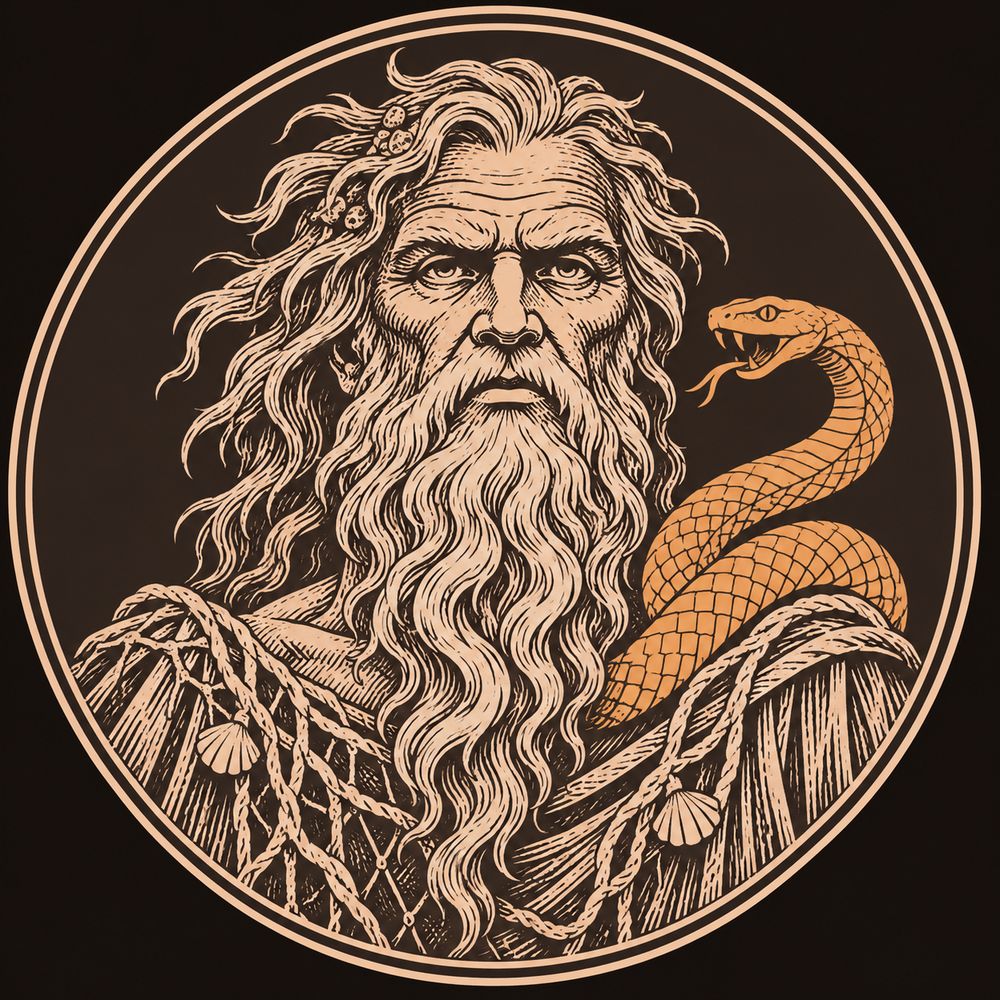
Phorcys with the serpent that guards the golden apples
Generated by AI from this page's own facts, not an ancient image or evidence of anything. How this site uses generated images
Sections on this page
In Practice
Hesiod makes him the husband of Ceto and the father of the Graeae, the Gorgons and the snake that guards the golden apples (Hesiod, Theogony 233-239; Hesiod, Theogony 270-283; Hesiod, Theogony 333-336). Homer names a harbor on Ithaca after him and calls him the old man of the sea (Homer, Odyssey 13.96-112).
Hesiod places Phorcys among the children of Pontus. He says the Sea begat Nereus first, and then great Thaumas, proud Phorcys, fair-cheeked Ceto and Eurybia (Hesiod, Theogony 233-239). The poem gives Phorcys no deeds of his own. He appears only as a parent.
Hesiod says Ceto bore to Phorcys the Graiae, grey from birth. The same passage names Sthenno, Euryale and Medusa, the Gorgons, who dwell beyond Ocean in the frontier land towards Night (Hesiod, Theogony 270-283). Ceto's youngest child by Phorcys is the awful snake that guards the golden apples in the dark earth at its great bounds (Hesiod, Theogony 333-336).
Apollodorus repeats the pairing and calls the Graeae daughters of Phorcys and Ceto (Apollodorus, Library 2.4.2). Aeschylus uses the father's name for the sisters. His Prometheus tells Io that the daughters of Phorcys live on the Gorgonean plains of Cisthene. They are three ancient maids shaped like swans, with one eye and a single tooth between them (Aeschylus, Prometheus Bound 790-800). The Graeae are the sisters he means.
In the Odyssey the name belongs to a place. When the Phaeacian ship brings Odysseus home, it comes to the harbor of Phorcys in the land of Ithaca. Two headlands shelter it from the waves, and an olive tree and a cave sacred to the nymphs stand at its head. The cave holds mixing bowls and stone jars, where bees store honey, and the nymphs weave there at stone looms (Homer, Odyssey 13.96-112).
Who is Phorcys in The Odyssey?
He is a sea-god, and he is also the name of a harbor on Ithaca. The poet calls him the old man of the sea (Odyssey 13.96). He is the father of the nymph Thoosa, who bore the Cyclops Polyphemus to Poseidon, so Phorcys is Polyphemus's grandfather (Odyssey 1.68-73).
What is Phorcys the god of?
The sources checked here give him no named office. Hesiod lists him as a child of the Sea and says nothing of his powers. Homer calls him the old man of the sea, and calls Thoosa the daughter of Phorcys who rules over the unresting sea. Both poets tie him to salt water only through his family and his title. Calling him the god of a particular thing, such as sea monsters, is a modern summary.
Is Phorcys the father of Scylla?
In Apollonius he is. Apollonius gives Scylla's mother as Crataeis and names Phorcys as her father. Homer names only Crataeis and gives no father. The two poets therefore disagree, and the sources checked here do not settle which account is older in the tradition.
Apollonius of Rhodes, Argonautica 4.783-832
Where Accounts Differ
- Scylla's father: Phorcys in Apollonius, unnamed in Homer
- Scylla's father is given differently. Homer names only her mother Crataeis (Odyssey 12.124-126), while Apollonius of Rhodes names Phorcys as her father (Argonautica 4.783-832). This page reports both.