Cerberus
Cerberus is the fearsome multi-headed hound guarding the gates of the Greek underworld, described by Hesiod as fifty-headed though later art settled on three. He prevents the living from entering uninvited and the dead from ever leaving, and Heracles captured him alive with his bare hands as the final of his twelve labors.
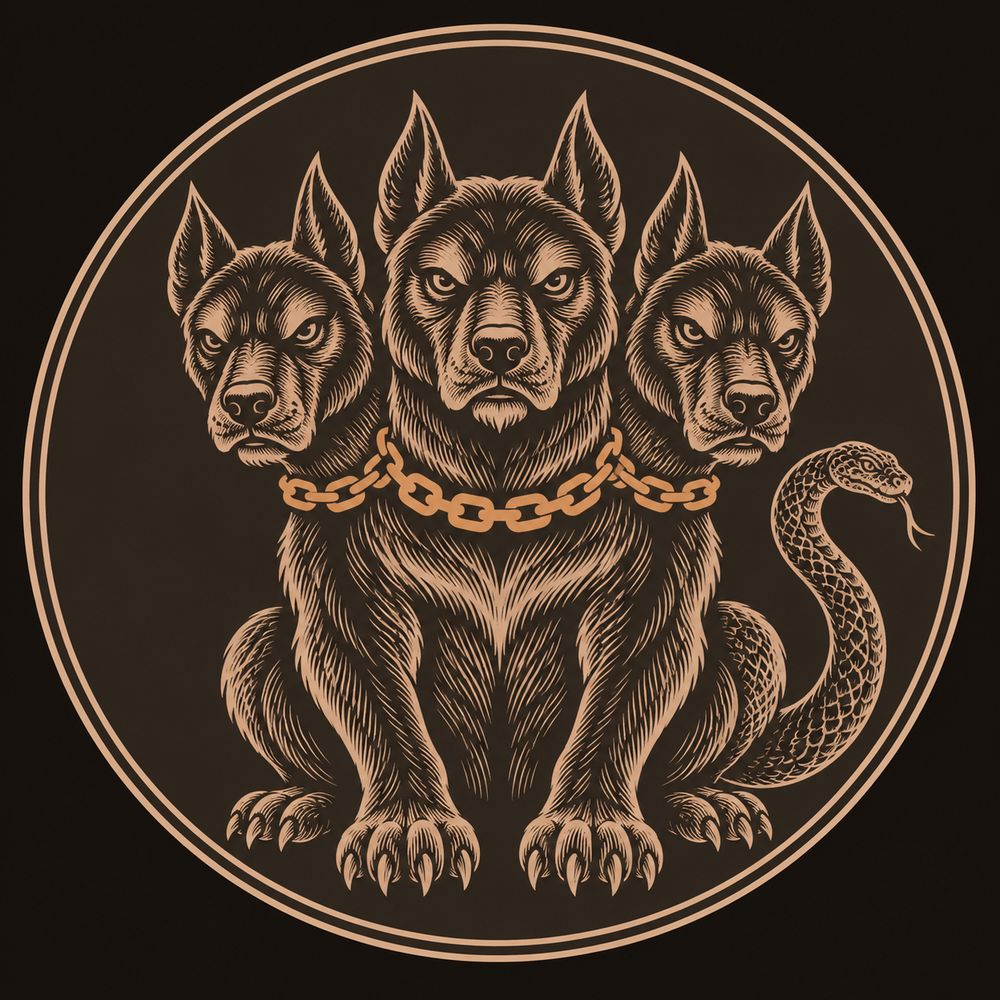
Cerberus, the three-headed hound of the underworld
Generated by AI from this page's own facts, not an ancient image or evidence of anything. How this site uses generated images
Sections on this page
See Cerberus in the Greek family tree.
Core Myth
Hesiod places Cerberus among the monstrous children of Typhon and Echidna, a full sibling of the Hydra, the Chimera, and the Nemean lion in the same catalogue that also names the Sphinx. Hesiod's own description is more extreme than the image most people carry: he calls the dog fifty-headed, bronze-voiced, and a shameless eater of raw flesh, guarding the house of Hades. The now-standard three-headed image is a later simplification that largely displaced Hesiod's number in art and in most surviving retellings, without any single source explicitly correcting or debating the earlier count.
Cerberus stood at the gates of the underworld with one function: to let the dead go in and keep them from ever coming back out, fawning on new arrivals and devouring anyone who tried to leave. Apollodorus records Heracles's final and most extreme labor, entering the underworld itself with Hades's permission on the condition that he subdue Cerberus without using any weapon, and carrying him bodily up to the surface to show Eurystheus before returning him. It followed the eleventh labor, the golden apples guarded by a hundred-headed dragon. Virgil describes an easier, non-violent passage: the prophetic Sibyl who guides Aeneas through the underworld silences the three-headed hound not by force but by throwing it a drugged cake laced with honey and herbs, which puts all three heads to sleep long enough for the pair to pass.
How many heads did Cerberus really have?
Hesiod, the earliest source to describe him in any detail, gives him fifty heads, not three. The three-headed image most people know from later art and retellings became the dominant version over time, but no single ancient source explicitly revises Hesiod's number or explains the change - the two figures simply coexist across the tradition.
Hesiod, Theogony 311-312
Could anyone get past Cerberus without fighting him?
Yes, more than one figure managed it without violence. Virgil's Sibyl throws him a cake drugged with honey and herbs that puts all his heads to sleep, and Orpheus is said to have charmed him into stillness with music alone, the same power he used on every hostile force he met on his own journey into the underworld.
Virgil, Aeneid 6.417-425
How did Heracles capture Cerberus for his final labor?
Hades allowed him to attempt it on one condition: he had to subdue the dog without using any weapon. Apollodorus says Heracles wrestled him into submission with his bare hands and armor alone, carried him up to the surface to show King Eurystheus as proof, and then returned him safely to the underworld afterward.
Apollodorus, Library 2.5.12
What job did Cerberus actually do at the underworld's gate?
He let every soul in and stopped any of them from leaving again, which is a narrower job than simply "guarding" suggests - arrival was never the problem he was posted to prevent. Hesiod describes him fawning on newcomers with his tail while devouring anyone who tried to cross back out, which is why getting past him mattered only to the living, not to the dead.
Hesiod, Theogony 769-774
Was Cerberus ever taken outside the underworld before Heracles's labor?
No source describes an earlier removal. Apollodorus frames Heracles's labor specifically as the first and only time Cerberus left the underworld, which is part of what makes it the culminating, most extreme task among the twelve - no one else had ever taken him from his post and returned him alive.
Apollodorus, Library 2.5.12
Later Traditions
Orpheus is also said to have gotten past Cerberus, not with a drugged cake or brute strength but with music alone, charming the guard dog into stillness the same way his playing calmed every other hostile force he met in the underworld. Dante later placed a version of Cerberus in the Inferno, guarding the circle of the gluttonous rather than the underworld's outer gate, adapting the figure to a Christian moral geography quite different from the Greek one it came from.
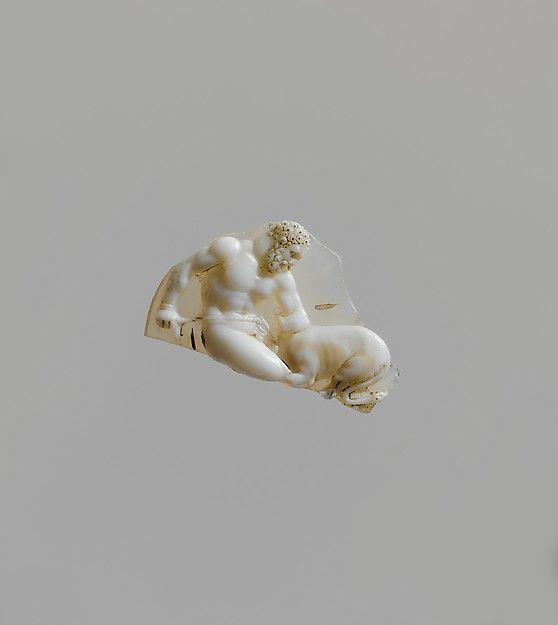
Sardonyx cameo fragment with Hercules tying up Cerberus - Greek or Roman, 1st century BCE–1st century CE, Sardonyx
Metropolitan Museum of Art, New York, NY, 32.142.1. CC0
Lineage
See the full family tree4 recorded relations, each with the ancient line behind it.


Siblings
-

Siblings through their shared parents, Typhon and Echidna, per Hesiod's catalogue of monstrous offspring.
-

Hesiod names the Sphinx in the same catalogue passage as these monsters, but manuscripts disagree on the exact parent pairing behind her birth, which is why this sibling link is marked weak rather than strong.
Also Connected
1 recorded connection, each with the ancient line behind it.
Connected
-

Charon describes Heracles binding Cerberus, "the warder of hell's door," in chains and dragging him from the underworld.
Where Accounts Differ
- head count variant
- Head count variant: Hesiod's original description gives fifty heads; the three-headed image that dominates later art and popular retellings displaced it without any source explicitly reconciling the two.
Read the full source verification →
Mythology
Appears In
Related Terms
Referenced By
Sources
- Hesiod, Theogony 306-312
- Apollodorus, Library 2.5.12
- Virgil, Aeneid 6.417-425
- Apollodorus, Library 2.5.11
- Timothy Gantz, Early Greek Myth (1993)