Pytho
Pytho is a Greek name for the place now known as Delphi, and Python is the name some sources give to the serpent Apollo killed there.
Serpent coiled at the sanctuary stone
Generated by AI from this page's own facts, not an ancient image or evidence of anything. How this site uses generated images
Sections on this page
In Practice
The Homeric Hymn to Apollo says the place is called Pytho because the dragon rotted on that spot after Apollo shot her. It adds that Apollo is called Pythian for the same reason (Hymn to Apollo 300-374).
The Hymn tells the killing in a few lines. Apollo shoots a bloated, great she-dragon with his strong bow. He tells her to rot on the soil that feeds men, and the strength of Helios makes her rot away. The passage gives her no name. She is one of the Greek monsters that a god kills.
Later writers name the serpent. Apollodorus says Apollo went to Delphi, killed the serpent Python and took over the oracle (Library 1.4.1). Apollonius of Rhodes has Orpheus sing that Apollo slew the monster Delphyne below Parnassus (Argonautica 2). The sources checked here never say that Python and Delphyne are one creature. Apollo is the slayer in all three.
In short, the serpent is Python, the place is Pytho, later called Delphi, and the slayer is Apollo. The aftermath is the Delphic oracle and the Pythian Games. Pindar's twelfth Pythian Ode tells the winner of an aulos contest to receive a victory garland from Pytho (Pindar, Pythian Ode 12.6-12). The ode is a Pythian Ode, and it shows that contests were won at Pytho.
The oracle had earlier holders. Aeschylus opens the Eumenides with a prayer that names Earth as the first prophet and Themis as the second. Phoebe, a third, gives the oracle to Phoebus Apollo as a birthday gift (Eumenides 1-9). The prayer then has Apollo travel from Delos to Parnassus, where Zeus makes him a prophet (Eumenides 10-19). These lines name no serpent. The sanctuary itself is described on the page for Delphi. The older owner of the site is covered on the page for Gaia.
Why did Apollo slay Python?
Apollodorus gives one reason: the serpent guarded the oracle, and Apollo killed it to take the oracle over. The Hymn to Apollo shows Apollo choosing the site and killing the she-dragon there, and the place takes the name Pytho from her death. The sources checked here give no other motive.
What did Apollo gain from killing the serpent?
In the Hymn to Apollo the killing gives Apollo a name and the place a name. The place is now called Pytho, and men call the lord Apollo Pythian. In Apollodorus the gain is the oracle itself, which Apollo takes over after he kills Python. The sources checked here describe no punishment for the killing, and the passages read here do not mention one.
Was the serpent at Pytho male or female?
The Hymn to Apollo calls the creature a she-dragon, so it is female there. Apollonius calls the monster Delphyne, a name of feminine form, but he does not say more. Apollodorus names the serpent Python, and the passage read here gives its sex no emphasis. The sources checked here do not agree on a single name, and only the Hymn plainly states a sex.
Was Apollo a child when he killed it?
Only Apollonius of Rhodes gives an age. His Orpheus sings that Apollo killed Delphyne while still young and beardless, still rejoicing in his long hair. The Hymn to Apollo and Apollodorus, as read here, say nothing of his age at the killing. The sources checked here therefore give a youthful Apollo in one text and no age in the other two.
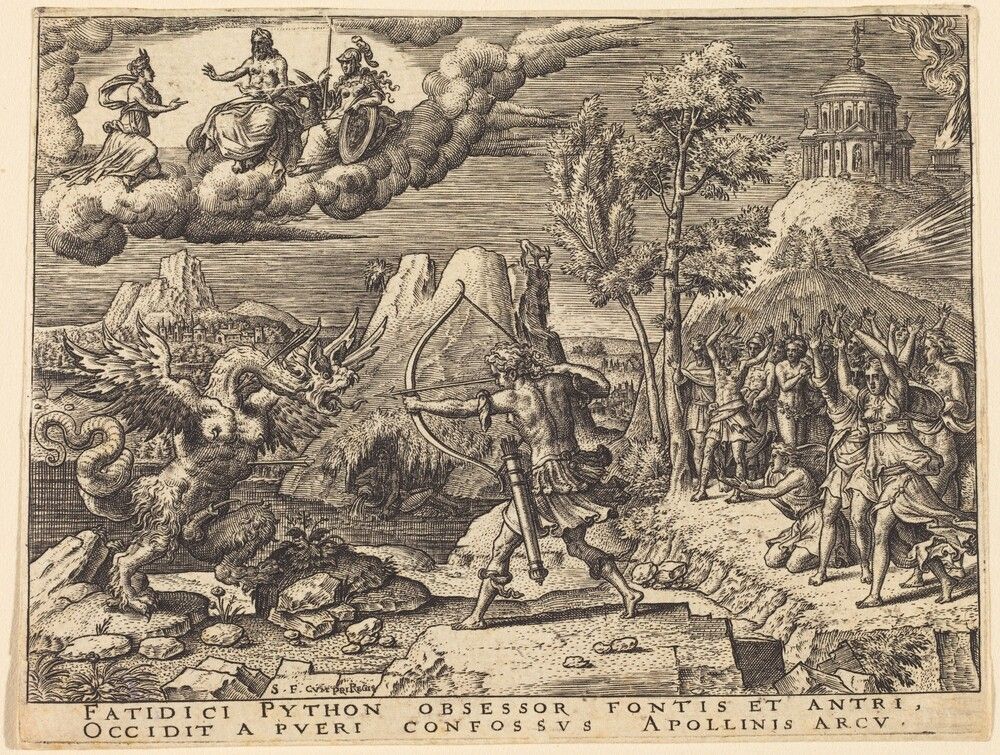
Apollo Killing Python - Etienne Delaune, engraving
National Gallery of Art, Washington, DC, 1964.8.607. CC0
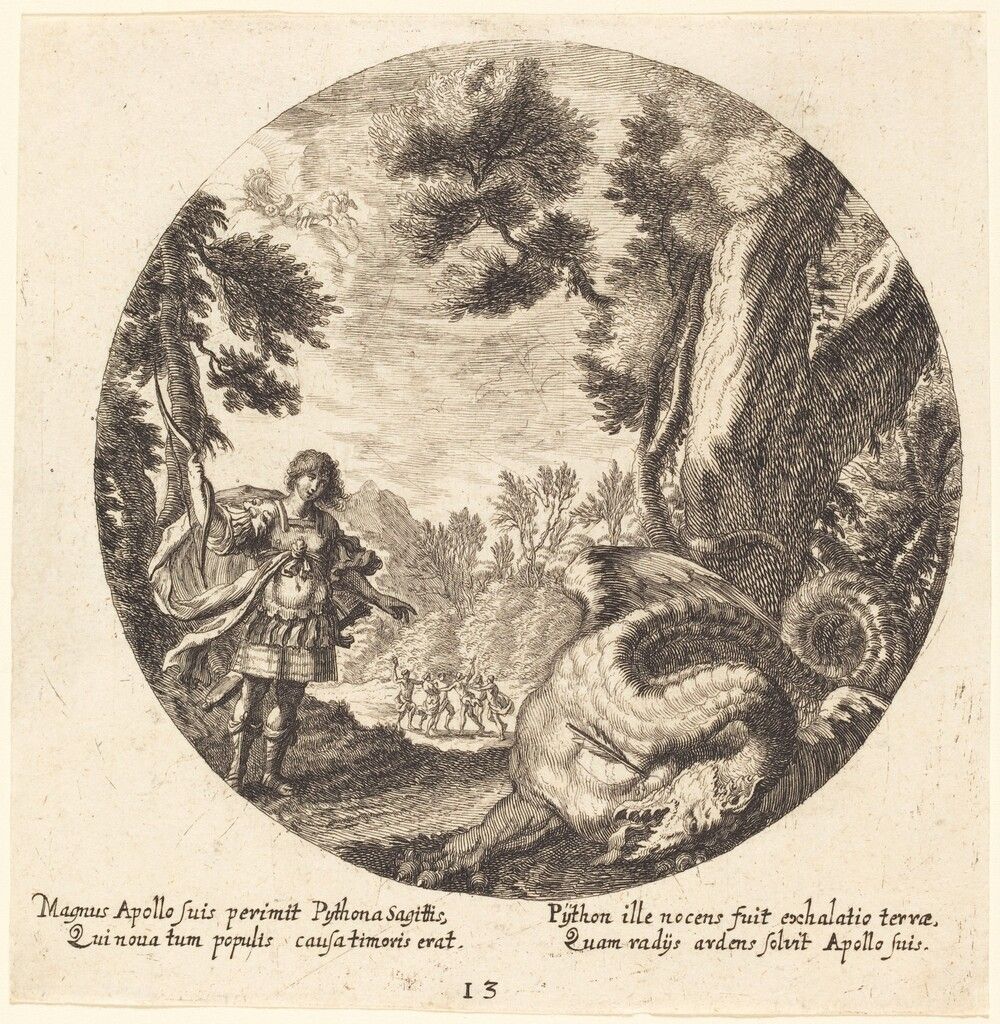
Apollo Killing the Python - Georg Andreas Wolfgang the Elder, 1665, etching on laid paper
National Gallery of Art, Washington, DC, 2005.17.15. CC0
Where Accounts Differ
- The serpent's name: an unnamed she-dragon, Python or Delphyne
- The serpent's name: the Hymn to Apollo gives an unnamed she-dragon (300-374), Apollodorus names the serpent Python (Library 1.4.1) and Apollonius names the monster Delphyne (Argonautica 2). This page reports all three and does not say whether they are one creature.
Where This Appears
Referenced By
Sources
- Homeric Hymn to Apollo 300-374
- Apollodorus, Library 1.4.1
- Aeschylus, Eumenides 1-9
- Aeschylus, Eumenides 10-19
- Apollonius of Rhodes, Argonautica 2
- Pindar, Pythian Ode 12.6-12