Daedalus and the Labyrinth
Daedalus's years on Crete run from exile to a manhunt. Banished from Athens for killing his nephew, he built the wooden cow, then the Labyrinth for the Minotaur. He gave Ariadne the thread, and Minos jailed him for it. After his flight, Minos chased him to Sicily with a spiral shell and died at the court of Cocalus.
Sections on this page
What Led To It
Diodorus calls Daedalus an Athenian of the Erechthid clan. Apollodorus makes his father Eupalamus, son of Metion, while Diodorus makes Metion the father and Eupalamus the grandfather. His exile on Crete follows a killing at home. Before he ever meets Minos, he has already been tried in the Areopagus and condemned.
The Myth
Daedalus came to Crete as a fugitive, and the island made use of him. Apollodorus calls him an excellent architect and the first inventor of images. He had fled Athens after throwing his sister's son from the Acropolis. The Library names the nephew Talos and says Daedalus feared a pupil of such talent would surpass him. The boy had found a snake's jawbone and sawed a thin stick with it.
Ovid tells the same crime with different names. In Metamorphoses the nephew is Perdix, the partridge, whom his mother sent to Daedalus as a pupil. He copied the backbone of a fish into a toothed saw, and he made hinged arms of iron that drew a circle. Daedalus threw him from Minerva's temple and spread word of an accident. Pallas saved the boy and changed him into a partridge in the air. For Apollodorus, Perdix is instead the mother's name.
Diodorus adds how the crime came out. Talos, in his telling, had invented the potter's wheel and an iron saw modelled on the snake's teeth. When Daedalus was caught burying the body, he said he was burying a snake. The Areopagus convicted him, and he fled. Pausanias, for his part, saw the tomb of the murdered boy, whom he calls Calos, on the path from the theatre up to the Acropolis. All of this is the origin of the exile. It is not the Cretan story, and it does not change what came next.
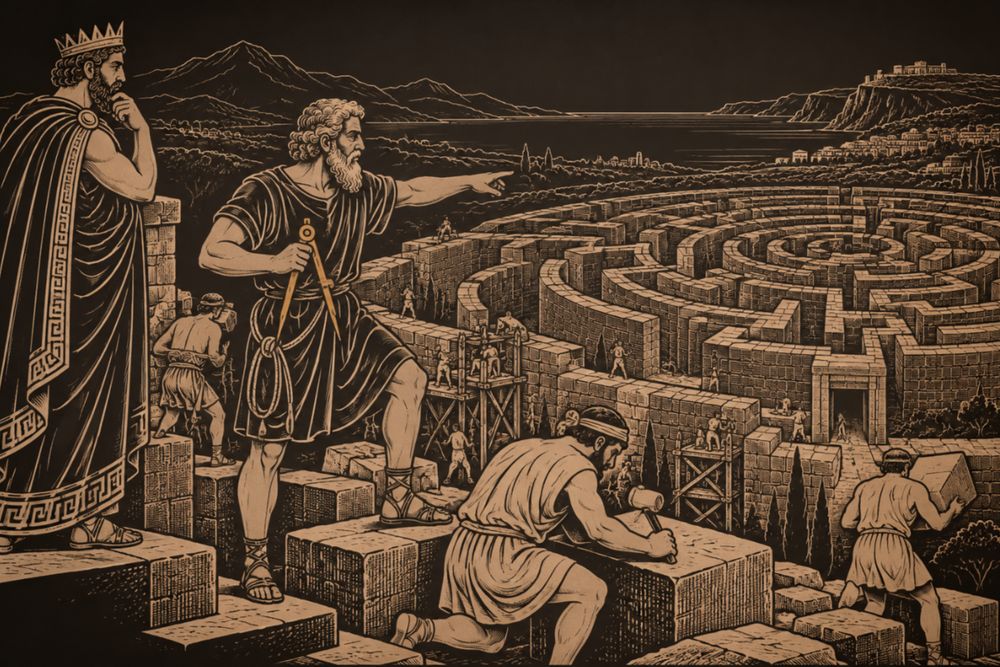
Daedalus builds the Labyrinth
Generated by AI from this page's own facts, not an ancient image or evidence of anything. How this site uses generated images
On Crete, Daedalus's first job was the wooden cow. Apollodorus says Poseidon grew angry when Minos did not sacrifice a bull the god had sent, and made Pasiphae desire the animal. Daedalus built a hollow wooden cow on wheels, covered it with a cow's hide, and set it in the bull's meadow. Diodorus tells the same episode as a myth that has been handed down and gives a similar cause. In both accounts the result is the Minotaur, called Asterius by Apollodorus. The Cretan bull and the Minotaur each have their own page.
Minos then needed somewhere to keep the child. Apollodorus says he shut the Minotaur up in the Labyrinth in compliance with certain oracles, and that Daedalus built it. Ovid describes a work of winding, misleading passages that Daedalus made so intricate that he could barely retrace his own steps. Ovid also says Minos wished to hide his disgrace. The tribute of Athenian youths, sent in as food for the monster, is the story of Theseus and the Minotaur, and the word itself has its own entry in the Labyrinth glossary.
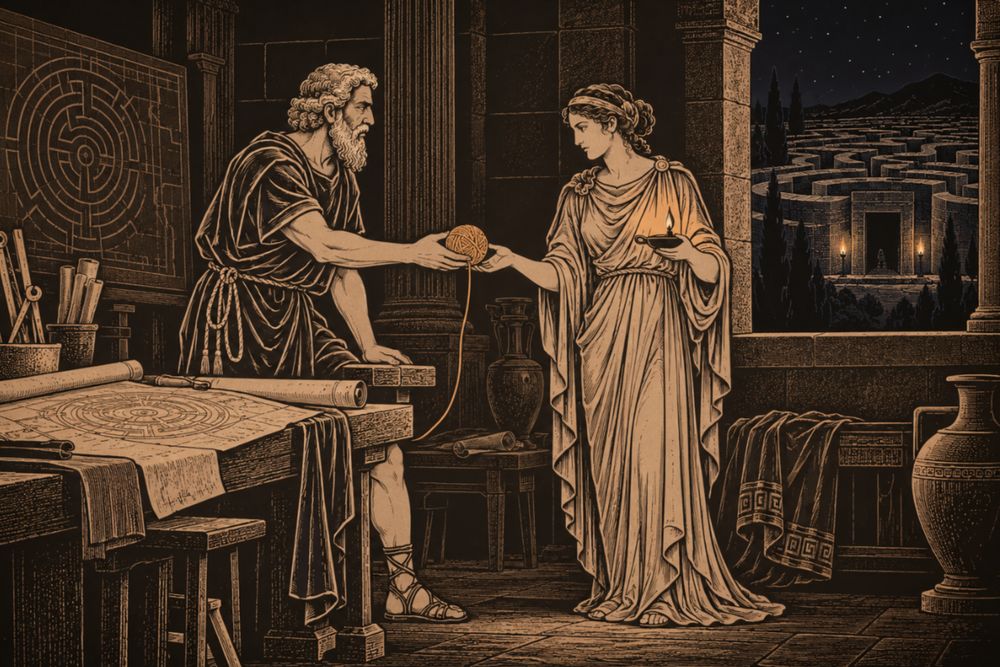
Daedalus gives Ariadne the thread
Generated by AI from this page's own facts, not an ancient image or evidence of anything. How this site uses generated images
The maze had one weak point, and it was its maker. When Theseus arrived among the Athenian tribute, Ariadne, the daughter of Minos, offered to help him if he would take her away and marry her. Apollodorus's Epitome says Theseus swore to it, and that she then begged Daedalus to disclose the way out of the labyrinth. At his suggestion she gave Theseus a clue, which he fastened to the door and unwound as he went in. Frazer's note, citing the scholiasts on Homer and Eustathius, says the clue was a ball of thread that Ariadne had asked Daedalus for.
Ovid never gives Daedalus that part. In his version Theseus finds the path out by Ariadne's thread, and Daedalus's advice goes unmentioned. The Epitome is the only source used here that makes the craftsman the adviser. That is the detail that makes Minos's later anger make sense.
Minos learned what had happened after Theseus had gone. The Epitome says that, on being told of the flight of Theseus and his company, he shut up the guilty Daedalus in the labyrinth with his son Icarus, whose mother was Naucrate, a slave of Minos. So in Apollodorus the builder ends up as a prisoner in his own work. Other writers give different reasons. Diodorus has Minos threaten Daedalus over the cow, so that Daedalus, afraid, left Crete with help from Pasiphae. Pausanias says only that Minos condemned him on some charge and had him thrown into prison with his son.
Then comes the flight. Daedalus made wings, warned Icarus against flying too high or too low, and Icarus fell into the sea that still bears his name. The flight is a story of its own, told on the Fall of Icarus page. It matters here only because Daedalus, in Apollodorus, went on alone and safely to Camicus in Sicily, and Minos followed.
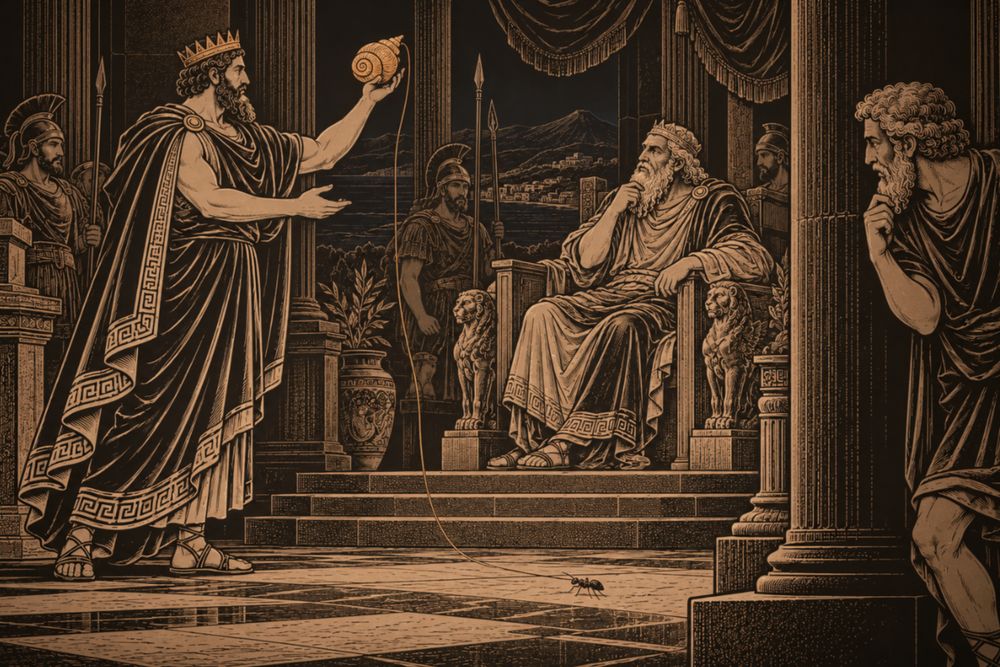
Minos and the spiral shell
Generated by AI from this page's own facts, not an ancient image or evidence of anything. How this site uses generated images
The sequel is a manhunt. Apollodorus says Minos pursued Daedalus and, in every country he searched, carried a spiral shell. He promised a great reward to whoever could pass a thread through it, believing that this would reveal where Daedalus was. At Camicus in Sicily he showed the shell at the court of King Cocalus, where Daedalus was hiding. Cocalus took it and promised to thread it. The Epitome's next lines are the trick itself, quoted below.
Cocalus took it, and promised to thread it, and gave it to Daedalus; and Daedalus fastened a thread to an ant, and, having bored a hole in the spiral shell, allowed the ant to pass through it.
When Minos saw the threaded shell, he knew Daedalus was with Cocalus and demanded his surrender. Cocalus promised to hand him over and gave Minos a feast. After his bath, Apollodorus says, Minos was undone by the daughters of Cocalus. Some said boiling water was the cause. The Minos page follows the king's death.
The other accounts drop the shell and keep the ending. Diodorus has Minos sail to Sicily with a fleet, land in the territory of Acragas and demand Daedalus. Cocalus invited him to a conference and killed him by keeping him too long in the hot water. Pausanias says Cocalus refused to give Daedalus up, and that the daughters of Cocalus, delighted with the craftsman's skill, plotted against Minos. Herodotus knows only that Minos went to Sicania in search of Daedalus and died a violent death. So Sicily and a violent end for Minos recur in all four writers. The riddle of the shell rests on Apollodorus alone.
What Followed
The story leaves Crete with Minos dead in Sicily. Herodotus says the Cretans, told by a god, went to Sicania in force, besieged Camicus for five years, and were later wrecked off Iapygia, where they settled Hyria. Diodorus says Minos's companions buried him in a two-storey tomb at Acragas, and that the bones were later returned to Crete in the time of Theron. Daedalus, by Diodorus, stayed on with Cocalus and built works in Sicily. An impregnable hilltop city on the Camicus river, the steam grotto at Selinus and the golden ram for Aphrodite at Eryx are among them. The Cretan side of the family is in Theseus and Crete.
Why did Daedalus design the Labyrinth?
Minos commanded it, to hold the Minotaur. Apollodorus says the king shut the monster up in the Labyrinth in compliance with certain oracles, and Ovid says Minos wished to hide his disgrace. Daedalus had already helped bring about the Minotaur's birth, so the maze finished a job he had begun.
Apollodorus, Library 3.1.4
Was Daedalus stuck in the Labyrinth?
In Apollodorus, yes. Once Minos learned Theseus had escaped, he shut Daedalus and Icarus up in the labyrinth. Ovid gives no cell: his Daedalus is in a long exile on a sea-girt island, and it is the sea and the land routes that Minos has closed.
Apollodorus, Epitome 1.12
Why did Minos imprison Daedalus in the Labyrinth?
Apollodorus says it was for the flight of Theseus, which Daedalus had helped by telling Ariadne the way out. Other writers give other reasons. Diodorus says Minos was threatening him over the cow, and Pausanias says only that he was condemned on some charge and jailed with his son.
Apollodorus, Epitome 1.8-1.9
How did Daedalus escape the Labyrinth?
By air, in Apollodorus and Ovid: he made wings for himself and Icarus. Diodorus has a rationalised version in which Pasiphae provides a ship, and Icarus drowns while landing. The flight itself, and Icarus's death, are told on the Fall of Icarus page.
Apollodorus, Epitome 1.12
Did the Minotaur escape the Labyrinth?
No. In Ovid the Minotaur is hidden in the maze and eats the Athenian tribute until Theseus kills it and retraces his way by Ariadne's thread. Nothing in the sources has it leaving. The killing is told on the Theseus and the Minotaur page.
Ovid, Metamorphoses 8.152-182
Is the Labyrinth on Crete real?
Arthur Evans thought the Palace of Knossos was the Labyrinth, but that identification is disputed. The archaeologist Andrew Shapland notes that Linear B tablets from Knossos mention a place called da-pu-ri-to, a name specialists judge close to the Greek word for labyrinth, separately from Knossos itself (ko-no-so). He says this suggests they were two different places, and that the hunt continues. The word's own history is on the labrys page.
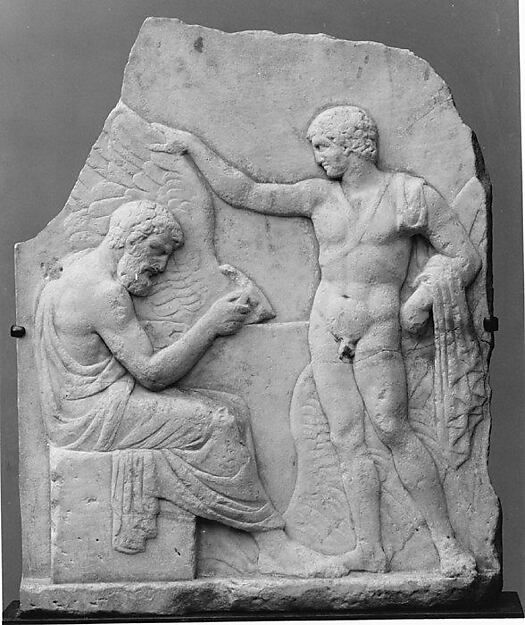
Relief of Daedalus and Icarus - Marble
Metropolitan Museum of Art, New York, NY, 1972.118.115. CC0
Where Accounts Differ
- name-of-the-murdered-nephew
- how-the-murder-was-found-out
- why-minos-imprisoned-daedalus
- who-gave-ariadne-the-thread
- where-daedalus-was-held
- how-daedalus-left-crete
- how-minos-died
- the-shell-and-the-ant
- The murdered nephew's name differs. Apollodorus, Library 3.15.8, calls him Talos and makes Perdix his mother. Ovid, Metamorphoses 8.183-259, calls him Perdix and turns him into a partridge. Pausanias, Description of Greece 1.21.4, calls him Calos.
- How the crime was found out differs. Diodorus, Bibliotheca Historica 4.76, has Daedalus caught burying the body with the words 'I am inhuming a snake'. Ovid says he spread the rumour of an accident. Apollodorus says only that the corpse was discovered.
- Why Minos imprisoned Daedalus differs. Apollodorus, Epitome 1.12, says it was the flight of Theseus. Diodorus, Bibliotheca Historica 4.77, says it was the affair of the cow. Pausanias, Description of Greece 7.4.6, says only that he was condemned on some charge.
- Who gave Ariadne the thread differs. Apollodorus, Epitome 1.8-1.9, has Daedalus suggest it. Ovid, Metamorphoses 8.152-182, credits the thread to Ariadne with no mention of Daedalus.
- Where Daedalus was held differs. Apollodorus, Epitome 1.12, has him shut in the labyrinth. Ovid, Metamorphoses 8.183-235, describes exile on the island and no cell.
- How he escaped Crete differs. Apollodorus, Epitome 1.12, and Ovid, Metamorphoses 8.183-235, give wings. Diodorus, Bibliotheca Historica 4.77, gives a ship provided by Pasiphae, and preserves the wing version separately as a myth.
- How Minos died differs. Apollodorus, Epitome 1.14-1.15, gives the shell trick and death after a bath at the hands of the daughters of Cocalus, or by boiling water. Diodorus, Bibliotheca Historica 4.79, has Cocalus scald him in the bath after a conference, with no shell. Pausanias, Description of Greece 7.4.6, has the daughters plot his death after Cocalus refuses to give Daedalus up. Herodotus, Histories 7.170, says only that Minos died a violent death in Sicania.
- Only Apollodorus, Epitome 1.14-1.15, has the shell and the ant. Diodorus, Pausanias and Herodotus do not mention them.
Read the full source verification →
Mythology
Figures In This Myth
Also Connected
Related Terms
Referenced By
Sources
- Apollodorus, Library 3.1.4
- Apollodorus, Library 3.15.8
- Apollodorus, Epitome 1.8-1.9
- Apollodorus, Epitome 1.12
- Apollodorus, Epitome 1.14-1.15
- Ovid, Metamorphoses 8.152-182
- Ovid, Metamorphoses 8.183-235
- Ovid, Metamorphoses 8.183-259
- Diodorus Siculus, Bibliotheca Historica 4.76-79
- Pausanias, Description of Greece 1.21.4
- Pausanias, Description of Greece 7.4.6
- Herodotus, Histories 7.170
- Andrew Shapland, interviewed by Matthew Symonds, 'Knossos: seeking the labyrinth', World Archaeology 118, 2023 (the-past.com)
- J. G. Frazer, Apollodorus: The Library (Loeb, 1921), notes to 3.15.8 and Epitome 1.9-1.15