Talos
Talos was a bronze automaton given by Zeus to guard Crete, circling the island three times a day. His only vulnerability was a single vein of divine ichor running from neck to ankle, sealed by a thin bronze nail. When the Argonauts arrived on their return voyage, the sorceress Medea cursed him, and he grazed the vein open on a rock and bled to death.

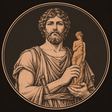
Talos, the bronze automaton of Crete
Generated by AI from this page's own facts, not an ancient image or evidence of anything. How this site uses generated images
Sections on this page
Core Myth
Talos was a giant made entirely of bronze, described as the last survivor of the Bronze Race, a generation of humanity from an earlier age of the world. Zeus gave him to Europa, or by another common account to King Minos, as guardian of Crete, and Talos discharged the duty by circling the island three times each day on foot, hurling boulders at any ship that tried to land uninvited. His body was invulnerable everywhere except for one point: a single vein carrying his life-force, called ichor, ran from his neck down to his ankle, where it was sealed shut by a thin bronze nail or pin.
Apollonius of Rhodes gives the fullest surviving account of his death, placing it near the very end of the Argonauts' voyage home with the Golden Fleece. As the exhausted crew tried to land on Crete for water, Talos pelted their ship with rocks and kept them from the shore. Medea, the Colchian sorceress traveling with Jason, offered to deal with him herself: chanting and invoking the Death-spirits, she fixed Talos with a hostile, bewitching stare that unsettled his mind. Distracted and disoriented by her curse, he grazed his ankle against a sharp rock while lifting stones to throw, tearing open the sealed vein; his ichor drained out like melted lead, and he collapsed and died. The Argonauts, freed to land, spent the night on Crete before continuing home. Medea does not yet have her own entry in this corpus, so her fuller role across the Argonautica is described here only in outline.
What was Talos's one weakness?
Although his bronze body was otherwise invulnerable, a single vein carrying his vital fluid, called ichor, ran from his neck down to his ankle and was sealed there by a thin bronze pin or nail. Anything that opened that one point, whether by accident or design, would drain him of the fluid that kept him alive.
Apollonius of Rhodes, Argonautica 4.1638-1693
How exactly did Medea defeat Talos?
In Apollonius's account, she did not attack him directly at all. She chanted invocations to the Death-spirits and fixed Talos with a hostile, bewitching stare that disturbed his mind, and in his disoriented state he accidentally grazed his own ankle against a sharp rock while lifting stones to throw at the Argonauts, opening the sealed vein himself.
Apollonius of Rhodes, Argonautica 4.1638-1693
Are there other versions of how Talos died?
Yes. Apollodorus records that some accounts have Medea drug Talos into madness rather than curse his mind, while others say she tricked him by promising immortality and then drew out the bronze nail herself, releasing the ichor. A separate, less common tradition credits an Argonaut named Poeas with simply shooting Talos in the ankle with an arrow.
Apollodorus, Library 1.9.26
Who made Talos, and why was he guarding Crete?
Accounts differ on his maker: one tradition credits the smith-god Hephaestus with forging him, while Apollonius describes him as the last survivor of an earlier, vanished race of bronze men rather than something built. Either way, Zeus gave him to Europa, or by another account to King Minos, specifically to guard Crete by circling the island three times daily.
Apollonius of Rhodes, Argonautica 4.1638-1693
Why couldn't the Argonauts just fight Talos directly?
His bronze body could not be wounded by ordinary weapons anywhere except the one sealed vein at his ankle, a vulnerability the Argonauts had no way of knowing how to reach or exploit. That is exactly why Medea's magic, rather than force of arms, is what the myth credits with ending the standoff.
Apollonius of Rhodes, Argonautica 4.1638-1693
Does Talos connect to the rest of the Argonauts' story?
Yes - his confrontation with the crew happens on the return voyage, after they had already retrieved the Golden Fleece from Colchis, making him one of the last obstacles between the Argonauts and reaching home safely. It is Medea, already central to the Fleece's retrieval, who resolves this final crisis as well.
Apollonius of Rhodes, Argonautica 4.1638-1693
Later Traditions
Apollodorus preserves the same episode with a different mechanism: rather than an accidental self-inflicted wound brought on by Medea's curse, some versions he records have her drug Talos into a temporary madness, or promise to make him immortal by drawing out the bronze nail herself, at which point all his ichor poured out and killed him. A separate, less commonly followed tradition has an Argonaut named Poeas shoot Talos in the ankle with an arrow instead, bypassing Medea's involvement entirely. Talos's origin is also told two ways: one tradition credits the smith-god Hephaestus with forging him and giving him to King Minos, while another has Zeus present him directly to Europa as a guardian gift, alongside a hound that never failed to catch its prey and a javelin that never missed. Talos's fully artificial, unborn body places him beside a wider Greek fascination with animated creations that are made rather than born, a theme Pygmalion's ivory bride, warmed to life by Aphrodite rather than forged by a god, belongs to as well.
Also Connected
4 recorded connections, each with the ancient line behind it.
Enemies
-

Talos blocked the Argonauts' ship from landing on Crete. Medea, who actually curses him to death, is not yet a separate entity in this corpus.
Connected
-

An alternate tradition credits the smith-god Hephaestus with forging Talos and giving him to Minos, rather than Zeus giving him to Europa.
-
Both are artificial bodies with no ordinary birth: Talos a bronze automaton animated to patrol Crete under his own power, Pygmalion's ivory statue an inert sculpture Aphrodite warms into a living woman.
-

One tradition has Zeus give Talos to Europa as a guardian gift for Crete, alongside a hound and a javelin that never missed.
Where Accounts Differ
- how Talos died
- who made Talos
- Death mechanism variant: Apollonius has Medea's curse cause Talos to accidentally graze his ankle open on a rock; Apollodorus records alternate traditions in which she drugs him mad or draws out the sealing nail herself, and a separate tradition in which the Argonaut Poeas shoots him with an arrow instead.
- Origin variant: one tradition credits Hephaestus with forging Talos and giving him to Minos; another has Zeus present him directly to Europa as a guardian gift.
Read the full source verification →
Mythology
Appears In
Related Terms
Sources
- Apollonius of Rhodes, Argonautica 4.1638-1693
- Apollodorus, Library 1.9.26
- Apollodorus, Library 3.1.1
- Timothy Gantz, Early Greek Myth (1993)