Pygmalion
Pygmalion is a sculptor of Cyprus in Ovid's Metamorphoses (Ovid, writing in Latin, calls the goddess Venus), disgusted by the immorality he sees in local women and living without a wife by choice. He carves an ivory statue more beautiful than any living woman and falls in love with it, bringing it gifts and dressing it as though it could feel them. At Aphrodite's festival, he prays for a bride like his statue; back home, he finds the ivory growing warm and soft under his hands, and the statue becomes a living woman. Ovid never names her. The name Galatea belongs to a much later, unrelated tradition and does not appear in any ancient text.
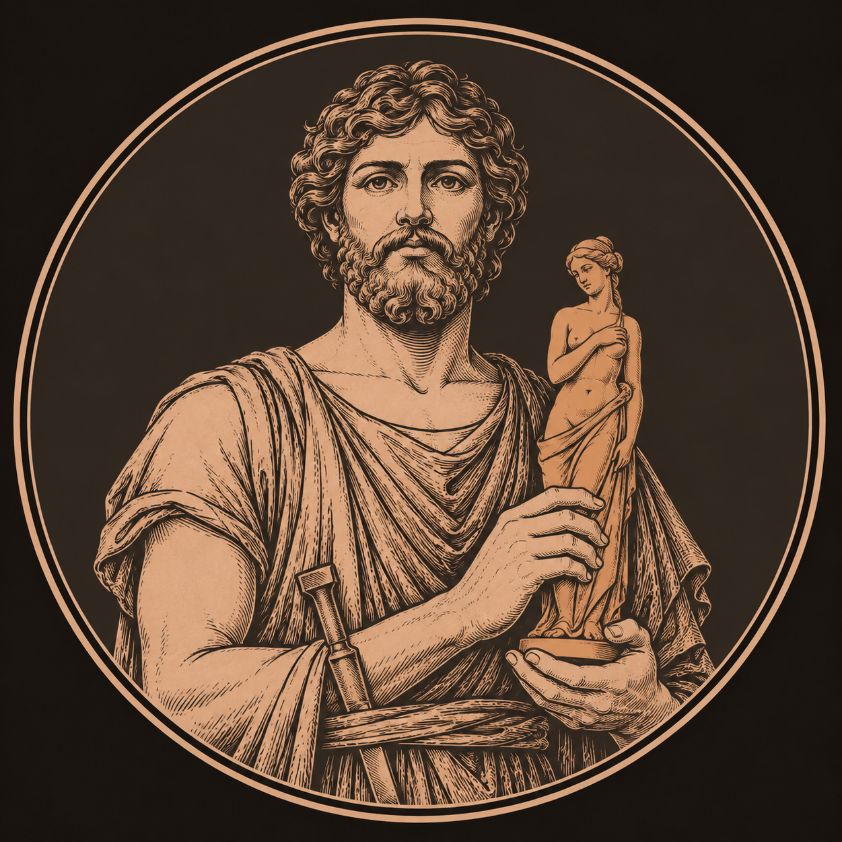
Pygmalion, the sculptor and his ivory statue
Generated by AI from this page's own facts, not an ancient image or evidence of anything. How this site uses generated images
Sections on this page
Core Myth
Ovid introduces Pygmalion as a man who has seen the Propoetides, women of his own Cyprus, punished for denying Aphrodite's divinity by being turned into the first prostitutes and then to stone; disgusted by what he takes to be a flaw in women generally, he chooses to live without a wife. His skill as a sculptor does not go dormant, though. He carves a statue of a woman out of snow-white ivory, giving it a beauty no real woman could match, and falls in love with his own creation. He treats it as though it were alive: bringing it small gifts prized by real girls, dressing it in clothing and jewelry, laying it in his bed, and speaking to it as a companion, even as he knows, on some level, that it cannot answer.
At Aphrodite's own festival, the most celebrated day on Cyprus, Pygmalion makes an offering and prays, not quite daring to ask outright for the ivory statue itself, but for a bride like it. Aphrodite, present at her own festival, understands what the prayer really means and signals her favor with a flame that flares three times. Pygmalion returns home, kisses the statue as he always has, and feels the ivory grow warm under his lips. He presses his fingers into it and the material yields like softening wax; the limbs bend under his touch, and where there was hardness there is now the give of living flesh. Ovid has him check his own judgment, afraid he is only imagining what he wants to feel, before the woman opens her eyes to the light and to the man who made her at the same instant, completing the transformation.
Why did Pygmalion carve the statue in the first place?
Ovid says he had watched the Propoetides, women of his own Cyprus, punished for denying Aphrodite's divinity by being turned first into prostitutes and then to stone. Disgusted by what he saw as a flaw in women generally, Pygmalion chose to live without a wife, but his sculptor's skill still produced an ivory woman more beautiful than any living one, and he fell in love with his own work.
Ovid, Metamorphoses 10.243-249
What did Pygmalion actually pray for at Aphrodite's festival?
Not for the statue itself outright - Ovid says he did not quite dare ask for that - but for a bride like it. Aphrodite, present at her own festival, understood the real meaning behind the careful phrasing and answered by making the altar's flame flare three times as a sign of favor.
Ovid, Metamorphoses 10.274-279
How did the statue actually come to life?
Pygmalion returned home and kissed the statue as he always did, and felt the ivory grow warm under his lips. Pressing his fingers into it, he found the material yielding like softening wax; the limbs bent under his touch, and the woman opened her eyes to the light and to Pygmalion at the same moment, completing a transformation Ovid stages as growing warmth rather than a sudden change.
Ovid, Metamorphoses 10.280-294
Is the statue's name really Galatea?
No. Ovid never names her - she is only "the ivory girl" or "the maiden" - and no other ancient source gives her a name either. Galatea is a name later tradition attached to the story with no basis in any surviving ancient text, and it is a different figure entirely from the sea-nymph Galatea loved by Polyphemus in Theocritus and in a separate part of Ovid's own Metamorphoses.
Ovid, Metamorphoses 10.243-297
What happened after the statue became human?
Ovid says Aphrodite herself attended the wedding that followed, and the couple had a daughter, Paphos, whom Ovid credits as the source of the Cyprian city of the same name - a city already tied to Aphrodite's cult through the goddess's own birth from the sea nearby.
Ovid, Metamorphoses 10.243-297
Why was Cyprus the right setting for this story?
Cyprus was Aphrodite's own sacred ground from her birth: Hesiod's Theogony has her carried by the sea straight to Cyprus after rising from the foam, making the island's devotion to her far older than Pygmalion's own story and explaining why his festival offering and prayer are addressed to her there specifically.
Hesiod, Theogony 188-206
Later Traditions
Ovid never gives the statue a name, and no other ancient source does either; she is only ever "the ivory girl" or "the maiden" in his own Latin. The name Galatea, now inseparable from the story in modern retellings, opera and film, is a post-classical addition with no basis in any surviving ancient text - a different figure from the sea-nymph Galatea loved by Polyphemus, who belongs to an entirely separate tradition running from Theocritus's pastoral poetry through Ovid's own later book of the Metamorphoses. Ovid does have the couple's union bear a child, a daughter named Paphos, whom he credits as the source of the Cyprian city's name - the same city already bound to Aphrodite's cult by the goddess's own mythic birth from the sea nearby. Apollodorus separately names a Pygmalion, king of Cyprus, whose daughter Metharme bears Adonis to Cinyras.
Pygmalion's ivory woman is not the only artificial being Greek and Roman myth brings to life. Hephaestus builds golden handmaidens with minds of their own to support him at his forge, and molds Pandora herself out of earth and water before the gods breathe life and speech into her; his bronze automaton Talos patrols Crete under his own power rather than a sculptor's touch. Pygmalion's statue is the only one of these figures animated by love rather than a craftsman-god's own design, but the pattern - an artificial body a maker (or a god) brings to life - is one Pygmalion's story shares with several of Hephaestus's own creations rather than inventing on its own.
Also Connected
5 recorded connections, each with the ancient line behind it.
Connected
-

Aphrodite grants Pygmalion's unspoken wish at her own festival, bringing his ivory statue to life and later attending the couple's wedding.
-

Named here to distinguish, not to equate: Pygmalion's ivory statue is unnamed in every ancient source, and the popular name Galatea attached to her by post-classical tradition belongs, in this site's own corpus, to the unrelated sea-nymph loved by Polyphemus.
-

Both bring an artificial body to life: Pygmalion's ivory statue through Aphrodite's answered prayer, Hephaestus's own golden handmaidens and creations through his own craft as a god.
-

Both are women's bodies shaped by a craftsman and then animated by divine power rather than born: Pandora molded from earth and water by Hephaestus at Zeus's order, Pygmalion's ivory statue carved by his own hand and warmed to life by Aphrodite.
-

Both are artificial bodies with no ordinary birth: Talos a bronze automaton animated to patrol Crete under his own power, Pygmalion's ivory statue an inert sculpture Aphrodite warms into a living woman.
Where Accounts Differ
- whether the statue has a name in any ancient source
- The statue is unnamed in every ancient source. The name Galatea is a later, non-classical addition and is kept off this page's factual claims to avoid confusing the statue with the unrelated sea-nymph Galatea already covered on this site. Hesiod's Theogony is cited for Cyprus's founding tie to Aphrodite's cult, which this story's own festival setting presupposes; it does not narrate Pygmalion's story itself, which survives only in Ovid.
Read the full source verification →
Mythology
Referenced By
Sources
- Ovid, Metamorphoses 10.243-249
- Ovid, Metamorphoses 10.274-279
- Ovid, Metamorphoses 10.280-294
- Ovid, Metamorphoses 10.243-297
- Hesiod, Theogony 188-206
- Apollodorus, Library 3.14.3
- Timothy Gantz, Early Greek Myth (1993)