Ariadne
Ariadne is the Cretan princess, Minos's daughter, who gave Theseus the thread that led him out of the Labyrinth after he killed the Minotaur. She sailed away with him but never reached Athens, and the sources disagree about why. Homer's Odyssey says Artemis killed her on the island of Dia. Hesiod's Theogony says she married Dionysus and Zeus made her deathless.
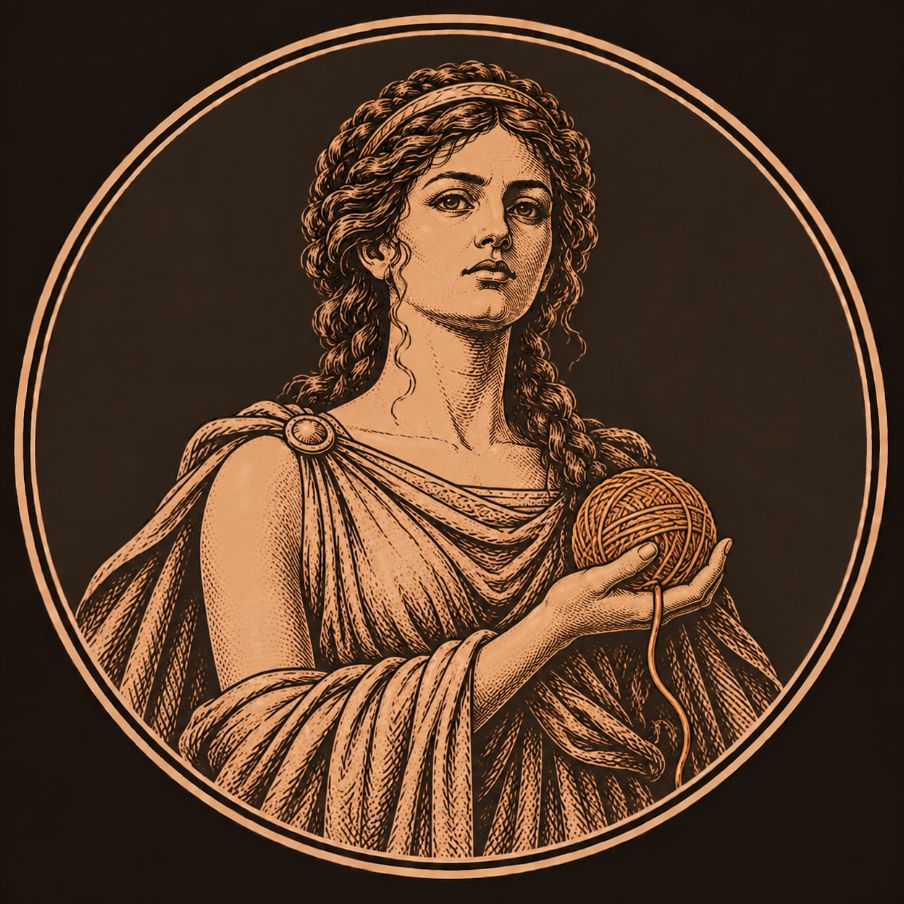
Ariadne, bronze medallion illustration
Generated by AI from this page's own facts, not an ancient image or evidence of anything. How this site uses generated images
Sections on this page
See Ariadne in the Greek family tree.
Core Myth
Ariadne was a daughter of King Minos of Crete, the king who kept the Minotaur in the Labyrinth. Every few years Athens sent young men and women to Crete as food for the monster. When Theseus came among them, Apollodorus's Epitome says Ariadne fell in love with him. She offered to help if he would take her to Athens as his wife, and Theseus swore an oath to do so.
Ariadne did not solve the maze herself. She asked Daedalus, who had built it, how to get out. At his suggestion she gave Theseus a clew, a ball of thread. Theseus tied it to the door and unwound it as he went in. He killed the Minotaur with his fists in the last part of the Labyrinth, then followed the thread back out. The full episode is told in Theseus and the Minotaur.
That night Theseus sailed off with Ariadne and the Athenian youths. What happened next is the great disagreement of her myth. In Apollodorus, they reached Naxos, where Dionysus fell in love with Ariadne and carried her off. He took her to Lemnos, and she bore him Thoas, Staphylus, Oenopion and Peparethus. Apollodorus adds that Theseus, grieving for her, forgot to change his black sail. His father Aegeus saw it from the acropolis, thought his son was dead, and threw himself down.
The oldest source tells a harsher story. In Homer's Odyssey, Odysseus sees Ariadne among the dead. Theseus wanted to bring her to Athens but had no joy of her, because Artemis killed her on sea-girt Dia on the word of Dionysus. Homer does not say what Dionysus witnessed. Hesiod's Theogony gives the opposite ending. There golden-haired Dionysus makes Ariadne his wife, and Zeus makes her deathless and unageing for him.
Catullus gives the abandonment its most famous voice. His Poem 64 describes a wedding coverlet embroidered with Ariadne on the shore of Dia, watching Theseus's ship sail away. In her lament she calls him a traitor and prays to the Furies that the same forgetful mind that left her should ruin him and his house. Jupiter nods, and Theseus forgets his father's order to raise white sails. Aegeus sees the dark sail and throws himself from the heights. On another part of the coverlet Iacchus, a name for Dionysus, arrives with his satyrs, burning with love for her.
What happened to Ariadne in the end?
The ancient sources give different endings. Homer's Odyssey, the oldest, says Artemis killed her on the island of Dia on the word of Dionysus, before Theseus could bring her to Athens. Hesiod's Theogony makes her the wife of Dionysus and says Zeus made her deathless and unageing. Apollodorus has Dionysus carry her off from Naxos to Lemnos, where she bore him four sons. Plutarch adds still more endings: suicide by hanging, marriage to a priest on Naxos, or death in childbirth on Cyprus.
Homer, Odyssey 11.321-325; Hesiod, Theogony 947-949
Why did Theseus abandon Ariadne on Naxos?
The sources do not agree, and some do not blame Theseus at all. Apollodorus says only that Dionysus fell in love with Ariadne on Naxos and carried her off. Pausanias thought Dionysus took her from Theseus with a stronger fleet. Plutarch reports a tradition that Theseus left her because he loved another woman, Aegle. Catullus and Ovid simply show Theseus sailing away while Ariadne is left on the shore of Dia, and Catullus has her call him a traitor who broke his oath.
Apollodorus, Epitome 1.9; Plutarch, Life of Theseus 20
What is Ariadne's curse?
In Catullus's Poem 64, Ariadne, abandoned on Dia, calls on the Furies to punish Theseus. She asks that the same forgetful mind that let him leave her should bring ruin on him and his family. Jupiter nods in assent. Theseus then forgets his father's instruction to replace his dark sails with white ones as he nears Athens. Aegeus sees the dark sail, believes his son is dead, and throws himself from the heights. Apollodorus tells the same fatal mistake without a curse, blaming Theseus's grief for Ariadne.
Catullus, Carmina 64.132-264
What happened between Dionysus and Ariadne?
Dionysus made Ariadne his wife. Hesiod's Theogony says so directly, adding that Zeus made her deathless and unageing for him. Apollodorus says Dionysus fell in love with her on Naxos, carried her off to Lemnos, and had four sons by her. Ovid says he found her abandoned and lamenting, and set her crown among the stars so her name would last. Homer's Odyssey tells a darker story: Artemis killed Ariadne because of Dionysus's testimony against her, which Homer leaves unexplained.
Hesiod, Theogony 947-949; Ovid, Metamorphoses 8.169-182
Did Dionysus and Ariadne have a child?
Yes, according to Apollodorus, who names four sons of Dionysus and Ariadne: Thoas, Staphylus, Oenopion and Peparethus, born after the god brought her to Lemnos. Plutarch shows the parentage was disputed. He records that some writers, including the poet Ion of Chios, made Oenopion and Staphylus sons of Theseus instead. Some Naxians told of two Ariadnes, and made the one who married Dionysus the mother of Staphylus and his brother.
Apollodorus, Epitome 1.9; Plutarch, Life of Theseus 20
Later Traditions
Ovid's Metamorphoses compresses the story into a few lines. Theseus leaves Ariadne on Dia, and Bacchus finds her lamenting and takes her for his own. To make her name last forever, he sets the crown from her brow in the sky. It becomes the constellation called Ariadne's Crown, between the Serpent-holder and the Kneeler.
Plutarch's Life of Theseus says frankly that the traditions about Ariadne do not agree at all. Some said she hanged herself after Theseus deserted her. Others said sailors took her to Naxos, where she married Oenarus, a priest of Dionysus, while Theseus had left her for love of Aegle. The poet Ion of Chios made Oenopion and Staphylus her sons by Theseus, not by Dionysus. Paeon of Amathus set her death on Cyprus, pregnant and dying before the birth, with a tomb in a grove the locals called that of Aphrodite Ariadne. Some Naxians spoke of two Ariadnes: one who married Dionysus on Naxos, and a later one whom Theseus carried off and abandoned.
Places in Greece kept their own versions. Pausanias saw a painting in the oldest sanctuary of Dionysus at Athens showing Ariadne asleep, Theseus putting out to sea, and Dionysus arriving to carry her off. At Argos he was shown a temple of Cretan Dionysus. The Argives said the god buried Ariadne there when she died, and a local writer, Lyceas, claimed her earthenware coffin was found during rebuilding. At Delphi, Pausanias describes a painting of the underworld with Ariadne seated on a rock, watching her sister Phaedra on a swing. There he gives his own opinion: Dionysus took Ariadne from Theseus with a superior fleet, either meeting her by chance or setting an ambush.
Homer knew one more detail. On the shield Hephaestus makes for Achilles in the Iliad is a dancing floor like the one Daedalus built in Cnossus for fair-tressed Ariadne.
Modern Influence
Titian's Bacchus and Ariadne, painted in 1520 to 1523 and now in the National Gallery in London, shows Bacchus leaping from his chariot toward her. According to the gallery, the stars above her head are her crown, set in the sky as the constellation Corona Borealis, and the picture draws on Ovid and Catullus. Richard Strauss and Hugo von Hofmannsthal staged her in the opera Ariadne auf Naxos. It premiered in Stuttgart in 1912, and its revised version with a new prologue opened in Vienna in 1916. In it Bacchus arrives on Naxos and promises to set Ariadne among the stars.
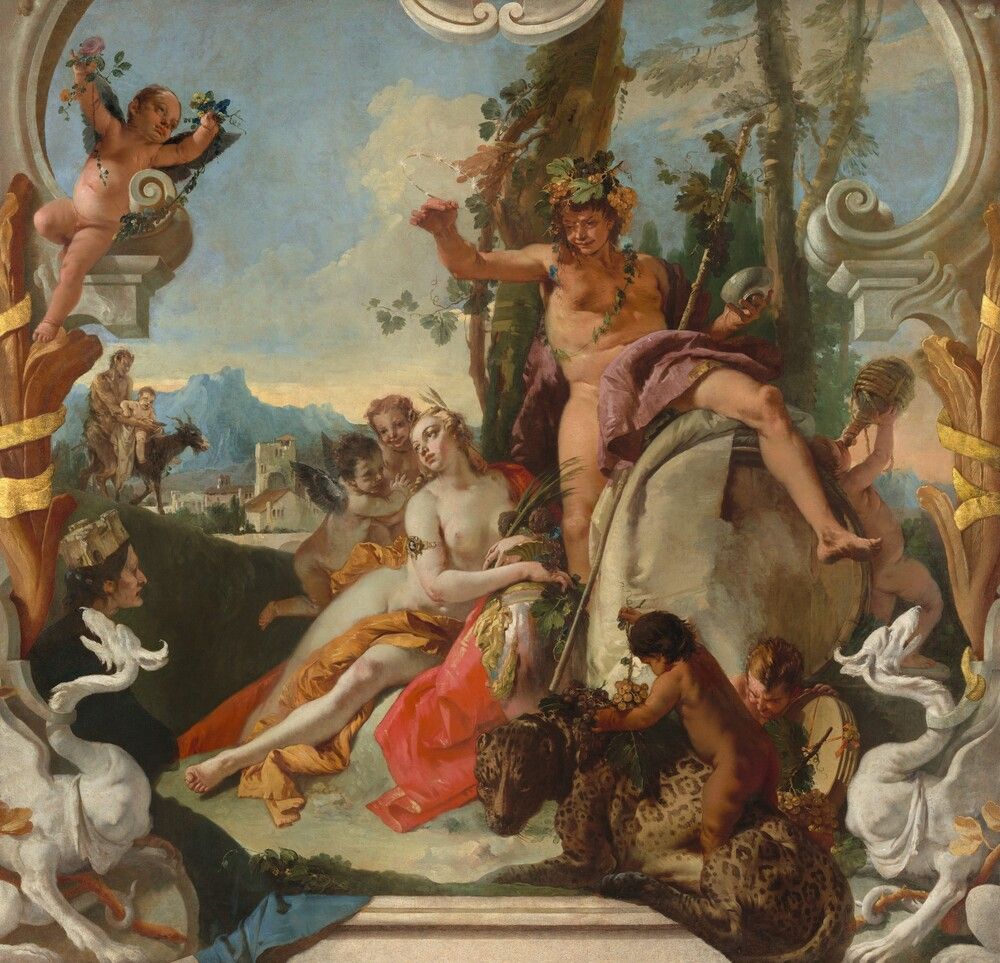
Bacchus and Ariadne - Giovanni Battista Tiepolo, c. 1743/1745, oil on canvas
National Gallery of Art, Washington, DC, 1960.6.36. CC0
Lineage
See the full family tree2 recorded relations, each with the ancient line behind it.
Parents
Siblings
Also Connected
3 recorded connections, each with the ancient line behind it.
Enemies
-

In Homer, Artemis killed her on Dia on the word of Dionysus.
Connected
-

Hesiod makes her the wife of Dionysus, made deathless by Zeus.
-

She gave him the thread for the Labyrinth on his oath to marry her, and he left her on Naxos.
Where Accounts Differ
- death on Dia or immortal marriage
- why Theseus left Ariadne
- Dia or Naxos
- father of Oenopion and Staphylus
- Whether Ariadne died or became immortal is the central disagreement. Homer's Odyssey says Artemis killed her on Dia on the word of Dionysus. Hesiod's Theogony says Dionysus married her and Zeus made her deathless and unageing. Pausanias records an Argive tradition that she died and Dionysus buried her at Argos.
- Why Ariadne was left behind differs by source. Apollodorus and Pausanias have Dionysus take her from Theseus. Plutarch reports a tradition that Theseus left her for love of Aegle. Catullus and Ovid show Theseus sailing away and leaving her on the shore of Dia.
- The island is named differently. Homer, Catullus and Ovid name Dia. Apollodorus and Plutarch name Naxos. One tradition in Plutarch, from Paeon of Amathus, moves her death to Cyprus.
- The fathers of Oenopion and Staphylus are disputed. Apollodorus makes them sons of Dionysus. Plutarch cites Ion of Chios for making them sons of Theseus.
Read the full source verification →
Mythology
Appears In
Related Terms
Referenced By
Sources
- Homer, Odyssey 11.321-325
- Homer, Iliad 18.590-592
- Hesiod, Theogony 947-949
- Apollodorus, Epitome 1.8-1.10
- Catullus, Carmina 64.52-264
- Ovid, Metamorphoses 8.169-182
- Plutarch, Life of Theseus 20
- Pausanias, Description of Greece 1.20.3
- Pausanias, Description of Greece 2.23.7-2.23.8
- Pausanias, Description of Greece 10.29.3-10.29.4
- Timothy Gantz, Early Greek Myth (1993)