Labrys
The labrys is a double-headed axe, with a blade on each side of the haft, best known today as a symbol of Minoan Bronze Age Crete and, through a much later and more speculative etymology, as the object some scholars believe gave the Labyrinth its name.
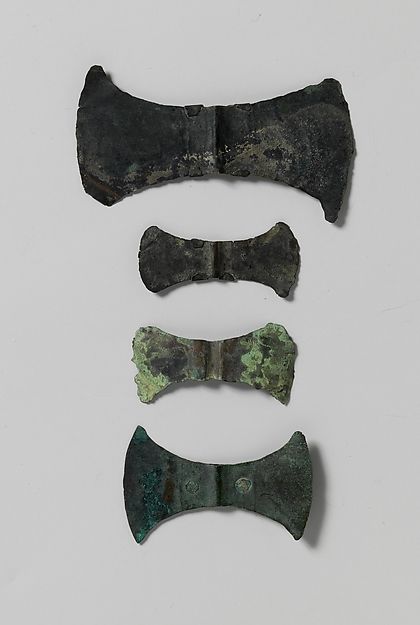
Bronze double-ax head - Minoan, ca. 1700–1450 BCE, Bronze
Metropolitan Museum of Art, New York, NY, 26.31.467. CC0
Sections on this page
In Practice
It sits at the intersection of two different kinds of evidence that should not be blurred together: real archaeological material from Minoan Crete, and mythological narrative about the Labyrinth and the Minotaur that never actually mentions a double axe.
Archaeologically, the labrys is well documented. Excavations at Knossos and other Minoan sites have recovered double axes in stone, bronze, and gold, some clearly ceremonial rather than functional, alongside wall paintings and carved reliefs showing the object in ritual contexts, carried in processions, set up on stands, or associated with figures generally identified as priestesses or a goddess. This evidence supports the labrys as a genuine cult object of Minoan religion centuries before the myths of Minos, the Minotaur, and Theseus took the literary shape in which they survive today.
The connection to the word "labyrinth" is a linguistic hypothesis rather than something any ancient myth states directly. The idea, most associated with the archaeologist Arthur Evans after his excavation of Knossos in the early twentieth century, reads "labyrinth" as meaning something like "house of the labrys," treating the maze's name as a memory of the double-axe cult once practiced in the palace complex itself. No surviving version of the Theseus and Minotaur story, not Apollodorus's summary, not Ovid's fuller retelling, ever mentions a double axe as an object within the narrative; Daedalus builds the maze, Ariadne provides the thread, and the Minotaur is killed with whatever means each version specifies, but the labrys itself never appears as a prop in the literary myth.
The word "labrys" is itself widely reported as non-Greek in origin, most often traced to Lydian or Carian, languages of Asia Minor, where it named a double axe carried by a local storm-god cult distinct from the Cretan material. Treating the labrys as "the axe of the Minotaur myth" therefore overstates what the ancient literary sources say. The accurate claim is narrower. A real religious object from Minoan Crete may have lent its name to the maze. That link comes from scholarly inference centuries later, not from ancient testimony.
What is a labrys?
A labrys is a double-headed axe, with a cutting blade on each side of the haft rather than just one. It survives today mainly as a term for a real category of Minoan Bronze Age ceremonial axes recovered from archaeological sites on Crete, rather than as a named object described inside any surviving Greek myth.
Is the labrys a real historical object or a mythological one?
It is fundamentally a real, archaeologically documented object: stone, bronze, and gold double axes have been excavated at Knossos and other Minoan sites, along with wall paintings and reliefs showing the axe used in ritual settings. Its connection to Greek mythology is a later scholarly inference about the word "Labyrinth," not a detail that appears inside any ancient telling of the Theseus and Minotaur story.
Does the word Labyrinth really come from labrys?
This is a hypothesis, most associated with the archaeologist Arthur Evans after he excavated Knossos, reading "Labyrinth" as meaning something close to "house of the double axe." It is a linguistic and archaeological argument built after the fact, not a claim any ancient Greek author makes about the maze's name, and it should be treated as a scholarly proposal rather than an established ancient fact.
Does the Minotaur myth itself mention a double axe?
No surviving literary version does. Apollodorus's summary of the story and Ovid's fuller poetic retelling both describe Daedalus building the Labyrinth, Ariadne giving Theseus a thread to escape it, and Theseus killing the Minotaur, but neither text gives the axe any role as an object in the narrative. Apollodorus tells the Minotaur's birth and imprisonment at Library 3.1.4 and Theseus's voyage and the thread at Epitome 1.7-1.9. The labrys's association with the myth comes entirely from the archaeological and etymological argument about the maze's name, not from anything a character carries or uses in the story.
Apollodorus, Library 3.1.4
Where does the word labrys come from?
Ancient tradition widely reports it as a non-Greek word, most often traced to Lydian or Carian, languages of Asia Minor, where it named the double axe carried by a local storm-god cult. This is a separate cult tradition from Minoan Crete, and the word's later use to describe the Cretan ceremonial axes is itself a case of one term covering two originally distinct regional traditions.
What does Minoan art actually show the labrys being used for?
Wall paintings, seals, and carved reliefs from Minoan sites show the double axe in ceremonial rather than combat contexts, carried in processions, mounted upright on stands, or placed near figures generally identified as priestesses or a goddess. This pattern supports reading it as a religious cult object of Minoan Crete rather than a weapon, centuries before Greek myths about Crete's labyrinth and its monster took the form in which they survive today.
Where Accounts Differ
- archaeological cult object vs. absent literary myth prop
- The labrys's link to Greek mythology is often overstated: it is a well-documented Minoan archaeological object, but no surviving ancient telling of the Theseus and Minotaur myth mentions a double axe as part of the story. The 'house of the double axe' reading of the word 'Labyrinth' is a modern etymological hypothesis, not an ancient literary claim.
Where This Appears
Referenced By
Sources
- Apollodorus, Library 3.1.4
- Ovid, Metamorphoses 8.159-176
- Apollodorus, Epitome 1.7-1.9