The Fall of Icarus
To escape imprisonment on Crete, the craftsman Daedalus built wings of feathers and wax for himself and his son Icarus. Ignoring his father's warning, Icarus flew too close to the sun, the wax melted, and he fell to his death in the sea.
Sections on this page
The Myth
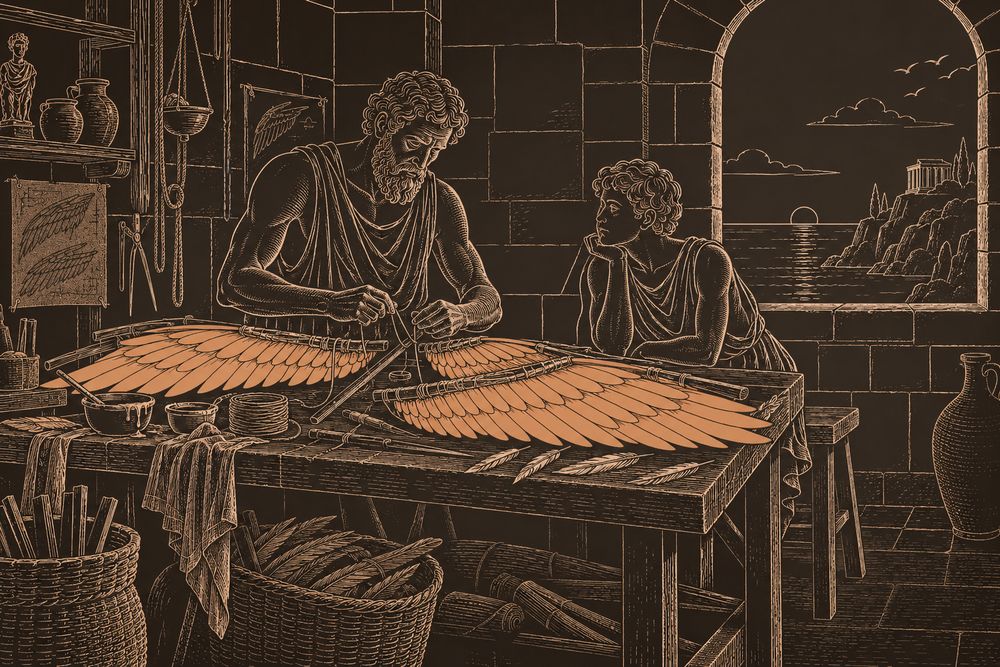
Daedalus binds the wax-and-feather wings
Generated by AI from this page's own facts, not an ancient image or evidence of anything. How this site uses generated images
After helping Theseus escape the Labyrinth he himself had built, the master craftsman Daedalus and his young son Icarus were imprisoned by the furious King Minos, some accounts say in the Labyrinth itself, others say in a tower on Crete. With every sea route watched and every ship searched, Daedalus realized the only escape was through the sky. He gathered feathers dropped by birds, arranged them from smallest to largest, and fastened them together with thread and wax to create two pairs of wings, testing them himself first the way a craftsman tests any device before trusting it to someone else. Before they took flight, Daedalus warned his son carefully: fly too low and the sea spray would dampen the feathers and drag them down; fly too high and the sun's heat would melt the wax holding them together. They must follow a middle course, neither hugging the water nor climbing toward the heavens.
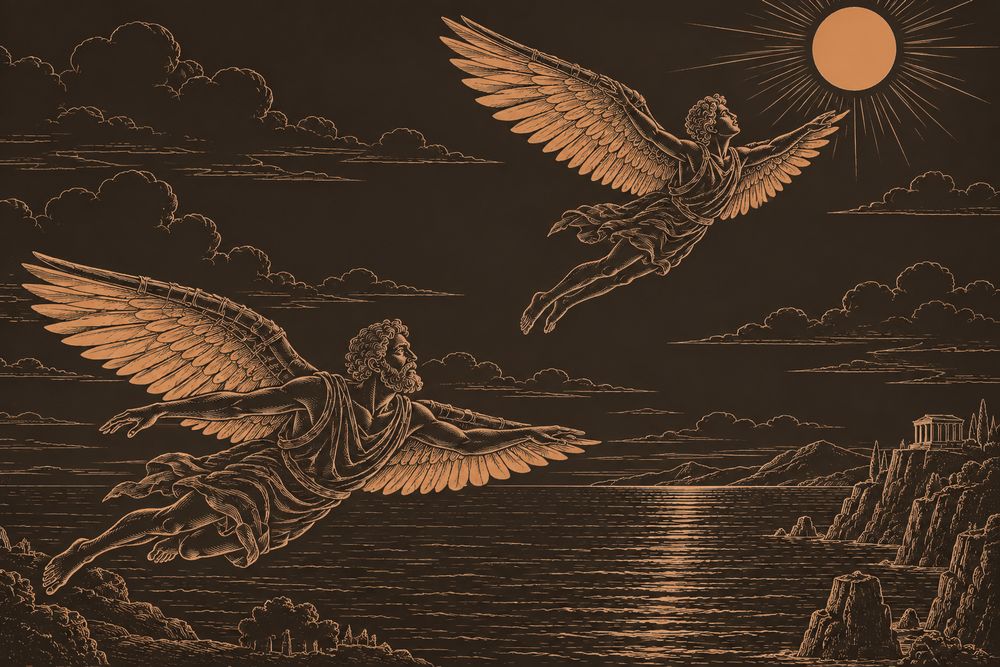
Father and son soar above the sea
Generated by AI from this page's own facts, not an ancient image or evidence of anything. How this site uses generated images
Father and son leaped from the tower and soared out over the sea. Fishermen, shepherds, and plowmen looked up in amazement, thinking them gods rather than men who had built their own way out. But Icarus, thrilled by the sensation of flight and the freedom of open sky after imprisonment, forgot his father's warning. He climbed higher and higher, drawn irresistibly toward the blazing sun, until the wax softened, then melted outright. Feathers came loose and scattered in the wind behind him. Icarus beat his bare arms but found no purchase in the empty air, and fell, calling out his father's name, into the sea below. Daedalus circled in anguish, calling for his son, until he saw nothing but feathers floating on the waves where the boy had been. He retrieved the body and buried it on the nearest island, which he named Icaria in his son's memory; the surrounding waters became known as the Icarian Sea, a name Ovid says still marked the spot in his own day, centuries later.
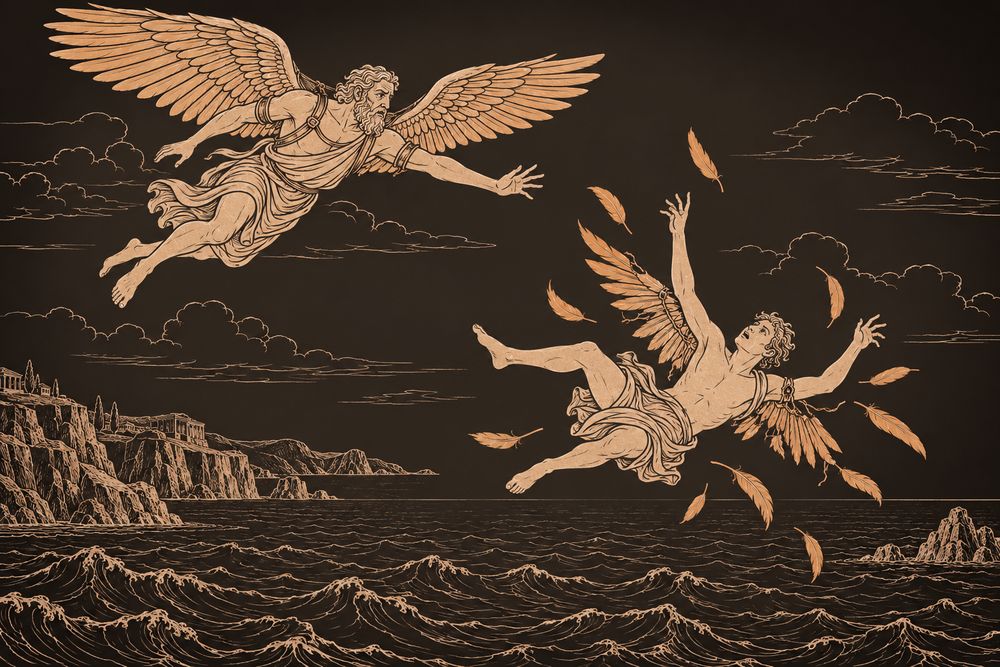
Icarus falls toward the sea
Generated by AI from this page's own facts, not an ancient image or evidence of anything. How this site uses generated images
Why were Daedalus and Icarus imprisoned in the first place?
Daedalus had built the Labyrinth on Crete to contain the Minotaur, and later helped Theseus escape it by giving Ariadne the thread that let Theseus find his way back out after killing the beast. King Minos, discovering that his own architect had betrayed the Labyrinth's secret, imprisoned Daedalus and his son to prevent him from helping anyone else - sources differ on whether the cell was a tower or the Labyrinth itself.
Apollodorus, Epitome 1.12-1.13
Why couldn't Daedalus just escape by sea?
Ovid says Minos controlled every ship and searched every route by land and sea, since Crete was an island kingdom and Minos held naval power over the surrounding waters. Daedalus concluded that the only path Minos did not control was the open sky, which is why he turned to inventing wings rather than attempting a conventional escape.
Ovid, Metamorphoses 8.183-235
Why did Icarus's wings fail but not his father's?
Both sets of wings were built the same way, from feathers held together with wax, and Daedalus flew the same route without incident. The difference was altitude: Daedalus kept to the middle course he had prescribed, while Icarus climbed too close to the sun despite the warning, and the wax on his wings, not his father's, melted from the heat.
Ovid, Metamorphoses 8.183-235
What happened to Daedalus after his son died?
He completed the flight alone, buried Icarus on the nearest island, and continued on to Sicily, where he found refuge at the court of King Cocalus. Minos eventually tracked him there by a riddle involving a spiral seashell that only Daedalus could solve, but accounts of what happened to Daedalus after that vary and are less consistently told than the flight itself.
Apollodorus, Epitome 1.12-1.13
Is Icarus's fall usually read as a warning against ambition?
Yes, and that reading goes back to antiquity: the myth is regularly invoked as a caution against ignoring the counsel of someone wiser and against overreaching one's proper limits, which is why "flying too close to the sun" survives as a standalone idiom independent of the rest of the story. Ovid's telling keeps the practical warning explicit rather than only implied, since Daedalus states the danger of both extremes before they ever take flight.
Ovid, Metamorphoses 8.183-235
Read the full source verification →
Mythology
Figures In This Myth
Related Terms
Referenced By
Sources
- Ovid, Metamorphoses 8.183-235
- Apollodorus, Epitome 1.12-1.13
- Timothy Gantz, Early Greek Myth (1993)