Narcissus
Narcissus was a mortal youth from the territory of Thespiae in Boeotia. Ovid makes him the son of the river-god Cephisus and the nymph Liriope. He rejected every lover, fell in love with his own reflection in a spring, and died beside it. The ancient sources disagree on how he died, why he stared, and whether the narcissus flower came from him.
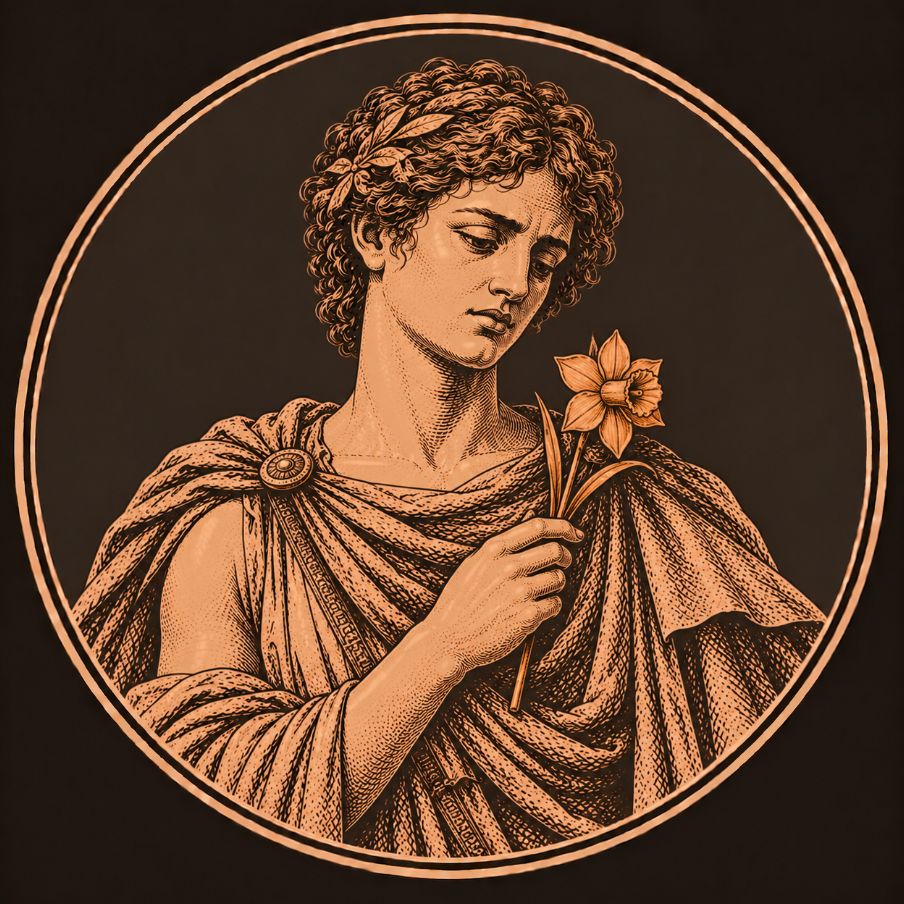
Narcissus, bronze medallion illustration
Generated by AI from this page's own facts, not an ancient image or evidence of anything. How this site uses generated images
Sections on this page
Core Myth
Ovid gives Narcissus the fullest ancestry. His mother was Liriope, a nymph, and his father the river-god Cephisus, on whose banks she bore him. Liriope asked the seer Tiresias whether her son would reach old age. The answer, that he would if he never came to know himself, is where Ovid's story of Narcissus and Echo begins.
By Ovid's account he grew into a youth whom many young men and girls desired, and his pride kept every one of them away. He spent his days hunting stags with nets. One of the young men he scorned lifted his hands to heaven and prayed that Narcissus might love and never win what he loved. Nemesis heard the prayer and granted it. The full narrative, with Echo's part in it, belongs to the story page; this page follows the figure through the versions that disagree with it.
The Greek writers place him in Boeotia. Pausanias saw the spring of Narcissus at Donacon, a reed-bed in the territory of Thespiae, and calls him "Narcissus the Thespian". Conon, a mythographer of Ovid's own generation, also sets the story at Thespiae, near Mount Helicon. His Narcissus is dismissive of both lovers and Eros.
Conon's version names the rejected suitor. A youth called Ameinias kept pleading after every other lover gave up, and Narcissus sent him a sword. Ameinias killed himself with it at Narcissus's door, calling on the god to avenge him. Narcissus later saw his own shape in a spring and fell in love with it. Judging that he suffered justly for what he had done to Ameinias, he killed himself.
Who was Narcissus?
Narcissus was a mortal youth of Greek myth, famous for his beauty and for loving his own reflection. Ovid calls him the son of the river-god Cephisus and the nymph Liriope. Pausanias and Conon both place him at Thespiae in Boeotia, where Pausanias saw his spring at Donacon. He rejected every lover who wanted him. The sources then divide: he wastes away at the water in Ovid, kills himself in Conon, and mourns a dead twin sister in the tradition Pausanias prefers.
Ovid, Metamorphoses 3.339-355
What Greek god is Narcissus?
Narcissus is not a god. Every ancient account treats him as a mortal who dies young, though Ovid gives him a divine father, the river-god Cephisus. The gods in his story act on him. In Ovid, Nemesis grants a rejected lover's prayer that Narcissus should love without winning what he loves. In Conon, the offended god is Eros, and Thespiae's special worship of Eros is explained by Narcissus's death. No ancient source describes a cult of Narcissus himself.
Ovid, Metamorphoses 3.370-406
Why is the flower named after Narcissus?
The myths say the flower grew where he died. In Ovid, the Naiads look for his body to burn it and find a flower with white petals around a yellow centre instead. Conon says it sprang from the ground soaked with his blood. Pausanias disagrees with both. He argues the narcissus existed before the youth, since the older poet Pamphos made it the flower that lured Persephone away. The Homeric Hymn to Demeter tells the same scene.
Pausanias, Description of Greece 9.31.9
Was Narcissus a narcissist?
Not in the modern clinical sense, which was named after him in 1899, not drawn from ancient texts. Ovid does show him proud, scornful of lovers, and consumed by his own image, but the love is a punishment sent by Nemesis. Pausanias rejects even that. In the Thespian version he prefers, Narcissus knew the face in the spring was his own and loved it only because it looked like his dead twin sister.
Pausanias, Description of Greece 9.31.7-9.31.8
Later Traditions
Ovid and Conon end the same youth in two different ways. In Ovid he wastes away at the water's edge and dies. Even among the shades he keeps gazing at himself in the water of the Styx. His sisters the Naiads mourn him and prepare a pyre, but his body has gone, and a flower with white petals around a yellow centre stands in its place. In Conon the flower springs from the ground where his blood was spilt.
A papyrus found at Oxyrhynchus in Egypt adds a third early witness. Published in 2005 as P.Oxy. 4711, it preserves short Greek poems on metamorphoses, including Narcissus. Its editor, W. B. Henry, suggested they come from the Metamorphoses of Parthenius of Nicaea, but other scholars dispute the attribution and date the verses later. As in Conon, the boy sheds his own blood on the earth.
Pausanias rejects the whole reflection story. He calls it utter stupidity to think a man old enough to fall in love could not tell a man from his own reflection. He prefers a less popular Thespian tradition. In it, Narcissus had an identical twin sister who hunted with him. After she died he went to the spring knowing the face was his own, and took comfort in imagining it was hers.
Pausanias also denies that the flower was named after the youth. He points to the older poet Pamphos, who said Persephone was lured away by a narcissus, not by violets. The Homeric Hymn to Demeter tells the same scene: Earth grew a radiant narcissus at the will of Zeus, as a snare for the girl, and Hades seized her when she reached for it. On that reading the flower is older than the boy.
His worship at Thespiae belongs to Eros, not to him. Pausanias says the Thespians honoured Eros above all gods from the beginning, with an ancient image of unworked stone, and admits he does not know who began the custom. Conon supplies an answer: the Thespians came to honour Eros especially because of what happened to Narcissus. Later still, the fifth-century AD poet Nonnus gives him a different father, Endymion, the mortal bridegroom of Selene.
Modern Influence
The youth's name passed into medicine at the end of the nineteenth century. Freud's essay On Narcissism (1914) opens by saying the term was chosen by the psychiatrist Paul Näcke in 1899. Näcke used it for a person who treats his own body as one would the body of a sexual partner. Havelock Ellis later claimed a share of the credit for his 1898 phrase "Narcissus-like". The everyday sense of narcissism grew out of that clinical term, not out of any ancient text.
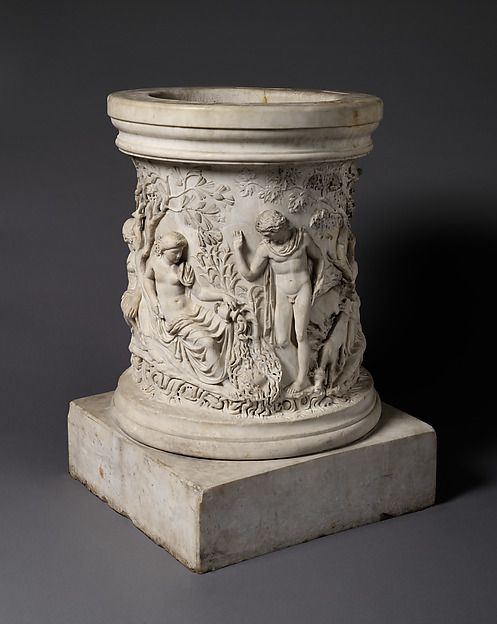
Puteal (wellhead) with Narcissus and Echo, and Hylas and the Nymphs - Roman, 2nd century, Marble
Metropolitan Museum of Art, New York, NY, 2019.7. CC0
Also Connected
1 recorded connection, each with the ancient line behind it.
Connected
-

In Ovid, a youth Narcissus scorned prays that Narcissus may love and never win what he loves, and Nemesis grants the prayer.
Where Accounts Differ
- who fathered Narcissus (Cephisus in Ovid, Endymion in Nonnus)
- how Narcissus died (wasting away in Ovid, suicide in Conon and P.Oxy. 4711)
- whether Narcissus loved his reflection or grieved a twin sister (Pausanias)
- whether the narcissus flower came from Narcissus or predates him (Pausanias)
- who avenged the rejected suitor (Nemesis in Ovid, Eros in Conon)
- Ovid (Metamorphoses 3.339-510) is the only source for Narcissus's parents Cephisus and Liriope, for Tiresias's prophecy, and for Echo. Nonnus (Dionysiaca, Book 48, read in W. H. D. Rouse's translation as quoted by Theoi) instead makes him a son of Endymion.
- How Narcissus died differs by source. Ovid has him waste away at the spring. Conon's Narrations (no. 24, surviving in the summary of Photius, read in Brady Kiesling's translation) and the Narcissus poem in P.Oxy. 4711 have him kill himself. Conon is not in the site's source registry, so he is named in the prose but not carried as a line-level citation.
- The rejected suitor is unnamed in Ovid and prays to the gods, with Nemesis answering. In Conon he is Ameinias, who kills himself with the sword Narcissus sent him and calls on the god to avenge him; Conon ties the outcome to Eros.
- Pausanias (9.31.7) dismisses the reflection story as stupidity and prefers a Thespian tradition (9.31.8) in which Narcissus mourns a twin sister. He also argues (9.31.9), from the poet Pamphos, that the narcissus flower predates the youth, which contradicts both Ovid and Conon on the flower's origin.
- The attribution of P.Oxy. 4711 to Parthenius of Nicaea is the first editor's suggestion and is disputed; this page does not treat it as settled.
- Pausanias (9.27.1) says the Thespians honoured Eros above all gods and that he does not know who began the custom. The link between that cult and Narcissus comes only from Conon.
Read the full source verification →
Mythology
Appears In
Related Terms
Referenced By
Sources
- Ovid, Metamorphoses 3.339-355
- Ovid, Metamorphoses 3.370-406
- Ovid, Metamorphoses 3.474-510
- Pausanias, Description of Greece 9.31.7-9.31.8
- Pausanias, Description of Greece 9.31.9
- Pausanias, Description of Greece 9.27.1
- Homeric Hymn to Demeter 5-14
- W. B. Henry, P.Oxy. 4711, in The Oxyrhynchus Papyri LXIX (2005)
- Sigmund Freud, On Narcissism: An Introduction (1914)