Liriope
Liriope in Greek myth is the nymph who bore Narcissus, not the lilyturf plant that shares her name. In Ovid's Metamorphoses she is the mother of Narcissus by the river-god Cephisus, and she asks the seer Tiresias whether her son will live to old age. He answers that the boy will, if he never comes to know himself.
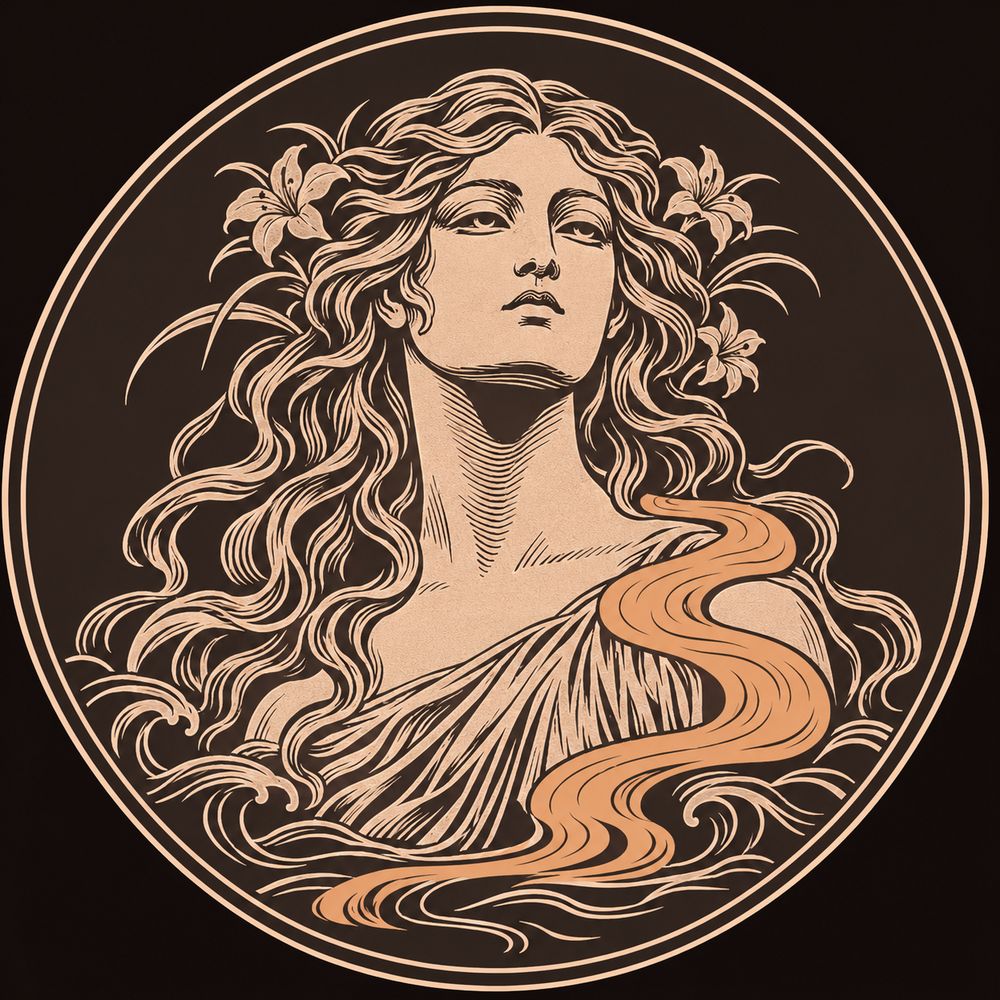
Liriope, nymph mother of Narcissus
Generated by AI from this page's own facts, not an ancient image or evidence of anything. How this site uses generated images
Sections on this page
See Liriope in the Greek family tree.
Core Myth
Liriope is also the botanical name of a genus of lilyturf, a garden plant, and a plain search for the word returns mostly plant pages. That use is modern. The ancient sources checked here say nothing of a plant. This page covers the nymph, who is named in Ovid's account of the birth and fate of Narcissus (Ovid, Metamorphoses 3.339-346).
Ovid brings her in right after the story of the seer Tiresias. Juno, whom the Greeks called Hera, blinded Tiresias for siding with Jupiter in a quarrel, and Jupiter gave him prophecy in return (Metamorphoses 3.316-338). Ovid says his fame spread through the cities of Aonia. He then says Liriope was the first to put his reliable voice to the test (Metamorphoses 3.339-340).
Ovid gives her a partner and a child. The river-god Cephisus once wrapped her in his winding stream, shut her in his waves and took her by force. She bore a very beautiful infant, one whom nymphs could already love, and named him Narcissus (Metamorphoses 3.341-344). Cephisus has no page of his own on this site. Ovid names the father only in this passage.
She went to Tiresias to ask whether her son would see a long and ripe old age. The seer answered with the Latin words si se non noverit, which mean "if he does not know himself" (Metamorphoses 3.344-346). That answer is the hinge of Narcissus and Echo, where Ovid shows what it meant.
After the prophecy Ovid does not return to Liriope in the passage checked here. He turns to the youth, whom many young men and many girls desired, and to his hard pride (Metamorphoses 3.349-355). Ovid says nothing in that passage about what became of her.
Is the plant liriope connected to the nymph Liriope?
The ancient texts checked here do not connect them. The nymph appears in Ovid as the mother of Narcissus, and no passage read for this page mentions lilyturf. Botanists now use Liriope as the name of a genus of garden plants. Questions about its sun, shade or pruning belong to gardening guides, not to the myth, and this page does not answer them.
What does "liriope" mean?
Ovid does not explain the name. He calls her caerula, the Latin word for blue or sea-coloured, an adjective that describes her and is not a translation of her name. The sources checked here give no ancient etymology for Liriope. Any derivation of the name would be modern philology, and none has been checked for this page.
Did Liriope understand Tiresias's answer?
Ovid does not say so. He reports that the seer's word seemed empty for a long time. Only the outcome proved it, together with the manner of the youth's death and the strangeness of his madness. Liriope is not shown reacting to the prophecy, then or later, in the passage checked here.
Does any other ancient source name Liriope?
Not among the sources checked here. Ovid is the only text read for this page that names her, and the same holds for Cephisus as Narcissus's father. Pausanias and Apollodorus appear in this site's pages on Narcissus and Tiresias, but not for her. A different father, Endymion, is recorded for Narcissus in Nonnus.
Later Traditions
The sources checked here name Liriope only in Ovid. The Narcissus page records that Nonnus gives the youth a different father, Endymion, so the pairing of Liriope and Cephisus rests on Ovid alone. Apollodorus tells Tiresias's blinding in several rival ways, and Ovid's version, a quarrel judged for Jupiter, is only one of them (Apollodorus, Library 3.6.7).
Her scene also sits inside a larger design. Ovid makes the Narcissus tale part of a run of Theban myths, and the love and transformation cluster groups it with other loves that end in a changed body. Liriope's part is small, but her question is what sets that story going.
1 recorded relation, each with the ancient line behind it.
Children
-
In Ovid the nymph Liriope bears a beautiful infant to the river-god Cephisus and names him Narcissus.
Also Connected
1 recorded connection, each with the ancient line behind it.
Connected
-
In Ovid, Liriope is the first to test the seer Tiresias and asks whether her son will reach old age.
Where Accounts Differ
- who fathered Narcissus (Cephisus in Ovid, Endymion in Nonnus)
- how Tiresias gained prophecy (Ovid and Apollodorus)
- Ovid is the only source checked here for Liriope and for Cephisus as father of Narcissus. Nonnus, as the Narcissus page records, makes the youth a son of Endymion, which leaves no place for Cephisus. Ovid's account of how Tiresias gained prophecy also differs from Apollodorus's rival accounts of his blinding.
Read the full source verification →