Midas and the Golden Touch
The golden touch is the gift Dionysus gives King Midas of Phrygia in Ovid's Metamorphoses, after Midas returns the captured Silenus: whatever he touches turns to gold. It ruins his meals, and Dionysus tells him to wash in the source of the river Pactolus, which takes the gift away. The tale of Midas turning his daughter to gold is not ancient. It comes from Nathaniel Hawthorne, in 1851.
Sections on this page
What Led To It
Midas is a king of Phrygia, in central Anatolia. Herodotus treats a Midas son of Gordias as a real earlier king who sent his royal seat to Delphi, and that was before Gyges of Lydia gave offerings there. The story of the golden touch is a different matter, a legend, and the fullest telling that this page has verified is Ovid's, in Metamorphoses 11.85-145. Ovid writes in Latin, so his god is Bacchus, the Roman name for Dionysus; this page uses the Greek name in its own voice and the Bacchus page covers the Roman one.
Ovid's Midas is not a villain. He shelters and feasts an old companion of the god, which is why he is rewarded. The wish itself is the fault, and Ovid says so plainly through Dionysus's grief.
The Myth
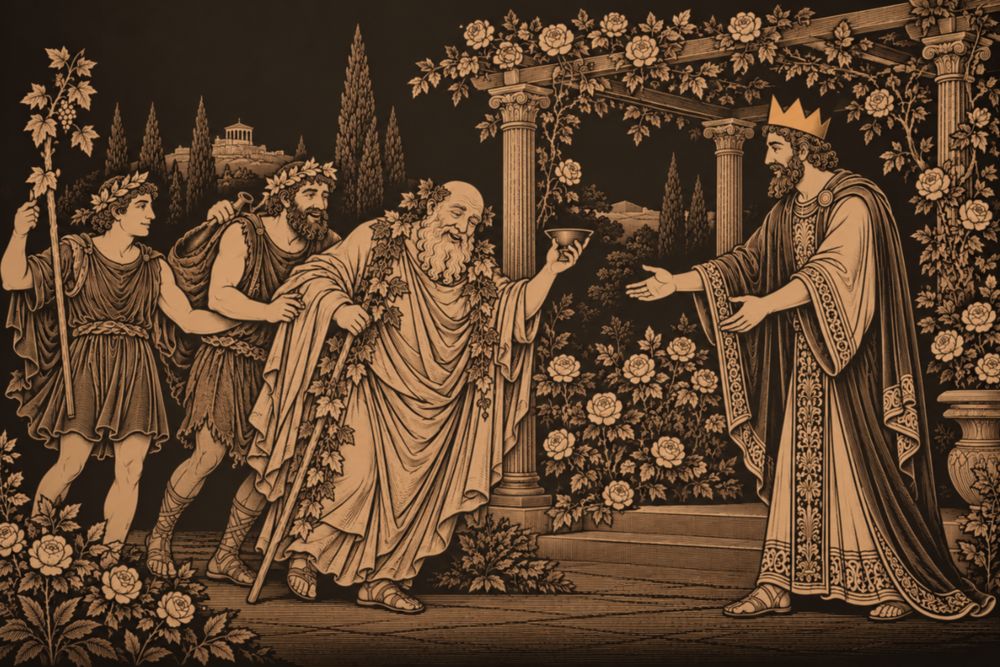
Silenus brought to Midas
Generated by AI from this page's own facts, not an ancient image or evidence of anything. How this site uses generated images
Ovid begins the episode with Dionysus (Bacchus in Ovid's Latin) leaving one land for the vineyards of Mount Tmolus and the river Pactolus. His usual crowd of satyrs and bacchants surrounds him, but not Silenus. Phrygian countryfolk have caught the old man as he staggered, faint with age and wine. They bind him in garlands and lead him to their king, Midas, whom Eumolpus and Thracian Orpheus had taught all the Bacchic rites. Midas knows his old friend at once and keeps a joyful feast for ten days and nights.
On the eleventh day the king takes Silenus to the Lydian lands and hands him back to his foster-child, young Dionysus. The god is delighted and offers Midas any reward he likes. Ovid calls the offer welcome but harmful.
Other ancient writers place the capture elsewhere and say how it was done. Xenophon's Anabasis has the Persian army pass a spring of Midas, king of the Phrygians, at Thymbrium, where Midas, according to the story, caught the satyr by mixing wine with the water. Herodotus puts the same capture in Macedonia: in a garden of Midas son of Gordias, where roses grow of themselves with sixty blossoms each, Silenus was taken captive "according to the Macedonian story." Neither writer mentions a wish. The full story of the wish, and the washing, is Ovid's.
Midas answers at once, and Ovid calls the reply ill-advised: let whatever he touches change to yellow gold. Dionysus agrees, grieving that the king chose harm and not good. Midas walks off delighted and starts testing the promise.
He pulls down a twig from a holm-oak, and it turns to gold. A dark stone he lifts from the ground goes pale with gold. A clod of earth becomes a shining lump, ripe ears of grain turn golden, and an apple in his hand looks like a gift from the Hesperides. Each door-post glistens when he touches it. Water from his hands runs like the golden shower that astonished Danae. He can hardly hold in his mind how much he has gained.
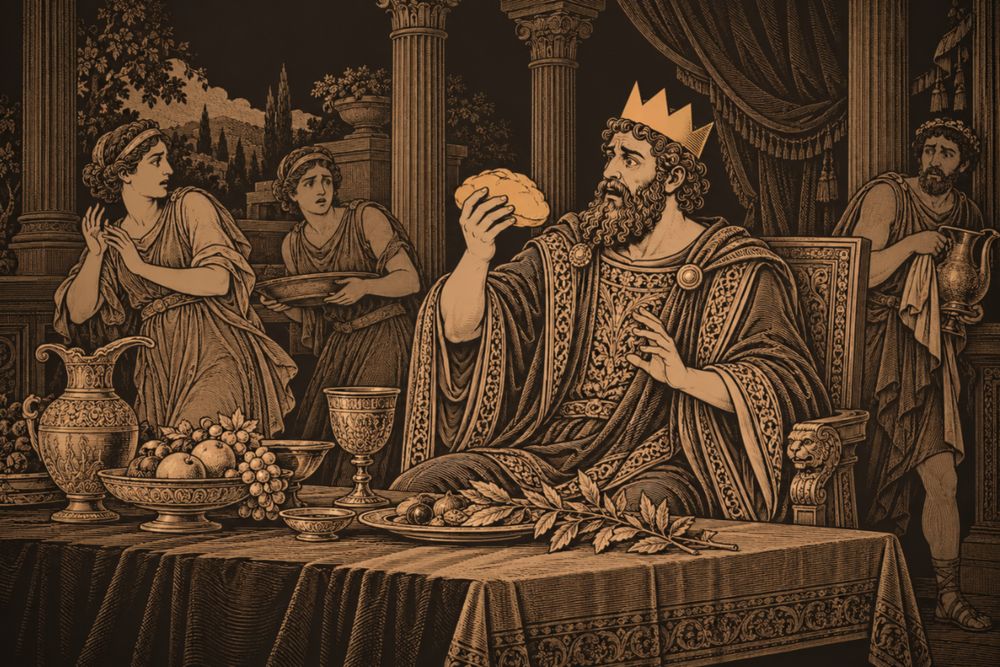
The golden bread
Generated by AI from this page's own facts, not an ancient image or evidence of anything. How this site uses generated images
Then his servants lay a table with dainties and bread. When Midas touches the gift of Ceres, it stiffens into gold. If he bites into a tender piece of meat with hungry teeth, the meat shines with yellow flakes of gold. Wine, the gift of Bacchus, mixed with pure water, shows in his astonished mouth as liquid gold.
Ovid calls him rich and wretched. Plenty could not lessen his hunger, and nothing eased his parched throat. The hated gold tormented him no more than he deserved. He lifts his hands and shining arms to heaven and pleads: pardon me, father Lenaeus, I have done wrong, but pity me and save me from this curse that looked so fair. Aristotle's Politics uses the same legend as an argument about money. It says a man can be well supplied with wealth and die of hunger, "like the famous Midas in the legend," whose prayer was so covetous that all the food served to him turned to gold. Ovid does not let Midas die.
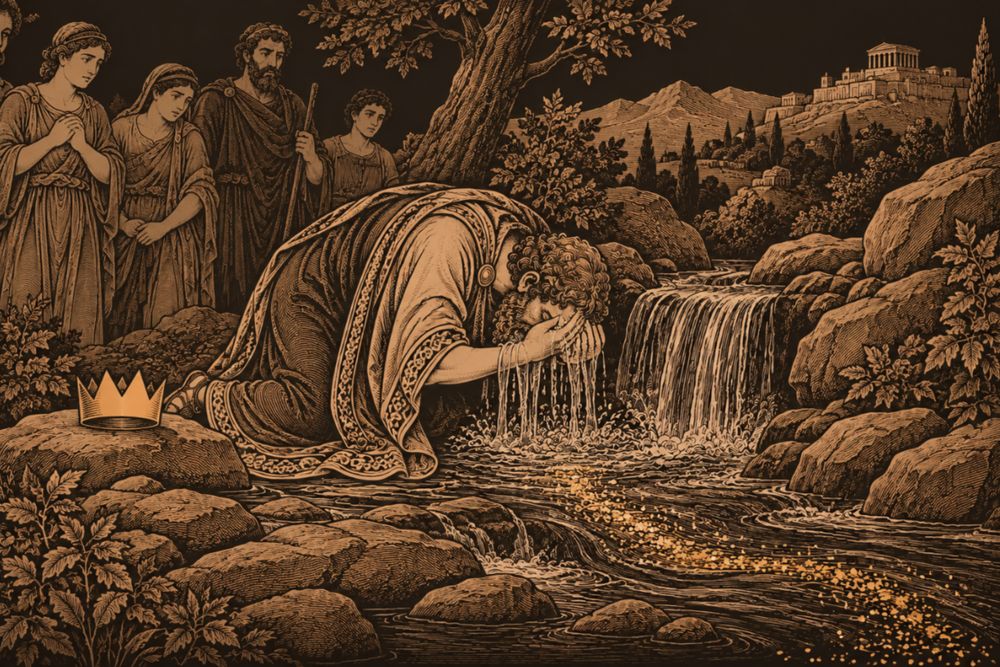
Midas washes in the Pactolus
Generated by AI from this page's own facts, not an ancient image or evidence of anything. How this site uses generated images
Ovid's Dionysus is patient, and because Midas confessed his fault, he cancels the favour. He tells the king to go to the stream that flows past great Sardis, trace it upward to its source, and plunge head and body into the foam where the spring leaps from the mountain rock. Midas obeys. The gold-making power leaves his body and tints the river. Ovid adds that the fields beside the river are still hard and coloured with the gold Midas left, and his opening lines stress that the Pactolus had not been golden before. The tale explains the river's gold.
Ovid does not stop there. Cured of wealth, Midas hates riches and lives in the woods, following Pan, but his mind stays as dull as before. On Mount Tmolus he sits among the listeners when Pan plays against Apollo, and when the mountain god Tmolus gives the prize to Apollo's lyre, Midas alone calls the award unjust. Apollo will not let such ears keep a human shape, and gives Midas the ears of a slow-moving ass. He hides them under a purple turban, but the servant who cuts his hair sees them, digs a hole, whispers the secret into it and fills it in. Reeds grow there, and about twelve months later they repeat the words in the south wind. That second story, and the sources that tell it differently, belong to the Midas page.
That you may not be always cased in gold, which you unhappily desired, depart to the stream that flows by that great town of Sardis and upward trace its waters, as they glide past Lydian heights, until you find their source. Then, where the spring leaps out from mountain rock, plunge head and body in the snowy foam. At once the flood will take away your curse.
What Followed
Ancient writers give three different ends for Midas, and none of them is the golden touch's happy ending. Ovid tells no death. Aristotle's Politics, which mentions the legend of the hungry king, says he died of hunger. Strabo's Geography reports, on the authority of an unnamed "they say," that when the Cimmerians overran Phrygia, Midas drank bull's blood and went to his doom. Plutarch's essay On Superstition also has him drink bull's blood, but as suicide, after disturbing dreams. Nobody links the bull's blood to the gold.
Ovid's own aftermath is the river: the Pactolus takes its gold from the king's cure.
Afterlife and Modern Influence
The daughter who turns to gold is not in any ancient source this page checked. Nathaniel Hawthorne invented her in "The Golden Touch", one of the retellings in A Wonder-Book for Girls and Boys, first published in 1851. His narrator says the king had a little daughter "whom nobody but myself ever heard of," and that he chose to call her Marygold because he loves odd names for little girls. In Hawthorne's version the king kisses her and she becomes a golden statue, and washing in a river later restores her. Because Hawthorne's story is the best known, most modern retellings carry the daughter, though the ancient Midas has none.
What is the golden touch of Midas?
It is the gift Dionysus grants Midas in Ovid's Metamorphoses: whatever the king touches turns to gold. It works on a twig, a stone, grain and an apple, and then on his bread, meat and wine, so he cannot eat. Dionysus lets him wash the gift away at the source of the river Pactolus.
Ovid, Metamorphoses 11.85-145
Who was Midas in Greek mythology?
A king of Phrygia, known for two stories: the golden touch, and the ass's ears Apollo gave him for judging a music contest against the god. Herodotus also names a Midas son of Gordias as a historical Phrygian king who sent his royal seat to Delphi. The character page covers his sources in full.
Ovid, Metamorphoses 11.85-193; Herodotus, Histories 1.14
What is the story behind the Midas Touch?
Midas is offered any reward for returning the captured Silenus to Dionysus, and asks for the golden touch. The gift turns his food to gold, and he begs to be freed. The ancient story is about a foolish wish, not a lost daughter, which is Hawthorne's 1851 addition.
Ovid, Metamorphoses 11.85-145
What killed King Midas?
The sources disagree, and Ovid gives no death. Aristotle's Politics has Midas of the legend die of hunger. Strabo's Geography says Midas drank bull's blood during the Cimmerian invasion of Phrygia, and Plutarch says he took it as suicide after bad dreams. None ties the bull's blood to the golden touch.
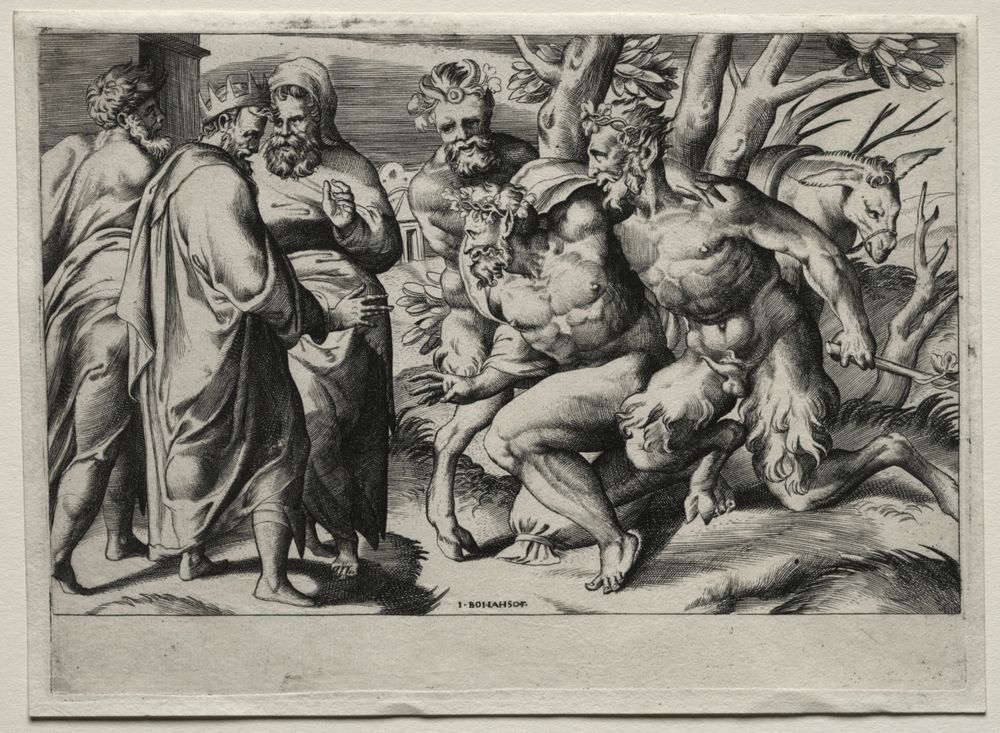
Silenus and King Midas - Italy, mid 16th century, engraving
The Cleveland Museum of Art, Cleveland, OH, 1968.256. CC0
Where Accounts Differ
- silenus-capture-versions
- how-midas-died
- daughter-is-hawthorne
- ovid-only-full-telling
- Silenus's capture differs by source. Ovid (Metamorphoses 11.89-99) has Phrygian countryfolk find him drunk and bring him to Midas. Xenophon (Anabasis 1.2.13) places a spring of Midas at Thymbrium where Midas caught the satyr with wine mixed into the water. Herodotus (Histories 8.138) places the capture in a rose garden of Midas son of Gordias in Macedonia and gives no method. Only Ovid, of the sources checked here, goes on to the wish.
- Ovid alone, of the sources checked, describes the touch turning a twig, stone, grain, apple, bread, meat and wine to gold. Aristotle (Politics, around 1257b) gives only the outline: a Midas of legend dies of hunger because all his food turned to gold. Xenophon and Herodotus do not mention the wish.
- Midas's death is disputed. Aristotle says hunger; Strabo (Geography 1.3.21) says he drank bull's blood during the Cimmerian invasion, on report ("they say"); Plutarch (On Superstition) says he killed himself by drinking bull's blood after disturbing dreams. Ovid records no death.
- The daughter who turns to gold is Hawthorne's invention, in A Wonder-Book for Girls and Boys. The book is dated 1851 in most references, and one online text of it is headed 1852. His narrator says nobody but himself ever heard of the girl.
- Ovid writes Roman names, such as Bacchus and Ceres. This page uses Dionysus in its own voice and keeps the Roman names only where it quotes.
Read the full source verification →
Mythology
Figures In This Myth
Also Connected
Related Terms
Referenced By
Sources
- Ovid, Metamorphoses 11.85-145
- Ovid, Metamorphoses 11.89-99
- Ovid, Metamorphoses 11.100-105
- Ovid, Metamorphoses 11.106-130
- Ovid, Metamorphoses 11.131-145
- Ovid, Metamorphoses 11.146-193
- Herodotus, Histories 1.14
- Strabo, Geography 1.3.21
- Herodotus, Histories 8.138
- Xenophon, Anabasis 1.2.13
- Aristotle, Politics 1.9
- Plutarch, On Superstition
- Nathaniel Hawthorne, A Wonder-Book for Girls and Boys (1851), "The Golden Touch"