Midas
Midas was a king of Phrygia whose wish came true. In Ovid's Metamorphoses, Dionysus lets him choose a reward for returning Silenus, and Midas asks that everything he touches turn to gold. His bread and wine turn to gold too, so he begs to be freed and washes the gift away in the Pactolus. Apollo later gives him ass's ears.
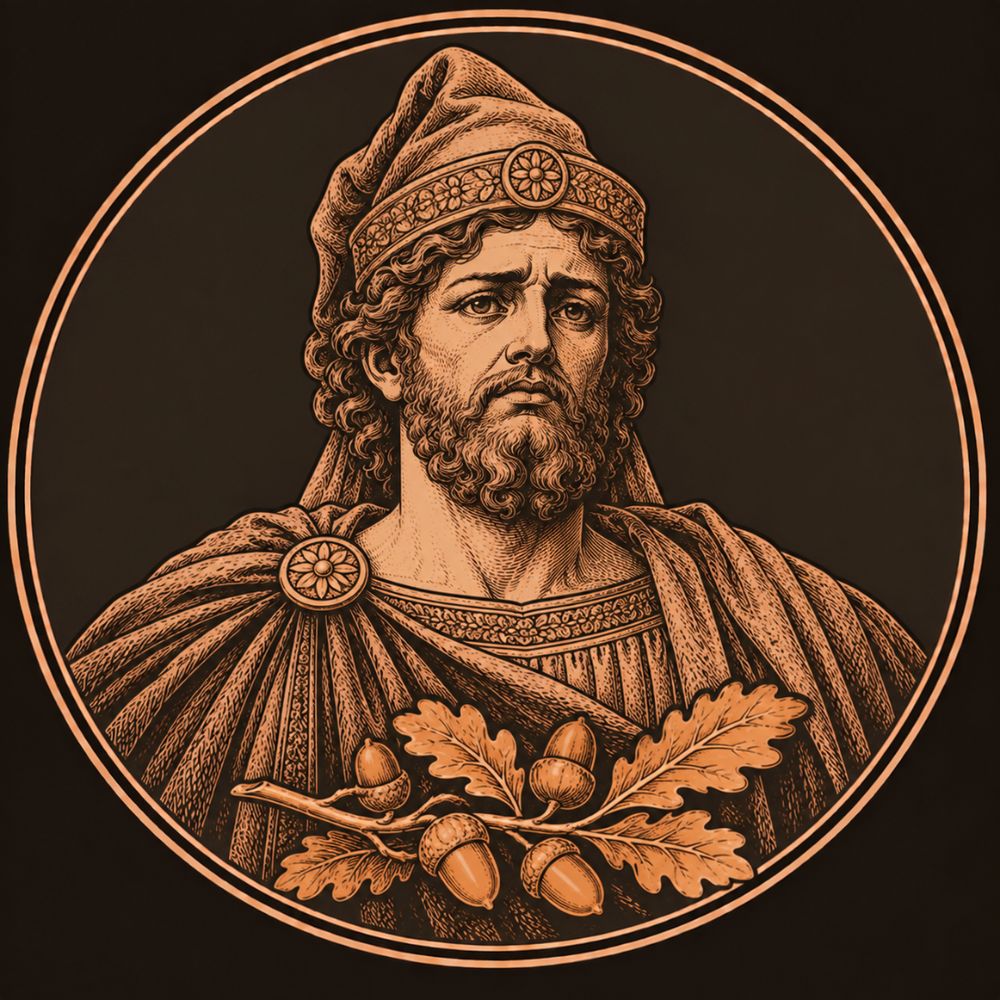
Midas, bronze medallion illustration
Generated by AI from this page's own facts, not an ancient image or evidence of anything. How this site uses generated images
Sections on this page
Core Myth
Midas is a king of Phrygia, and Ovid's Metamorphoses tells his two famous stories back to back. The first, the golden touch, begins with Silenus, the old companion of Dionysus. Phrygian countryfolk find him staggering with age and wine, bind him with garlands and lead him to their king. Midas had learned the Bacchic rites from Orpheus and Eumolpus, so he knows his guest at once.
Midas feasts Silenus for ten days and nights, Ovid says, and on the eleventh brings him back to Dionysus in Lydia. The god, glad to have his foster-father back, lets the king choose any reward. Midas asks that whatever he touches turn to yellow gold. Dionysus grants it, grieving that Midas did not ask for something better.
At first the gift delights him. A twig, a stone, a clod of earth, ears of grain and an apple all turn to gold in his hands. Then his servants set a meal before him. The bread stiffens into gold at his touch, the meat turns to gold under his teeth, and his wine flows into his mouth as liquid gold. Rich and wretched at once, he hates what he had just prayed for.
Midas raises his gleaming arms to heaven and admits he has done wrong. Dionysus takes the gift back. He sends Midas to the river that flows past Sardis, to plunge his head and body into its spring. The gold passes from his body into the water. Ovid says the fields along that river, the Pactolus, are still hard and pale with gold.
Cured of wealth, Midas takes to the woods and follows Pan, but Ovid says his mind stays as dull as before. On Mount Tmolus, Pan boasts that his reed pipe beats the music of Apollo. The mountain god Tmolus judges the contest and gives the prize to Apollo's lyre. Everyone agrees except Midas, who calls the verdict unjust.
Apollo will not let such dull ears keep a human shape. He stretches them, fills them with grey hair and makes them twitch. Midas now has the ears of a slow-moving ass. He hides them under a purple headdress. But the servant who trims his hair sees them. Unable to keep the secret, the man digs a hole, whispers into it and buries his words.
A thick bed of reeds grows on the spot. About a year later, Ovid says, the reeds stir in the south wind and repeat the buried words. So the secret of their master's ears comes out after all.
What is the real story of King Midas?
The fullest ancient telling is Ovid's Metamorphoses. Midas, king of Phrygia, returns the drunken Silenus to Dionysus and is offered any reward. He asks that everything he touches turn to gold, then cannot eat when his bread and wine turn to gold as well. Dionysus lets him wash the gift away in a river near Sardis. Later he prefers Pan's music to Apollo's and is given ass's ears. Herodotus's Histories also treats a Midas son of Gordias as a real Phrygian king who sent his judgment seat to Delphi.
Ovid, Metamorphoses 11.85-145
What killed King Midas?
The sources disagree, and Ovid tells no death at all. Aristotle's Politics refers to the Midas of legend who died of hunger because all the food served to him turned to gold. Strabo's Geography reports that Midas died by drinking bull's blood when the Cimmerians invaded Phrygia. Plutarch's On Superstition also names bull's blood, but calls it suicide, brought on by troubling dreams. None of these writers links the bull's blood to the golden touch.
Is King Midas good or bad?
The ancient sources show a generous but foolish king, not a villain. Ovid's Midas welcomes Silenus kindly and feasts him for ten days, which is why Dionysus rewards him. Then he makes an ill-advised wish, and the god grieves that he did not ask for something better. Once the gold starves him, he admits his fault and hates his wealth. Ovid still calls his mind dull, and his verdict against Apollo earns him ass's ears. In Hyginus, too, Apollo punishes his judgment, not any crime.
Ovid, Metamorphoses 11.85-145
Who did Midas turn to gold?
In the ancient sources, nobody. Ovid's Metamorphoses has Midas turn a twig, a stone, grain and an apple to gold. Then his own food and drink turn: bread, meat and wine. Hyginus's Fabulae says only that whatever he touched in his palace became gold, until hunger tormented him. The daughter who becomes a golden statue comes from Nathaniel Hawthorne's Wonder-Book for Girls and Boys, written in 1851. His narrator admits that nobody but himself ever heard of her, and that he named her Marygold.
Ovid, Metamorphoses 11.106-130
Why did Apollo give Midas donkey ears?
Because Midas disputed a musical verdict. In Ovid's Metamorphoses, Pan challenges Apollo on Mount Tmolus, and the mountain god Tmolus awards the prize to Apollo's lyre. Only Midas calls the judgment unjust. Apollo will not let such dull ears keep a human shape and turns them into the ears of a slow-moving ass. Hyginus's Fabulae names Apollo's rival as Marsyas or Pan, and has Apollo say that Midas will have ears to match the mind he showed in judging.
Ovid, Metamorphoses 11.146-179
Who told the secret of Midas's ears?
In Ovid's Metamorphoses it was the servant who trimmed the king's hair, the barber of later retellings. Midas hid his ears under a purple headdress, but this servant saw them. Unable to keep quiet, he dug a hole, whispered what he had seen into the earth and filled it in. Reeds grew over the spot, and about a year later they repeated his words in the south wind. Hyginus's Fabulae mentions the ears but tells nothing of the servant or the reeds.
Ovid, Metamorphoses 11.180-193
Later Traditions
Hyginus's Fabulae tells both stories in the opposite order, with different details. There Midas is the son of the Mother goddess. He judges a pipe contest between Apollo and either Marsyas or Pan, and says Marsyas should have won. Apollo tells him he will have ears to match the mind he showed in judging, and gives him ass's ears.
In Hyginus, Silenus is not captured at all. He wanders away while Dionysus leads his army to India, and Midas hosts him generously and gives him a guide back. The golden touch follows as a reward. When hunger torments him, Midas asks Dionysus to take the gift away and washes in the Pactolus, which Hyginus says is now called Chrysorrhoas.
Other writers say Midas caught Silenus by a trick. In Xenophon's Anabasis, the army passes a Spring of Midas at Thymbrium in Phrygia. There, the story went, Midas caught the satyr by mixing wine with the water. Pausanias knew a Spring of Midas at Ancyra, a city he says Midas son of Gordius founded. There too, he says, Midas mixed its water with wine to capture Silenus.
Herodotus places the capture in Macedonia instead. His Histories describe a garden of Midas son of Gordias, where roses grow of themselves with sixty blossoms each. In this garden, according to the Macedonian story, Silenus was taken captive. Herodotus does not say how.
The ancient sources disagree on how Midas died. Aristotle's Politics mentions the Midas of legend, who died of hunger because every dish served to him turned to gold. Strabo's Geography reports that Midas died by drinking bull's blood when the Cimmerians overran Phrygia. Plutarch's essay On Superstition also has him drink bull's blood, but as suicide, after dreams left him dispirited and disturbed.
Herodotus also treats Midas son of Gordias as a real king of Phrygia. He says Midas sent an offering to Delphi before the Lydian Gyges did: the royal seat on which he sat to give judgment. It stood beside the bowls of Gyges in Herodotus's own day. Herodotus also names a later Adrastus, son of Gordias son of Midas, who came to Croesus at Sardis as a suppliant.
Modern Influence
The daughter turned to gold is a modern addition. Nathaniel Hawthorne gave Midas a little girl in The Golden Touch, part of his Wonder-Book for Girls and Boys, whose preface is dated 1851. His narrator admits that nobody but himself ever heard of her, and that he named her Marygold because he loves odd names for little girls. In his version her father's kiss turns her into a golden statue, and river water brings her back.
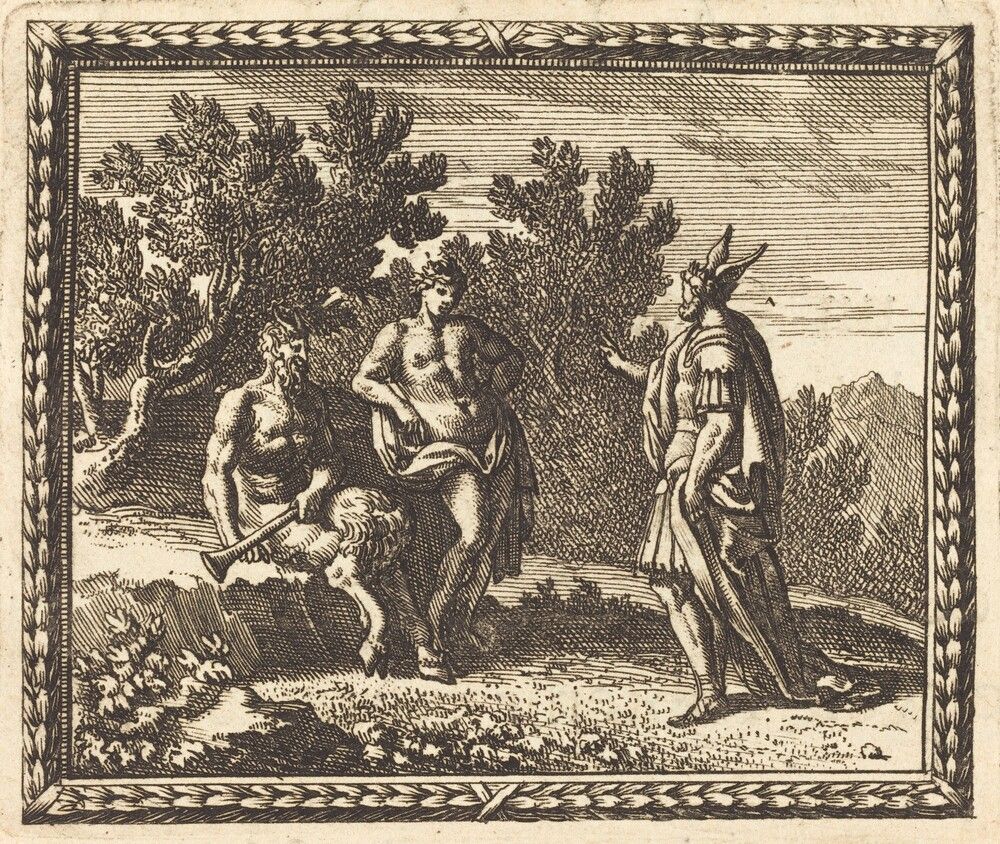
Midas with Apollo and Pan - Jean Lepautre, published 1676, etching and engraving on laid paper
National Gallery of Art, Washington, DC, 1988.49.4. CC0
Also Connected
4 recorded connections, each with the ancient line behind it.
Connected
-

In Ovid's Metamorphoses, Apollo gives Midas the ears of an ass after Midas alone calls the verdict of the music contest on Mount Tmolus unjust.
-

In Ovid's Metamorphoses, Dionysus rewards Midas for returning Silenus by granting his wish that everything he touches turn to gold, then takes the gift back and sends him to wash in the river near Sardis.
-

Ovid's Metamorphoses says Orpheus, with Eumolpus, taught Midas the Bacchic rites, which is how Midas recognizes Silenus when the Phrygians bring him in.
-

In Ovid's Metamorphoses, Midas follows Pan into the woods after losing the golden touch and is the only listener to prefer Pan's reed pipe to Apollo's lyre.
Where Accounts Differ
- Pan or Marsyas in the musical contest
- how Silenus was caught
- a servant or a barber who told the reeds
- which story comes first
- how Midas died
- son of Gordias or of the Mother goddess
- the daughter turned to gold
- The musical contest differs by source. Ovid (Metamorphoses 11.146-179) has Pan play against Apollo, with Tmolus as judge and Midas alone objecting to the verdict. Hyginus (Fabulae 191) names Apollo's rival as Marsyas or Pan, and has Midas say the prize should have gone to Marsyas.
- The sources disagree on how Silenus came to Midas. In Ovid (Metamorphoses 11.89-99) Phrygian countryfolk catch him drunk and bring him to the king. Xenophon's Anabasis (at Thymbrium) and Pausanias (1.4.5, at Ancyra) say Midas caught him by mixing wine into a spring. Herodotus (8.138) says the Macedonians placed the capture in the garden of Midas, without a method. In Hyginus (Fabulae 191) Silenus strays from Dionysus's army and Midas simply hosts him.
- Ovid (Metamorphoses 11.180-193) calls the man who gave away the secret a servant (famulus) who used to cut the king's hair; the barber of modern retellings is this servant. Hyginus (Fabulae 191) mentions the ass's ears but not the servant or the reeds.
- Ovid tells the golden touch first and the ass's ears second; Hyginus (Fabulae 191) tells the ears first.
- The death of Midas is disputed. Aristotle's Politics cites the legend that he died of hunger when his food turned to gold. Strabo's Geography, in its first book, reports that he died by drinking bull's blood during the Cimmerian invasion of Phrygia. Plutarch's On Superstition makes the bull's blood a suicide after troubling dreams. Ovid and Hyginus tell no death.
- His parentage differs. Herodotus (1.14, 8.138) and Pausanias (1.4.5) call him the son of Gordias or Gordius; Hyginus (Fabulae 191) calls him the son of the Mother goddess.
- No ancient source gives Midas a daughter turned to gold. Ovid (Metamorphoses 11.106-130) and Hyginus (Fabulae 191) turn only objects and food to gold. The daughter, Marygold, is Nathaniel Hawthorne's addition in A Wonder-Book for Girls and Boys (preface dated 1851), and his narrator says so.
Read the full source verification →
Mythology
Appears In
Related Terms
Referenced By
Sources
- Ovid, Metamorphoses 11.85-145
- Ovid, Metamorphoses 11.89-99
- Ovid, Metamorphoses 11.100-105
- Ovid, Metamorphoses 11.106-130
- Ovid, Metamorphoses 11.131-145
- Ovid, Metamorphoses 11.146-193
- Ovid, Metamorphoses 11.146-179
- Ovid, Metamorphoses 11.180-193
- Hyginus, Fabulae 191
- Herodotus, Histories 1.14
- Herodotus, Histories 1.35
- Herodotus, Histories 8.138
- Pausanias, Description of Greece 1.4.5