Cupid
Cupid is the Roman god of love and the son of Venus. Ovid has him wound Apollo with desire for Daphne (Metamorphoses 1.452-473), and Virgil has Venus send him, disguised as the boy Ascanius, to make Dido love Aeneas (Aeneid 1.657-694). Romans identified him with the Greek Eros, but Roman writers use him as Venus's instrument rather than as a primordial power.
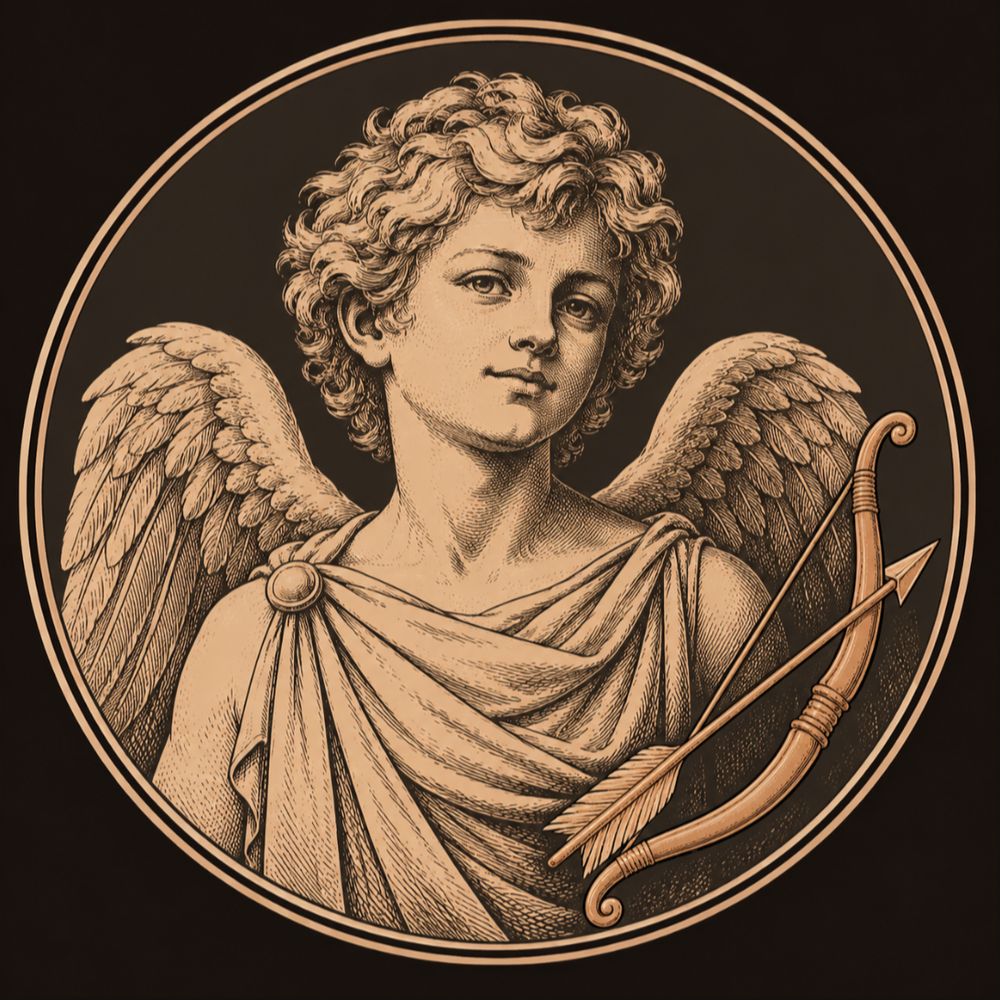
Cupid, bronze medallion illustration
Generated by AI from this page's own facts, not an ancient image or evidence of anything. How this site uses generated images
Sections on this page
Greek vs Roman: Eros vs. Cupid → See how Eros differs.
Core Myth
Roman poets know Cupid best as the son and agent of Venus. In Ovid's Metamorphoses he first appears in the story of Apollo and Daphne. Apollo, proud of killing the Python, mocks the boy for handling a bow, and tells him to be content with the flames his torch kindles (Metamorphoses 1.454-462). Venus's son answers that Apollo's arrows can pierce every creature, but his own will pierce Apollo (Metamorphoses 1.463-465). He then shoots the god with an arrow that causes love and the nymph Daphne with one that repels it (Metamorphoses 1.466-473).
Virgil gives Cupid a different task in the Aeneid. Venus fears Juno and Dido's court, so she asks her son to take the shape of Ascanius and inflame the queen of Carthage with a fatal fire (Aeneid 1.657-688). She calls Aeneas his brother, and she tells him to sit in disguise on Dido's lap during the banquet (Aeneid 1.667-668, 1.715-719). Dido, who does not know which god she holds, begins to burn (Aeneid 1.717-722).
Ovid uses him again in the Metamorphoses. Venus complains that Pluto alone in the three realms has escaped her power. She tells Cupid to strike the king of the dead so that he will love Proserpina, and Cupid does so (Metamorphoses 5.363-384). In Ovid's telling, the god of love is the first cause of the abduction.
Are Cupid and Eros the same?
Romans treated them as one god under two names, but the sources differ. Hesiod counts Eros among the first beings, fairest of the deathless gods (Theogony 116-122). Roman poets almost always make Cupid Venus's son, as in Virgil's Aeneid (1.664-668) and Ovid's Metamorphoses (1.463). Cicero even lists three separate Cupids (De Natura Deorum 3.60). The two are compared in Eros vs Cupid.
Cicero, De Natura Deorum 3.60
Who are Cupid's parents?
Venus is his mother in every Roman poet cited here: Virgil has her call him her son (Aeneid 1.664-668), and Ovid calls him her son (Metamorphoses 1.463). No poet named here gives him a father. Cicero lists three Cupids and names their fathers as Mercury for the first two and Mars for the third (De Natura Deorum 3.60), so the answer depends on which Cupid is meant.
Cicero, De Natura Deorum 3.60
Why did Cupid shoot Apollo?
Ovid says it was revenge for an insult. Apollo, proud of killing the Python, mocked Cupid's small bow and told him to keep to the flames of his torch (Metamorphoses 1.454-462). Cupid replied that his arrow would strike Apollo, then shot him with love for Daphne and Daphne with a shaft that made her flee (Metamorphoses 1.463-473).
Ovid, Metamorphoses 1.452-473
Did Cupid make Dido fall in love with Aeneas?
In Virgil's Aeneid, yes. Venus asks Cupid to take the shape of Ascanius so that Dido will love Aeneas, and he does (Aeneid 1.657-688). Dido holds the disguised god in her lap without knowing him, and Cupid begins to erase her old love for Sychaeus (Aeneid 1.717-722). Juno's opposition is the reason Venus acts.
Virgil, Aeneid 1.657-722
Who did Cupid fall in love with?
Psyche, in Apuleius. Venus sends Cupid to make the mortal Psyche love a low man, but he falls for her himself (Metamorphoses 4.28-31). He visits her at night, flees when a drop of lamp oil burns him (Metamorphoses 5.22-23), and after her trials Jupiter approves their marriage (Metamorphoses 6.23-24). The Greek form of the story appears on the Eros and Psyche page.
Apuleius, Metamorphoses 6.23-24
Later Traditions
Apuleius made Cupid the hero of a full tale in the Metamorphoses. Venus is jealous of the mortal Psyche's beauty and sends her son to make Psyche love an unworthy man, but Cupid himself falls in love with her (Metamorphoses 4.28-31). He visits her only in the dark, and when Psyche lights a lamp to see him, a drop of oil burns him and he flies away (Metamorphoses 5.22-23). After Psyche's trials, Jupiter agrees to their marriage and the gods celebrate it (Metamorphoses 6.23-24). The story is told on this site as Eros and Psyche.
Roman scholars also debated who Cupid was. Cicero lists three Cupids, the first the son of Mercury and the first Diana, the second of Mercury and a Venus, and the third of Mars and a Venus, who is Anteros (De Natura Deorum 3.60). He also names Cupid among the qualities Romans consecrated, together with Voluptas and Lubentine Venus (De Natura Deorum 2.61). The bow and arrows he carries are the same bow and arrow that Greek writers give to Eros.
Lineage
See the full family tree1 recorded relation, each with the ancient line behind it.
Parents
-

Virgil has Venus address Cupid as her son and ask him to help his brother Aeneas.
Also Connected
5 recorded connections, each with the ancient line behind it.
Connected
-
Venus calls Aeneas Cupid's brother and sends Cupid, disguised as Ascanius, to make Dido love him.
-

Ovid has Cupid answer Apollo's mockery by shooting him with an arrow that causes love for Daphne.
-

Cupid wounds Daphne with the arrow that repels love, so that she flees Apollo.
-

At Venus's order Cupid shoots the king of the dead so that he will love Proserpina.
-

Ovid makes Cupid's arrow the first cause of Proserpina's abduction.
Where Accounts Differ
- who Cupid's parents are
- whether Cupid is one god or several
- Cupid's parentage is not settled. Virgil and Ovid make him Venus's son and name no father (Aeneid 1.664-668; Metamorphoses 1.463). Cicero, reporting older Greek and Roman lists, gives three Cupids: a son of Mercury and the first Diana, a son of Mercury and a Venus, and a son of Mars and a Venus called Anteros (De Natura Deorum 3.60).
- Cupid's role differs by author. Ovid makes him a vengeful archer who punishes Apollo (Metamorphoses 1.452-473) and the agent of the abduction of Proserpina (Metamorphoses 5.363-384). Virgil uses him in disguise (Aeneid 1.657-688), and Apuleius makes him a lover who suffers a wound himself (Metamorphoses 5.22-23).
Read the full source verification →
Mythology
Appears In
Equivalent Figures
Related Terms
Referenced By
Sources
- Ovid, Metamorphoses 1.452-473
- Ovid, Metamorphoses 5.363-384
- Virgil, Aeneid 1.657-722
- Apuleius, Metamorphoses 4.28-31
- Apuleius, Metamorphoses 5.22-23
- Apuleius, Metamorphoses 6.23-24
- Cicero, De Natura Deorum 2.61
- Cicero, De Natura Deorum 3.60
- Hesiod, Theogony 116-122