Antigone
Antigone is a Theban princess, the daughter of Oedipus and his own mother Jocasta. She is famous for burying her brother Polynices after King Creon forbade anyone to do so. In Sophocles's Antigone she is shut alive in a rock tomb and hangs herself there. Other ancient versions differ: Euripides sends her into exile with her blind father, and Hyginus has Haemon hide her for years.
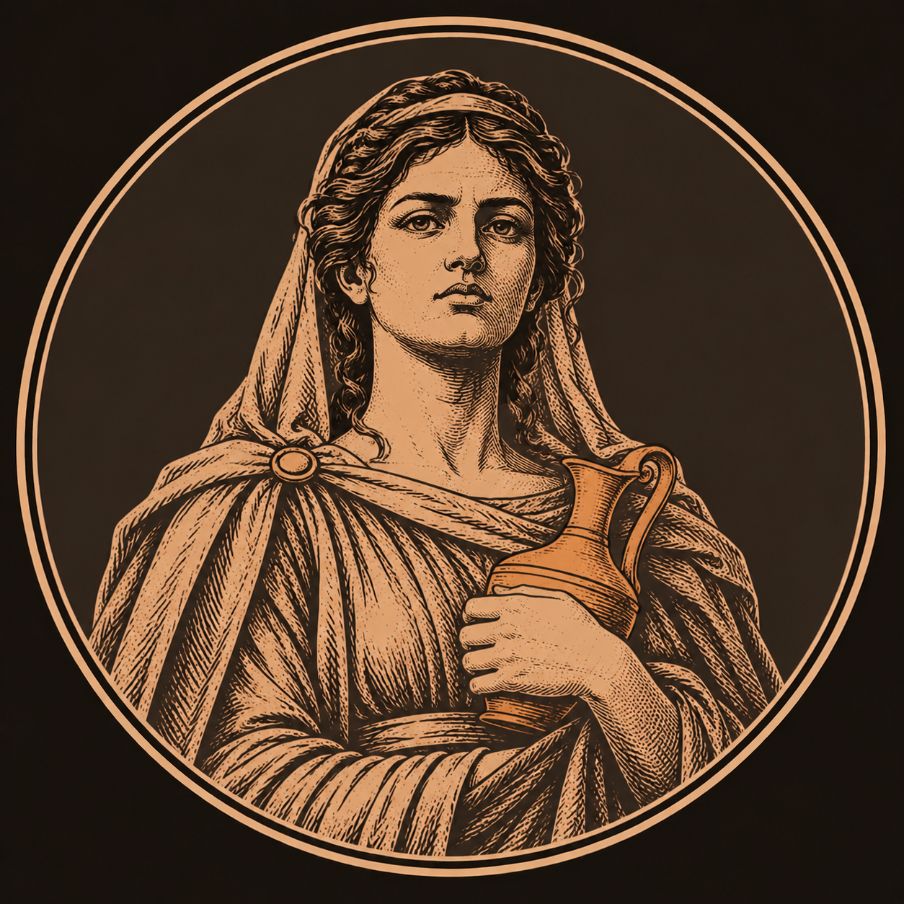
Antigone, bronze medallion illustration
Generated by AI from this page's own facts, not an ancient image or evidence of anything. How this site uses generated images
Sections on this page
See Antigone in the Greek family tree.
Core Myth
Antigone was born into the doomed house of Labdacus. Her father Oedipus had won the throne of Thebes by answering the riddle of the Sphinx and marrying the widowed queen, not knowing she was his mother. In Euripides's Phoenissae, Jocasta names their four children: Eteocles, Polynices, Ismene, and Antigone, the elder daughter. Apollodorus gives the same four. When the truth came out, Oedipus blinded himself and left Thebes. Sophocles's Oedipus at Colonus opens with the blind king calling on Antigone to tell him where they have come. He says she has been his guide ever since she was grown, often hungry and barefoot in the wild. At Colonus near Athens she persuades her father to hear her brother Polynices. She then begs Polynices to turn his army back from Thebes. He refuses, and asks his sisters to give him burial if their father's curse comes true. After Oedipus dies, Antigone asks to be sent home to Thebes to stop her brothers killing each other. They die by each other's hands in the war told in Seven Against Thebes.
Sophocles's Antigone begins the morning after the battle. Creon, now king, has ordered that Eteocles be buried with honor and Polynices left for the birds and dogs. The penalty is death. Antigone asks her sister Ismene to help and is refused. She scatters dust on the body alone. When the guards clear it away, she returns, pours three libations, and is caught. Before Creon she defends herself with the play's most quoted argument. His edict did not come from Zeus, she says, and no mortal decree can override the unwritten laws of the gods. Creon sentences her to be walled up alive in a rocky vault, left to pray to Hades, the only god she honors. His son Haemon, her betrothed, warns that the city quietly praises her. The seer Tiresias then tells Creon that the Furies lie in wait for him for keeping a corpse from the gods below.
Creon gives in too late. As he hurries off, the chorus calls on Dionysus, the god of Thebes, to come and heal the city. Creon buries Polynices first, then opens the tomb to find Antigone hanged in a linen noose. Haemon, clinging to her body, lunges at his father with his sword, misses, and kills himself. Creon's wife Eurydice then takes her own life, cursing her husband. The play's last lines warn that the great words of proud men are repaid with great blows, a closing judgment on Creon's hubris rather than on Antigone.
Is Antigone the daughter of Oedipus?
Yes. Sophocles, Euripides, and Apollodorus all make Antigone the daughter of Oedipus, king of Thebes. They also make her mother Jocasta, who was Oedipus's own mother. That makes Antigone both his daughter and his half-sister, a fact she laments in Sophocles's play. Pausanias records a different view. He doubted that Jocasta bore Oedipus any children at all. Citing the lost epic Oedipodia, he names the mother of all four children as Euryganeia, daughter of Hyperphas.
Apollodorus, Library 3.5.8
What is the main story of Antigone?
After her brothers Eteocles and Polynices killed each other in the war over Thebes, their uncle Creon became king. He ordered Eteocles buried with honor and Polynices left unburied as a traitor, on pain of death by stoning. Antigone refused to obey. She covered her brother's body with dust and poured libations, was caught, and told Creon that his decree could not override the unwritten laws of the gods. Creon condemned her to be shut alive in a rock tomb, and his decision destroyed his own family.
Sophocles, Antigone 21-38
What happened to Antigone at the end?
In Sophocles's play, Antigone hangs herself with a linen noose inside the tomb where Creon walled her up. Creon, warned by the seer Tiresias, arrives too late. His son Haemon, her betrothed, is found embracing her body. He draws his sword on his father, misses, and kills himself beside her. Apollodorus says only that she was buried alive. Euripides's Phoenissae ends differently, with Antigone leaving Thebes to share her blind father's exile.
Sophocles, Antigone 1192-1240
Did Antigone marry her cousin?
Haemon was her cousin, since his father Creon was Jocasta's brother. In Sophocles she is only betrothed to him, and they are joined in death rather than marriage. Other versions let the marriage happen. An ancient summary of Sophocles's play reports that in Euripides's lost Antigone she was given to Haemon in marriage and bore a son, Maion. Hyginus's Fabulae also has Haemon save her, live with her secretly, and father a son, before Creon discovers them and Haemon kills her and himself.
Hyginus, Fabulae 72
What is Antigone's tragic flaw?
Sophocles never labels a single flaw, and readers have argued about it for centuries. The chorus comes closest. It tells Antigone that she has rushed to the far limits of daring, that she is paying for her father's crime, and that her own self-willed temper has destroyed her. Yet the same play ends by condemning Creon's arrogance, not hers. Tiresias and the gods side with the burial, and the chorus's final lesson is aimed at the proud words of the king.
Sophocles, Antigone 853-875
Later Traditions
The ancient accounts do not agree on how Antigone's story ended. Aeschylus's Seven Against Thebes closes with a herald announcing that Polynices must lie unburied, and Antigone answering that she will bury him herself. The chorus splits in two, half following her. Many scholars have argued that this final scene was added to the play after Aeschylus's death, and the debate is not settled. Euripides's Phoenissae tells the story differently again. There Oedipus is still in Thebes when his sons die. Creon forbids Polynices's burial and orders Antigone to marry Haemon. She threatens to kill Haemon on the wedding night like a Danaid bride, and chooses exile as her blind father's guide instead. Oedipus recalls an oracle of Apollo that he will die at Colonus near Athens. In her last lines Antigone still vows to bury her brother secretly, even at the cost of her life, yet leaves Thebes with her father.
Euripides also wrote an Antigone, now lost except for fragments. An ancient summary attached to Sophocles's play reports that in Euripides's version she was caught together with Haemon, given to him in marriage, and bore a son, Maion. Hyginus's Fabulae tells a darker tale. Antigone and Polynices's widow Argia secretly place his body on Eteocles's pyre. Creon hands Antigone to Haemon to be killed, but Haemon hides her among shepherds. Years later their son comes to Thebes for the games. Creon recognizes him by the birthmark shared by all descendants of the dragon's teeth sown by Cadmus. Heracles pleads for mercy, but Creon refuses, and Haemon kills Antigone and himself. Pausanias saw a spot near Thebes that locals called the Dragging of Antigone. There, they said, she hauled her brother's body onto Eteocles's burning pyre because she could not lift it.
Modern Influence
Antigone became one of the most discussed figures in European thought. Hegel took the clash between Antigone and Creon as his model of tragedy: two ethical claims, the family and the state, each justified and each one-sided. In occupied Paris, Jean Anouilh's Antigone opened at the Théâtre de l'Atelier in February 1944, staged under Nazi censorship. Bertolt Brecht adapted Friedrich Hölderlin's German translation of Sophocles. His version was first performed in Chur, Switzerland, in 1948, with Helene Weigel as Antigone. The play's central question, whether a law of the state can bind against the claims of the underworld and the gods, keeps it in constant modern performance.
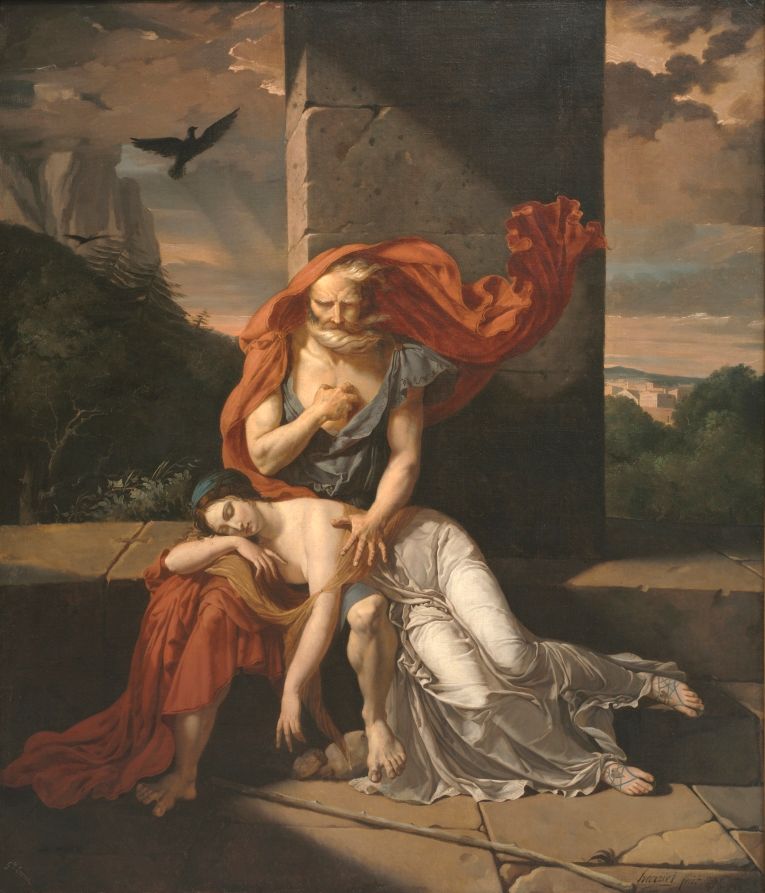
Oedipus at Colonus - France, 1798, oil on canvas
The Cleveland Museum of Art, Cleveland, OH, 2002.3. CC0
Lineage
See the full family tree1 recorded relation, each with the ancient line behind it.
Parents
-
Apollodorus names Antigone and Ismene as daughters of Oedipus; Pausanias gives their mother as Euryganeia rather than Jocasta.
Where Accounts Differ
- Antigone's mother
- how Antigone buried Polynices
- who was left unburied
- how Antigone died
- source of Hyginus's version
- authenticity of the Seven Against Thebes ending
- when Antigone left Thebes with Oedipus
- Antigone's mother is Jocasta in Sophocles, in Euripides's Phoenissae, and in Apollodorus's Library. Pausanias disagrees: citing the epic Oedipodia, he names the mother of Oedipus's four children as Euryganeia, daughter of Hyperphas.
- How Antigone buried Polynices differs by source. Sophocles has her sprinkle dust and pour libations over the body. Hyginus has her and Argia place it on Eteocles's pyre by night, and Pausanias records a Theban spot called the Dragging of Antigone, where she hauled the body onto that pyre.
- Sophocles's Creon forbids burial to Polynices alone. Apollodorus says Creon cast out all the Argive dead unburied and set watchmen over them.
- Her death is told four ways. Sophocles has her hang herself in the tomb. Apollodorus says only that she was buried alive. Hyginus has Haemon hide her for years and finally kill her and himself. An ancient summary of Sophocles's play says that in Euripides's lost Antigone she married Haemon and bore a son, Maion.
- Whether Hyginus's tale reflects Euripides's lost Antigone is disputed. Welcker identified the two; Jebb, following Heydemann, argued that the ancient summary puts the marriage at the end of Euripides's play, so Hyginus must be summarizing some other, unknown tragedy.
- The closing scene of Aeschylus's Seven Against Thebes, where Antigone vows to bury Polynices against the herald's decree, is widely suspected of being a later addition to the play. Some scholars have defended it, and the question remains open.
- Sophocles's Oedipus at Colonus has Oedipus die at Colonus before his sons' war, with Antigone returning to Thebes afterward. Euripides's Phoenissae keeps Oedipus in Thebes through the war and ends with Antigone leading him into exile toward Colonus, while still vowing to bury Polynices in secret.
Read the full source verification →
Mythology
Appears In
Related Terms
Referenced By
Sources
- Sophocles, Antigone 21-38
- Sophocles, Antigone 192-206
- Sophocles, Antigone 407-440
- Sophocles, Antigone 450-470
- Sophocles, Antigone 692-700
- Sophocles, Antigone 773-780
- Sophocles, Antigone 853-875
- Sophocles, Antigone 1064-1076
- Sophocles, Antigone 1115-1125
- Sophocles, Antigone 1192-1240
- Sophocles, Antigone 1301-1305
- Sophocles, Antigone 1348-1353
- Sophocles, Oedipus at Colonus 345-352
- Sophocles, Oedipus at Colonus 1181-1189
- Sophocles, Oedipus at Colonus 1405-1413
- Sophocles, Oedipus at Colonus 1414-1446
- Sophocles, Oedipus at Colonus 1768-1772
- Aeschylus, Seven Against Thebes 1005-1025
- Aeschylus, Seven Against Thebes 1026-1053
- Aeschylus, Seven Against Thebes 1054-1078
- Euripides, Phoenissae 55
- Euripides, Phoenissae 1625-1682
- Euripides, Phoenissae 1683-1707
- Euripides, Phoenissae 1710-1766
- Apollodorus, Library 3.5.8
- Apollodorus, Library 3.5.9
- Apollodorus, Library 3.7.1
- Pausanias, Description of Greece 9.5.10-9.5.11
- Pausanias, Description of Greece 9.25.2
- Hyginus, Fabulae 72
- Richard C. Jebb, commentary on Sophocles, Antigone, Introduction section 16 (Perseus Digital Library)
- James George Frazer, notes to Apollodorus, The Library 3.7.1 (1921)
- A. L. Brown, "The End of the Seven Against Thebes," Classical Quarterly 26.2 (1976)
- Stanford Encyclopedia of Philosophy, "Hegel's Aesthetics"