Iphigenia in Aulis
Iphigenia in Aulis is the episode in which the Greek fleet, held in port by contrary winds, is told it cannot sail for Troy until Agamemnon offers his daughter to Artemis. He lures her to the camp with a false wedding to Achilles. Euripides has her accept the altar, and his ending replaces her with a deer.
Sections on this page
What Led To It
The episode belongs to the run-up to the Trojan War. The Greek kings have gathered to win back Helen for Menelaus, and Aulis is where the whole army waits. Agamemnon commands it. He belongs to the House of Atreus, and the family's later history makes Aulis the place where his own killing is first explained.
The Myth
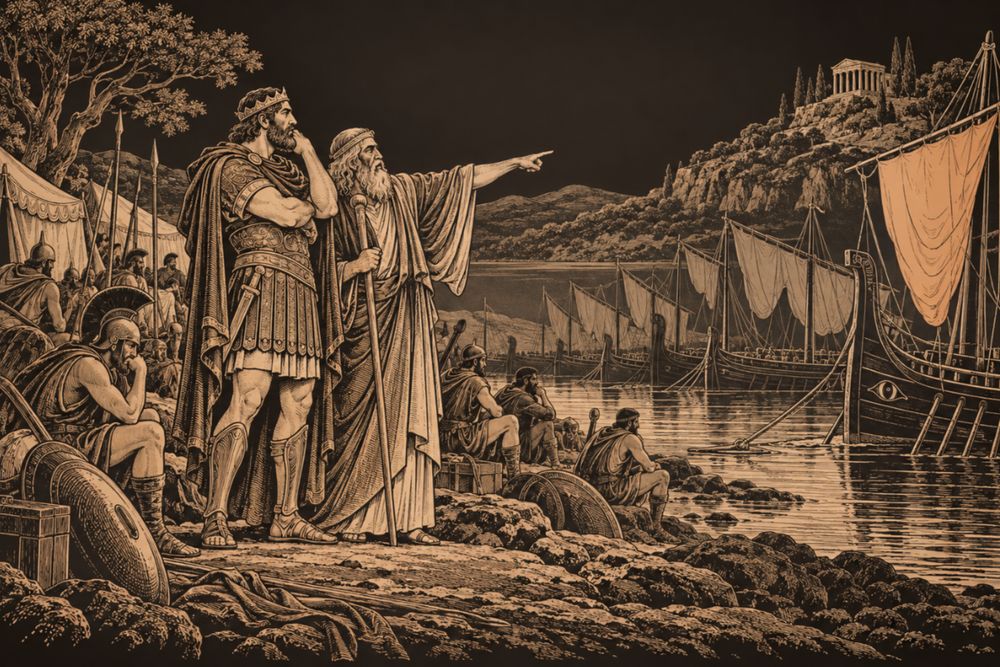
The becalmed fleet at Aulis
Generated by AI from this page's own facts, not an ancient image or evidence of anything. How this site uses generated images
The fleet is already at Aulis, and it cannot leave. Aeschylus puts the harbour on the shore across from Chalcis, where the tides surge to and fro. Apollodorus's Epitome says this was the second gathering there. At the first, a serpent ate a nest of sparrows and turned to stone. Calchas read it as a sign that Troy would fall in ten years. The Greeks then landed in Mysia by mistake. They found the course to Troy only after Achilles healed Telephus, who had been wounded there.
Now the winds hold them. The chorus in Aeschylus's Agamemnon says the breezes from the Strymon bring harmful leisure, hunger and idle wandering. They spare neither ship nor cable, and they wither the flower of Argos. In Ovid's Metamorphoses some declare that Neptune is helping Troy because he built its walls. Calchas knows better.
Calchas names a different cause, and Agamemnon himself reports it in Euripides. Weatherbound at Aulis, the army asks the seer, who answers that they will sail and sack the Phrygian capital only if Iphigenia is sacrificed to Artemis. Agamemnon first orders the herald Talthybius to disband the whole army. His brother Menelaus then argues him round.
The sources disagree about what angered Artemis. Apollodorus says Agamemnon shot a deer and boasted that Artemis herself could not have done it better. He adds that Atreus never sacrificed the golden lamb to her. Aeschylus gives the chorus an omen instead: two eagles feeding on a pregnant hare. The chorus prays that Artemis will not raise adverse gales to hold the fleet back. The reasons vary. The demand does not.
It is a hard fate to refuse obedience, and hard, if I must slay my child, the glory of my home, and at the altar-side stain a father’s hand with streams of virgin’s blood. Which of these courses is not filled with evil? How can I become a deserter to my fleet and fail my allies in arms? For that they should with all too impassioned passion crave a sacrifice to lull the winds - even a virgin’s blood - stands within their right. May all be for the best.
In Euripides's play the plan needs a lie. Agamemnon writes to his wife, telling her to send their daughter to marry Achilles. He calls it, in his own words, a sham marriage for the maiden. Only four men in the army know the truth: Calchas, Odysseus, Menelaus and Agamemnon. Apollodorus keeps the trick but has Odysseus and Talthybius carry the request to Clytemnestra.
Agamemnon soon regrets it. In the play he sends a second letter forbidding the journey, entrusted to an old servant. Menelaus stops the man and takes the letter. He then confronts his brother over it. By then the first letter has done its work, and the girl is on the road to the camp.
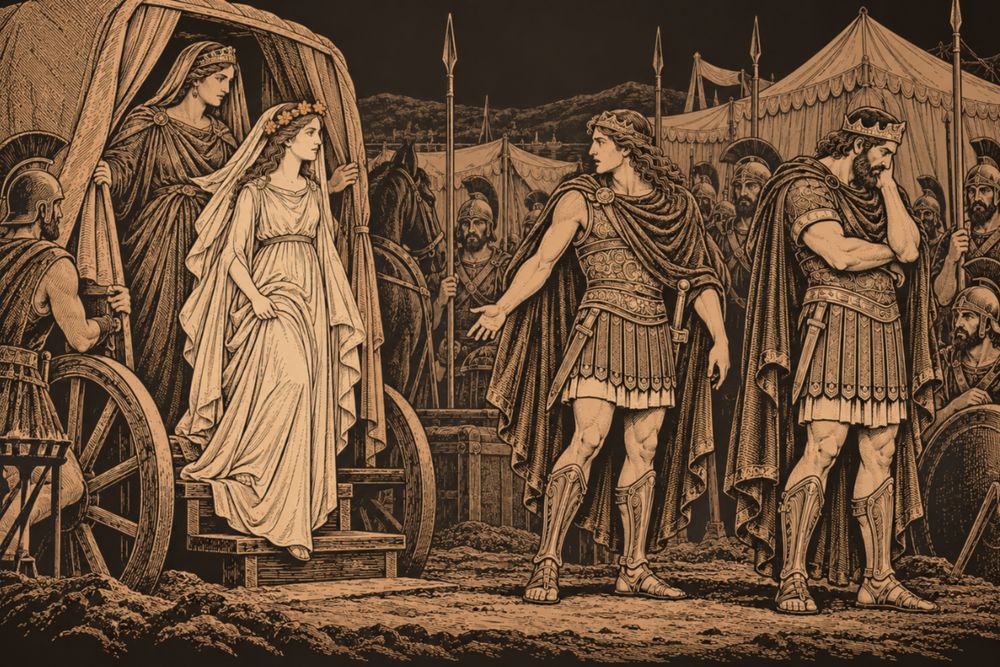
Iphigenia arrives at the camp
Generated by AI from this page's own facts, not an ancient image or evidence of anything. How this site uses generated images
Clytemnestra reaches the camp with her daughter and meets Achilles before she meets her husband. She offers him her hand as a prelude to a happy marriage. He recoils. He has never courted her daughter, he says, and the sons of Atreus never mentioned marriage to him. Both see that someone has made fools of them.
Then an old servant calls them back and tells her the truth. Her husband is about to offer their child to Artemis so the army can start for Troy and Menelaus can recover Helen. Clytemnestra kneels to Achilles. His name was the bait, she says, and he is bound to stand by it.
Achilles answers with anger and a promise. Her daughter, once called his bride, will not die by her father's hand, he says, because his name would be what killed her. He swears by Nereus that Agamemnon will not touch even her robe with a fingertip. Perseus's translation carries an editor's note doubting that this speech is all Euripides's own.
The promise is soon tested. Achilles comes back to report an uproar in the army. He was nearly stoned for trying to save her, he says, and his own Myrmidons turned on him first. They taunted him as a man enslaved by marriage. He tells Clytemnestra to keep hold of her daughter. Odysseus, he says, will lead the men who come for her, and he means to hold them back.
Iphigenia ends the argument herself. She does not want a man to die for her. Hellas looks to her, she tells her mother, and the passage over the sea and the fall of Troy depend on her. If Artemis has decided to take her body, she asks, how can a mortal thwart the goddess? Achilles calls it a noble resolve and says he still wishes he could have won her. He will place his arms by the altar and wait for her there. Dindorf thought the whole passage from line 1408 spurious, a view the Perseus notes record.
She then says her farewells. She tells Clytemnestra not to cut her hair or wear mourning and to rear Orestes to manhood. She asks her not to hate her father. Then she goes to the grove of Artemis.
What happens at the altar depends on who tells it. Aeschylus's chorus describes only the preparation. The men lay hold of her as if she were a young goat and lift her high above the altar. A gag holds back the shouted curse against her house. Then the chorus breaks off: "What happened next I did not see and do not tell." It adds that the art of Calchas was not unfulfilled.
Euripides's messenger gives Clytemnestra a fuller and stranger report. Iphigenia says she offers her body willingly for all Hellas, and asks that none of the Argives lay hands on her. Agamemnon hides his face in his robe. Calchas lays a sword in a golden basket and crowns her head. In the messenger's telling Achilles then takes the basket and lustral water and runs round the altar, praying to Artemis for safe sailing. The speech does not explain why he no longer resists.
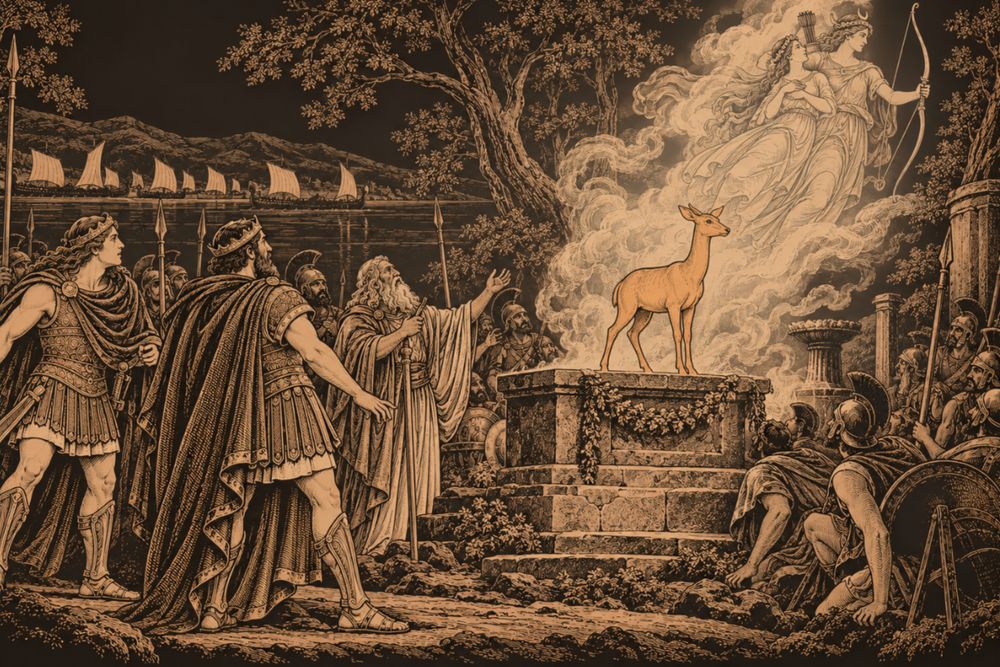
The deer on the altar
Generated by AI from this page's own facts, not an ancient image or evidence of anything. How this site uses generated images
Then, in the speech, comes the substitution. Everyone hears the sound of a blow, but no one sees where the maiden vanished. On the ground lies a deer of immense size, gasping out her life. Calchas says the goddess has put it before her altar in place of the girl. The fleet may sail. The messenger tells Clytemnestra that her daughter flew away to the gods and that this day has seen her "dead and living." Perseus prints this whole passage, from line 1578, in square brackets, because many scholars doubt it is Euripides's own.
Other accounts agree on the deer. Ovid says Diana spread a mist before their eyes and left a hind in the maiden's place. Apollodorus says Artemis carried her off to the Taurians and made her a priestess, though some said she made her immortal. J. G. Frazer's note adds that Dictys Cretensis has Achilles rescue her from the altar instead.
What Followed
The fleet sails in every version. What follows for Iphigenia depends on the source. In Aeschylus she is treated as dead, and Clytemnestra later says her husband sacrificed the child she bore, to charm the blasts of Thrace. In Euripides's Iphigenia in Tauris, the goddess gave the Greeks a deer and made her priestess among the Taurians.
Afterlife and Modern Influence
Roman poets kept the episode as a warning. Lucretius, in the first book of On the Nature of Things, places the sacrifice at Aulis at the head of his examples of the wrongs done in the name of religion. He calls the girl Iphianassa. He writes that she was led to the altar not to the wedding hymn but to fall as a victim on her wedding day, so the fleet might have a lucky departure. His verdict closes the passage: religion could persuade to such evils.
What is the story of Iphigenia in Aulis?
A becalmed Greek fleet is told it cannot sail for Troy until Agamemnon offers his daughter to Artemis. He summons her with a false promise of marriage to Achilles. The sources then split. Aeschylus's chorus leaves her at the altar. Euripides and Apollodorus say Artemis put a deer in her place. Apollodorus adds that the goddess made her a priestess of the Taurians.
Apollodorus, Epitome 3.22
Can you summarize the story of Iphigenia at Aulis?
In Euripides's play Agamemnon lures Iphigenia and Clytemnestra to the camp with a sham marriage. Menelaus seizes the letter that would have warned them. Achilles vows to protect the girl, but the army turns on him. Iphigenia chooses the altar for the sake of Hellas. The messenger's speech that closes the play, whose authenticity is disputed, says a deer lay on the altar in her place.
Euripides, Iphigenia at Aulis 87-110
Did Achilles try to save Iphigenia?
In Euripides he does. He swears that Agamemnon will not touch her, and he is nearly stoned by the army for it. He offers to fight for her. Iphigenia refuses his help, and the messenger later has him at the altar. Frazer notes that Dictys Cretensis has Achilles rescue her from the altar.
Euripides, Iphigenia at Aulis 1338-1367
What is Aulis in Greek mythology?
Aulis is the harbour on the Boeotian shore across from Chalcis where the Greek fleet gathered for Troy. It is the setting for two omens. Calchas read a serpent eating a nest of sparrows as a sign that Troy would fall in ten years. Later, contrary winds held the fleet there until Iphigenia was offered to Artemis.
Aeschylus, Agamemnon 184-247
What is the myth of Iphigenia?
Iphigenia is the daughter of Agamemnon and Clytemnestra, offered to Artemis at Aulis so the Greek fleet could sail for Troy. Some tellings end at the altar, others save her with a deer and send her to the Taurians. Her full profile, with the disputed endings, is on the Iphigenia page.
Euripides, Iphigenia in Tauris 1-41
What is the story of Iphigenia in Tauris about?
Iphigenia in Tauris is Euripides's play about what came after Aulis. Iphigenia is a priestess among the Taurians, where strangers are sacrificed. Her brother Orestes arrives to fetch the goddess's wooden image, and she recognises him. The Iphigenia page follows the play.
Apollodorus, Epitome 6.27
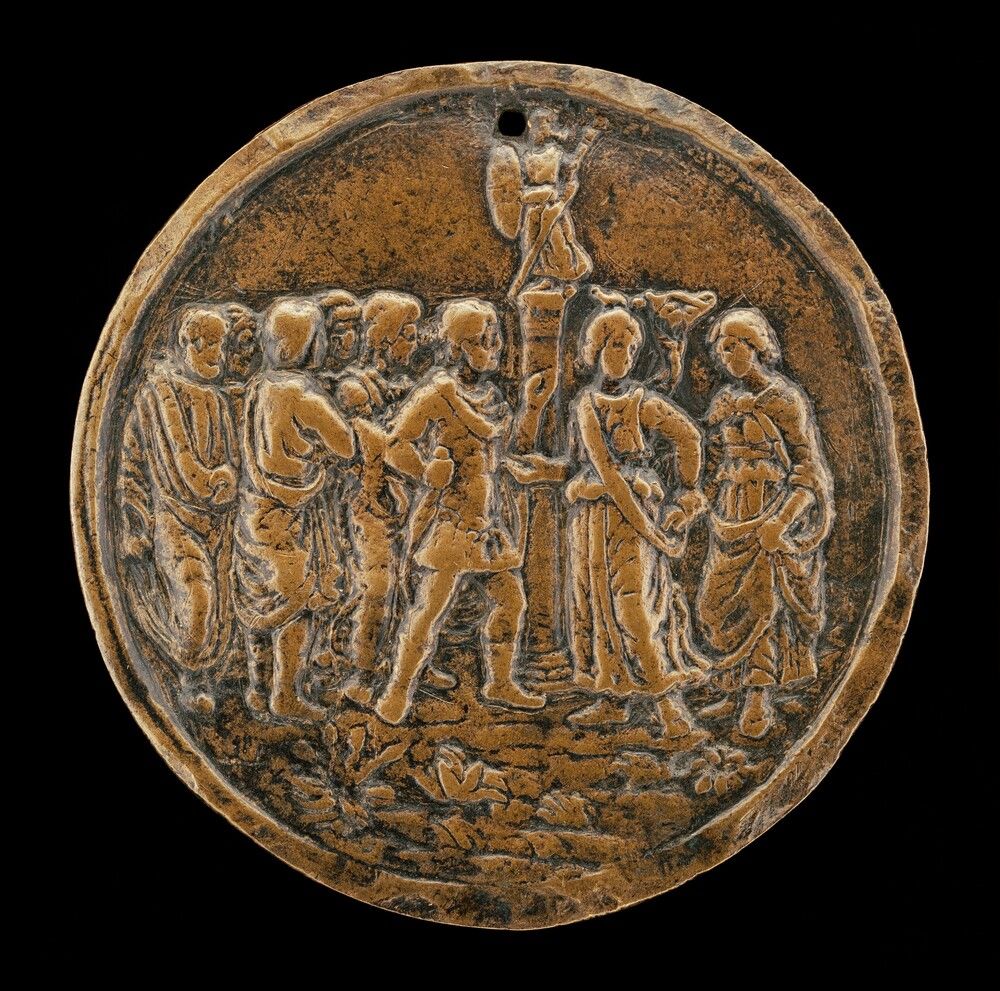
The Sacrifice of Iphigenia - Master of the Orpheus Legend, fourth quarter 15th century, bronze//Medium brown patina
National Gallery of Art, Washington, DC, 1957.14.231. CC0
Where Accounts Differ
- why-artemis-was-angry
- whether-iphigenia-died-at-aulis
- authenticity-of-the-euripides-ending
- achilles-role-at-the-altar
- who-fetched-iphigenia
- Artemis's grievance differs. Apollodorus, Epitome 3.21, gives Agamemnon's boast over a deer and Atreus's withheld golden lamb. Aeschylus, Agamemnon 134-155, gives the omen of the eagles and the pregnant hare. Euripides, Iphigenia in Tauris 1-41, gives Agamemnon's vow of the most beautiful creature born that year.
- The ending of Iphigenia at Aulis is doubted. The Perseus translation prints the messenger's account of the blow and the deer, from line 1578, in square brackets. The scene cannot be cited as certainly Euripides's own, though Apollodorus, Epitome 3.22, and Ovid, Metamorphoses 12.24-38, also give the deer.
- Whether she died is disputed. Aeschylus, Agamemnon 184-247, breaks off at the altar and later treats her as killed. Euripides, Iphigenia in Tauris 1-41, and Apollodorus, Epitome 3.22, replace her with a deer. Ovid, Metamorphoses 12.24-38, has the goddess spread a mist. Frazer's note to Epitome 3.22 says Dictys Cretensis has Achilles rescue her from the altar.
- The Cypria is reported only through Frazer's note to Apollodorus, Epitome 3.22, which says the epic, as summarized by Proclus, agrees on the deer. No line of the Cypria was checked here.
- Achilles's part is not fixed. In Euripides, Iphigenia at Aulis 919-974 and 1338-1367, he vows to defend her. In the messenger's speech, 1532-1577, he takes the basket and prays. The Perseus notes doubt parts of his speeches, including lines 1408-1433 and the speech beginning at 919.
- Who fetched her differs. Euripides, Iphigenia at Aulis 87-110, has Agamemnon write to Clytemnestra. Apollodorus, Epitome 3.22, has him send Odysseus and Talthybius to ask for her.
- Lucretius is outside this site's source registry. The passage was read in the Latin text served by Perseus at 1.80-101, and it names the girl Iphianassa at 1.85.
Read the full source verification →
Mythology
Figures In This Myth
Also Connected
Related Terms
Referenced By
Sources
- Aeschylus, Agamemnon 134-155
- Aeschylus, Agamemnon 184-247
- Aeschylus, Agamemnon 205-217
- Aeschylus, Agamemnon 1412-1425
- Euripides, Iphigenia at Aulis 87-110
- Euripides, Iphigenia at Aulis 358-380
- Euripides, Iphigenia at Aulis 819-860
- Euripides, Iphigenia at Aulis 861-918
- Euripides, Iphigenia at Aulis 919-974
- Euripides, Iphigenia at Aulis 1338-1367
- Euripides, Iphigenia at Aulis 1368-1432
- Euripides, Iphigenia at Aulis 1433-1467
- Euripides, Iphigenia at Aulis 1532-1577
- Euripides, Iphigenia at Aulis 1578-1612
- Euripides, Iphigenia in Tauris 1-41
- Apollodorus, Epitome 3.15
- Apollodorus, Epitome 3.17
- Apollodorus, Epitome 3.20
- Apollodorus, Epitome 3.21
- Apollodorus, Epitome 3.22
- Apollodorus, Epitome 6.26
- Apollodorus, Epitome 6.27
- Ovid, Metamorphoses 12.24-38
- Lucretius, On the Nature of Things 1.84-101
- J. G. Frazer, Apollodorus: The Library (Loeb, 1921), notes to Epitome 3.15-3.22 and 6.26-6.27