Persephone vs. Proserpina
What is the Roman name of Persephone? The Roman name of Persephone is Proserpina.
The Roman name of Persephone is Proserpina, whom Cicero equates with her (De Natura Deorum 2.66). Both are the grain goddess's daughter, seized by the god of the dead and returning for part of each year. In the Greek poem Zeus gives her to Hades and she spends a third of the year below. In Ovid, Cupid's arrow starts the abduction at Enna in Sicily and Jupiter halves the year.
Sections on this page

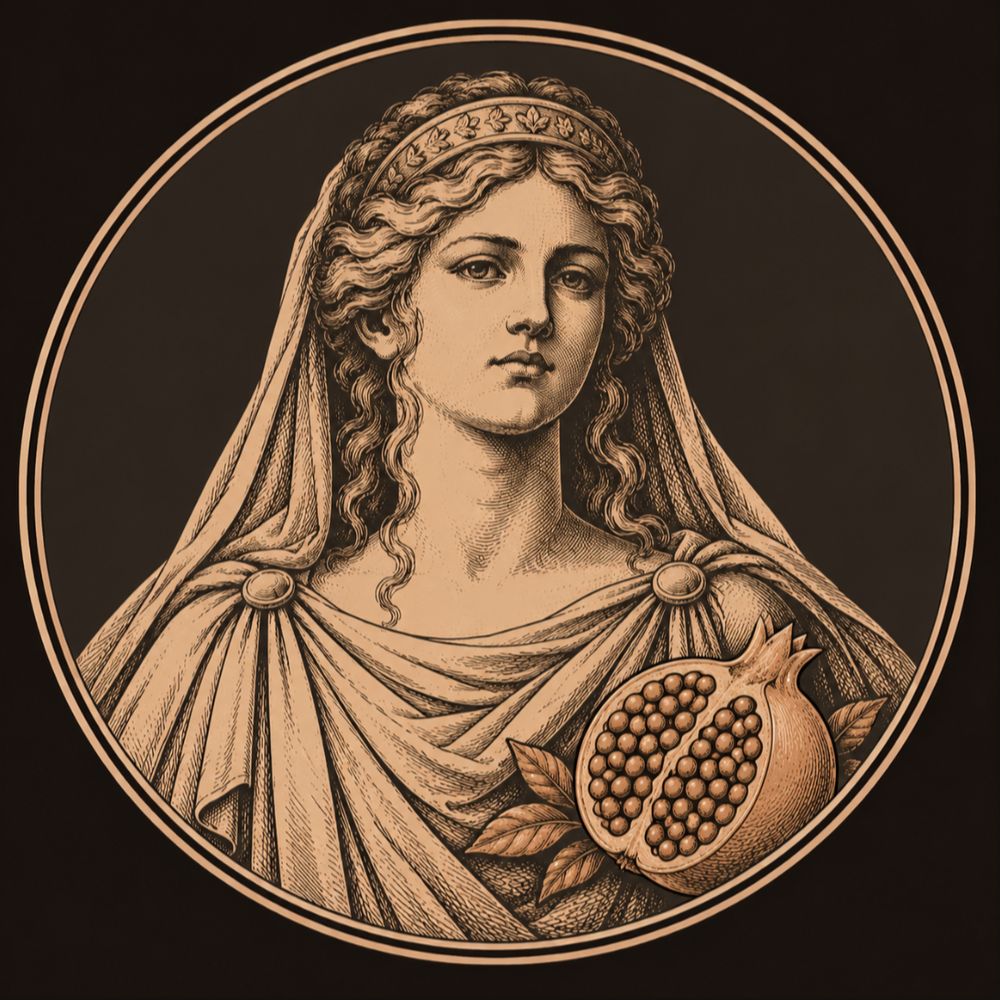
How They Compare
The Roman name carries the Greek story into Latin, and Ovid's version in the Metamorphoses is the fullest Latin telling. What Ovid changes tells you what a Roman poet wanted from the myth: a motive from love poetry, a Sicilian setting, and a legal settlement by Jupiter.
Side by Side
| Aspect | Persephone | Proserpina |
|---|---|---|
| Who sets the abduction off | In the Homeric Hymn to Demeter, Zeus has given the girl to Hades, her uncle, without asking Demeter. | In Ovid, Venus sends Cupid to shoot Pluto with desire, so the abduction begins as a goddess's plan. |
| Place | The hymn sets the seizure on the Nysian plain. | Ovid sets it near Enna in Sicily, and Cyane and Arethusa are drawn into the story. |
| Time below | A third of the year in the hymn, and two thirds with her mother and the gods. | Half the year in Ovid, when Jupiter divides the year equally between Pluto and Ceres. |
| Who tells of the pomegranate | Hades puts a pomegranate seed in her mouth as she leaves, and she says he forced it on her. | Ascalaphus reports that she picked a pomegranate and ate seven seeds in the garden of the dead. |
| Afterlife | Her return is tied to the Eleusinian Mysteries, whose rites Demeter establishes in the hymn (Homeric Hymn to Demeter 473-482). | Virgil ties her to the golden bough that Aeneas must carry to enter the underworld. |
Shared between both
- daughter of the grain goddess (Demeter or Ceres)
- seized by the king of the dead and made queen of the underworld
- eats pomegranate seeds, which bind her to the underworld
- returns to her mother for part of every year
What is the difference between Persephone and Proserpina?
The Romans treated them as one goddess. Proserpina is the Roman equivalent of Persephone, and Cicero equates Proserpine with Persephone (De Natura Deorum 2.66). The stories differ in where they begin and how they end. The Greek poem has Zeus give the girl to Hades and a third of the year below (Homeric Hymn to Demeter 1-3; 398-403). Proserpina in Ovid is abducted in Sicily because of Cupid's arrow and spends half the year below (Metamorphoses 5.363-384; 5.564-571).
Cicero, De Natura Deorum 2.66
Who kidnapped Persephone and Proserpina, and why?
The king of the dead, Hades in Greek and Pluto in Latin, takes her in both. The reasons differ. In the Greek poem, Zeus had given her to Hades (Homeric Hymn to Demeter 1-3). In Ovid, Venus complains that Pluto alone has escaped her power and sends Cupid to strike him with love (Metamorphoses 5.363-384). Persephone has the Greek version.
Ovid, Metamorphoses 5.363-384
How long does Persephone spend in the underworld compared with Proserpina?
The Greek poem says Persephone spends a third of the seasons each year below, and two parts with her mother (Homeric Hymn to Demeter 398-403). Ovid's Jupiter divides the year equally between his brother and his sister, so Proserpina spends half of it below (Metamorphoses 5.533-571).
Homeric Hymn to Demeter 398-403
Where was Proserpina taken from?
Ovid places the abduction near Enna in Sicily, where Proserpina is picking flowers by a lake (Metamorphoses 5.385-395). Pluto seizes her and carries her off through the earth while she calls for her mother (Metamorphoses 5.385-408). The Greek hymn sets the scene on the Nysian plain (Homeric Hymn to Demeter 5-20).
Ovid, Metamorphoses 5.385-395
Did Persephone eat the pomegranate willingly?
The sources disagree on how she came to eat it. In Ovid, Ascalaphus says he saw her pick a pomegranate from a bent branch and eat seven seeds (Metamorphoses 5.533-538). In the Homeric hymn, Persephone tells her mother that Hades secretly put a sweet pomegranate seed in her mouth and made her swallow it against her will (Homeric Hymn to Demeter 411-413).
Homeric Hymn to Demeter 411-413
Where Accounts Differ
- how long she stays below
- how she came to eat the pomegranate
- The length of the stay below differs. The Homeric hymn gives a third of the year (Homeric Hymn to Demeter 398-403). Ovid divides the year equally (Metamorphoses 5.533-571).
- The eating of the pomegranate is told two ways. In the hymn Hades forces the seed on her (Homeric Hymn to Demeter 411-413). In Ovid, Ascalaphus says she picked and ate it herself (Metamorphoses 5.533-538).
The Two Figures
Related Terms
Sources
- Homeric Hymn to Demeter 1-3
- Homeric Hymn to Demeter 5-20
- Homeric Hymn to Demeter 398-403
- Homeric Hymn to Demeter 411-413
- Homeric Hymn to Demeter 473-482
- Ovid, Metamorphoses 5.363-384
- Ovid, Metamorphoses 5.385-395
- Ovid, Metamorphoses 5.385-408
- Ovid, Metamorphoses 5.533-538
- Ovid, Metamorphoses 5.533-571
- Cicero, De Natura Deorum 2.66