Calliope
Calliope is the Muse of epic poetry, one of the nine daughters of Zeus and Mnemosyne. Hesiod's Theogony calls her the chief of them all because she attends on worshipful princes, and a translator's note in the Perseus text calls her queen of epic poetry. Apollodorus makes her the mother of the singer Orpheus and of Linus. She is a different figure from Callisto, the nymph Zeus loved, and from Calypso, who kept Odysseus.
Calliope, Muse of epic poetry, in a bronze medallion
Generated by AI from this page's own facts, not an ancient image or evidence of anything. How this site uses generated images
Sections on this page
See Calliope in the Greek family tree.
Core Myth
Three Greek names that begin with Cal- are easy to confuse, and only one belongs to a Muse. Calliope is a daughter of Zeus and a Muse. Callisto is a different figure: Pausanias calls her the daughter of Lycaon, whom Zeus loved (Pausanias, Description of Greece 8.3.6). Calypso is a third, the nymph on whose island Odysseus stays until she sends him away on the fifth day after he finishes his raft (Homer, Odyssey 5.262-281). Hesiod also lists Calypso in the Theogony as joined to Odysseus (Hesiod, Theogony 1017-1018). Neither Callisto nor Calypso is a Muse in these passages.
Calliope's parents are named in two sources. Hesiod says Zeus lay with Mnemosyne for nine nights in Pieria, apart from the other immortals, and that after a year she bore nine daughters of one mind who love song (Hesiod, Theogony 53-62). Apollodorus gives the same parentage and lists the Muses, naming Calliope first (Apollodorus, Library 1.3.1). Hesiod, who names all nine, puts her last in his list, and adds that she is the chief of them all (Hesiod, Theogony 75-80).
Hesiod gives the reason for her rank in the same line. She attends on worshipful princes (Hesiod, Theogony 75-80). The epic label comes from a translator's note in the Perseus edition, not from Hesiod's verse. The Theogony lines checked here assign no separate art to any Muse. Homer's Iliad, before the catalogue of ships, asks the Muses who live on Olympus for help without naming any one of them (Homer, Iliad 2.484-487).
Apollodorus records her children. He says Calliope bore a son Linus to Oeagrus or, nominally, to Apollo, and that Hercules killed Linus. He adds another son, Orpheus, whose songs moved stones and trees (Apollodorus, Library 1.3.2). The same passage gives the story of Orpheus and his wife Eurydice, who died of a snakebite, and of his failed rescue from Hades. Virgil adds that after Eurydice died, the Dryads, her companions, filled the mountain tops with their cry (Virgil, Georgics 4.460-461). Virgil also calls on the Fauni, gods of the countryside, together with the Dryad maidens (Virgil, Georgics 1.10-12). Apollodorus therefore leaves open whether the father of her sons was the Thracian Oeagrus or the god Apollo.
What does calliope mean?
Calliope is a Greek name, and the Perseus edition of Hesiod's Theogony, in Evelyn-White's translation, glosses it in a footnote as 'she of the noble voice'. That is a modern translator's gloss, not a statement by Hesiod. Hesiod himself only names her and calls her the chief of the Muses.
Was Calliope Zeus' daughter?
Yes. Hesiod says the nine Muses were born to Zeus and Mnemosyne, Memory, after nine nights in Pieria, and he names Calliope among them. Apollodorus agrees that Zeus had the Muses by Memory and lists Calliope first. The sources checked here give no rival father for any of the nine.
What is Calliope the goddess of?
She is the Muse of epic poetry. The Perseus edition of Hesiod's Theogony carries that label in a translator's note, 'Calliope is queen of Epic poetry'. Hesiod's own lines call her the chief of the nine Muses because she attends on worshipful princes. The note is the translator's gloss, not a line of the poem.
Did Calliope have other children besides Orpheus?
Apollodorus gives her a second son, Linus. He says Linus was born to Oeagrus or, nominally, to Apollo, and that Hercules killed him. The passage is short and gives no further story for Linus. The Theogony lines checked here name no children for Calliope at all.
Later Traditions
Apollodorus is the only source checked here that names Calliope as a mother. His wording shows the father was already disputed: Oeagrus is given first, and Apollo only in name. The nymphs and Muses cluster places her with the other figures of her kind. The pairing of each Muse with one art is not in the passages checked for this page. Calliope's link to epic rests there only on the translator's note.
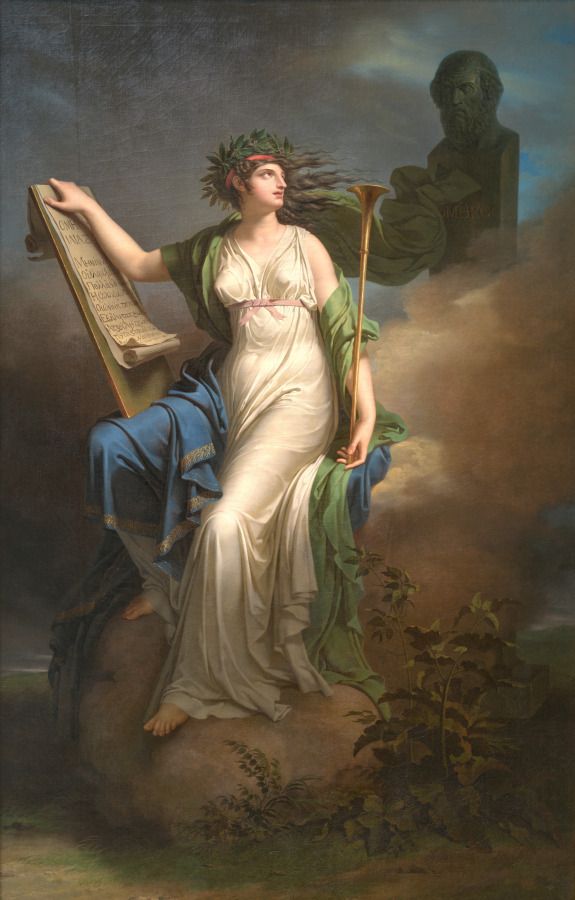
Calliope, Muse of Epic Poetry - France, late 18th-early 19th century, 1798, oil on canvas
The Cleveland Museum of Art, Cleveland, OH, 2003.6.4. CC0
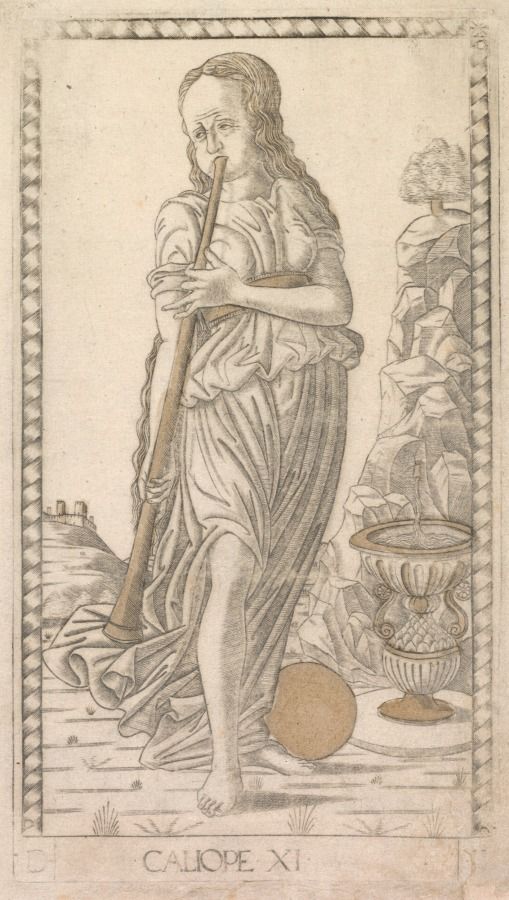
Calliope (from the Tarocchi series D: Apollo and the Muses, #11) - Italy, Ferrara, 15th century, before 1467, engraving hand-colored with gold
The Cleveland Museum of Art, Cleveland, OH, 1924.432.11. CC0
3 recorded relations, each with the ancient line behind it.
Parents
-

Apollodorus says Zeus had the Muses by Memory, and he names Calliope first among them.
-

Calliope is one of the nine Muses Zeus fathered by Mnemosyne.
Children
-

Apollodorus makes Calliope the mother of Orpheus, with his father given as Oeagrus or nominally Apollo.
Where Accounts Differ
- father-of-orpheus
- Apollodorus names Oeagrus as the father of Calliope's sons and Apollo only nominally. The passage checked here does not settle which father is meant for Orpheus.
Read the full source verification →
Mythology
Appears In
Related Terms
Referenced By
Sources
- Hesiod, The Homeric Hymns and Homerica, trans. Hugh G. Evelyn-White (1914), footnote to the Muses' names