Lycaon
Lycaon is a king of the Arcadians in Greek myth, a son of Pelasgus in Apollodorus and the father of fifty sons. Pausanias and Ovid say Zeus turned him into a wolf after a human child was sacrificed or served as a meal. Pausanias also makes him the father of Callisto, whom Zeus loved. Apollodorus records that some blamed the flood of Deucalion's age on the impiety of his sons.
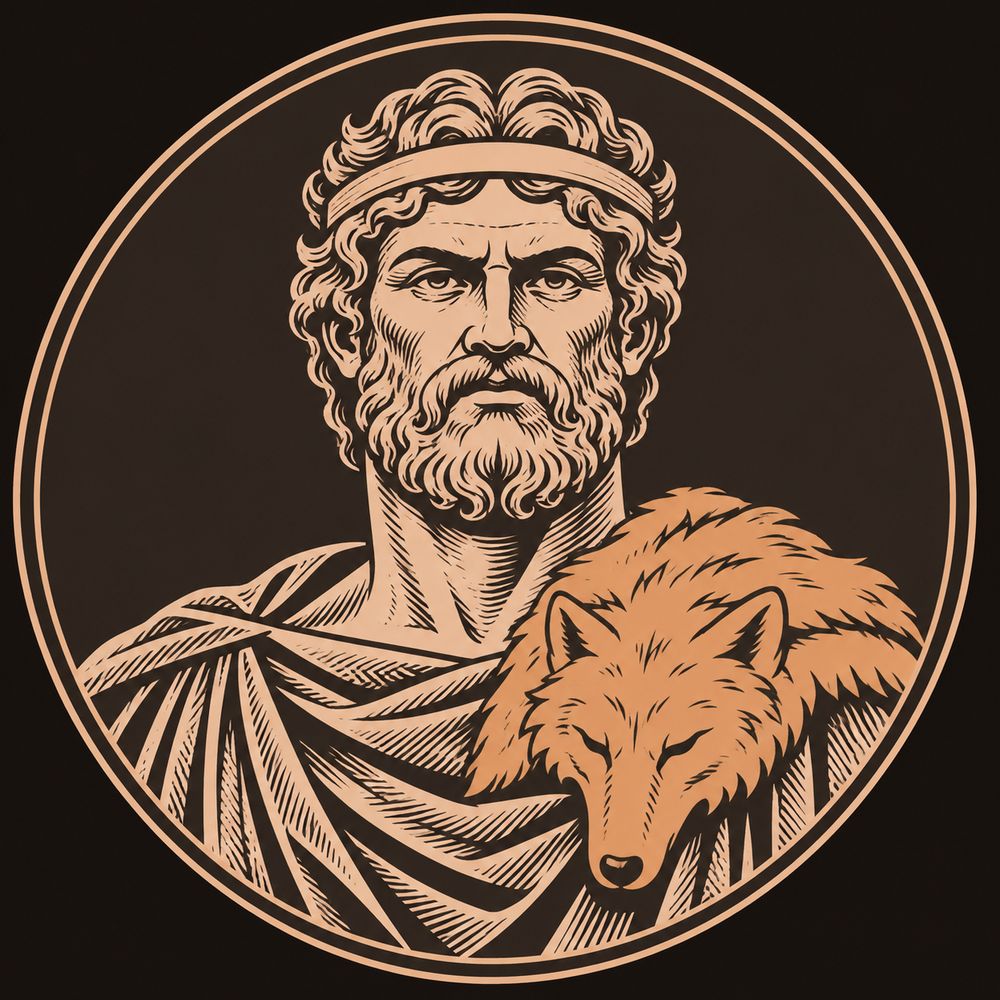
Lycaon, Arcadian king in a wolf-skin mantle
Generated by AI from this page's own facts, not an ancient image or evidence of anything. How this site uses generated images
Sections on this page
See Lycaon in the Greek family tree.
Core Myth
Apollodorus introduces Lycaon as the son of Pelasgus, a king of the Arcadians. He notes a disagreement about the father: Acusilaus made Pelasgus a son of Zeus and Niobe, but Hesiod declared him a son of the soil (Apollodorus, Library 3.8.1). Lycaon is a mortal ruler in this account, not a god or a monster. His fame in the sources rests on his crime and his punishment.
Apollodorus gives Lycaon fifty sons by many wives. He says they exceeded all men in pride and impiety. To test them, Zeus came to their house disguised as a day labourer. The sons slaughtered a child and mixed its flesh with the sacrificial meat. Zeus overturned the table, and the place was afterwards called Trapezus, from the Greek word for table. He then struck Lycaon and his sons with thunderbolts. Only the youngest, Nyctimus, was spared, because Earth caught Zeus's right hand and calmed his anger (Apollodorus, Library 3.8.1).
Pausanias tells a different version in which the wolf appears. He says Lycaon brought a human baby to the altar of Zeus Lycaeus and sacrificed it, and that he was changed from a man into a wolf. Pausanias adds that a man who became a wolf in this way turned human again after nine years, if he had kept from human flesh (Pausanias, Description of Greece 8.2.1-6). Here the crime is a cult act on an Arcadian altar, not a trick played on a guest.
Ovid makes the story a speech by Zeus, whom he calls Jupiter. Jupiter tells the council of the gods that Lycaon mocked the pious vows of the people and proposed a fair test of whether his guest was god or man. Lycaon cut the throat of a Molossian hostage and served the flesh at table. Jupiter destroyed his house. Lycaon fled in terror to the silent fields and howled where he meant to speak. His clothes became shaggy hair and his arms became legs, and he turned into a wolf (Ovid, Metamorphoses 1.163-252).
In Pausanias, Lycaon is also a father whose line leads to Callisto. Pausanias says that besides all his male issue Lycaon had a daughter, Callisto, whom Zeus loved and who bore a child to him. He calls this the current Greek legend (Pausanias, Description of Greece 8.3.6). The Zeus who punishes Lycaon is therefore the same god who later takes the daughter. The Callisto page follows her change into a bear and her place among the stars.
Who was Lycaon in Greek mythology?
He was an early king of the Arcadians. Apollodorus makes him the son of Pelasgus and says his father was variously a son of Zeus and Niobe or a son of the soil. Lycaon had fifty sons, and the sources name Nyctimus as the one who survived Zeus's anger. Pausanias adds a daughter, Callisto. The Lycaon who is a son of Priam in the Iliad is a different person.
Why was Lycaon turned into a wolf?
Pausanias gives the cause as a human sacrifice. Lycaon brought a baby to the altar of Zeus Lycaeus and sacrificed it, and he was changed from a man into a wolf. Ovid gives a different cause, the murder of a hostage and the serving of the flesh to his guest. Apollodorus does not mention a wolf in the passage checked here and has Zeus use thunderbolts instead.
Is Lycaon the first werewolf?
Not in the sources checked here, which never use the word werewolf. Pausanias does record that a man who became a wolf in this way could turn human again after nine years, if he had avoided human flesh. That is a wolf transformation tied to a cult, and Lycaon is its named origin. The later idea of the werewolf is modern and is not found in these passages.
Why did Zeus punish Lycaon?
Zeus acts against impiety in every version. In Apollodorus he tests the proud sons of Lycaon in disguise and finds them serving a slaughtered child, so he strikes them with thunderbolts. In Ovid he hears that Lycaon mocked the people's vows and doubted whether his guest was a god, and he answers the hostage's murder by destroying the house.
Which of Lycaon's sons survived Zeus's anger?
Apollodorus says only Nyctimus, the youngest, survived. Earth took hold of Zeus's right hand and calmed his wrath, so the thunderbolts spared him. He then succeeded to the kingdom, and the flood of Deucalion's age came during his reign. A translator's note in the Perseus edition says Pausanias calls Nyctimus the eldest, so the sources differ on his age.
Later Traditions
The sources disagree on what became of Lycaon's house. In Apollodorus, Nyctimus succeeded to the kingdom, and the flood of Deucalion's age followed. Apollodorus says some said it was caused by the impiety of Lycaon's sons, which leaves other causes open (Apollodorus, Library 3.8.2). Ovid is firmer. His council of the gods meets because of Lycaon's meal, and the flood is the answer to it (Ovid, Metamorphoses 1.163-252). The flood of Deucalion page sets out the full variants.
Callisto's parentage is also disputed. Apollodorus says Eumelus and some others made her a daughter of Lycaon. Hesiod said she was one of the nymphs, Asius called her a daughter of Nycteus, and Pherecydes a daughter of Ceteus (Apollodorus, Library 3.8.2). The Perseus edition of Apollodorus carries a translator's note that Pausanias calls Nyctimus the eldest son, not the youngest. The same note says a later writer, Hyginus, has Zeus turn Lycaon himself into a wolf. Neither point was checked against the original text for this page. The love and transformation cluster places Lycaon beside Callisto, though his own change is a punishment, not an outcome of love.
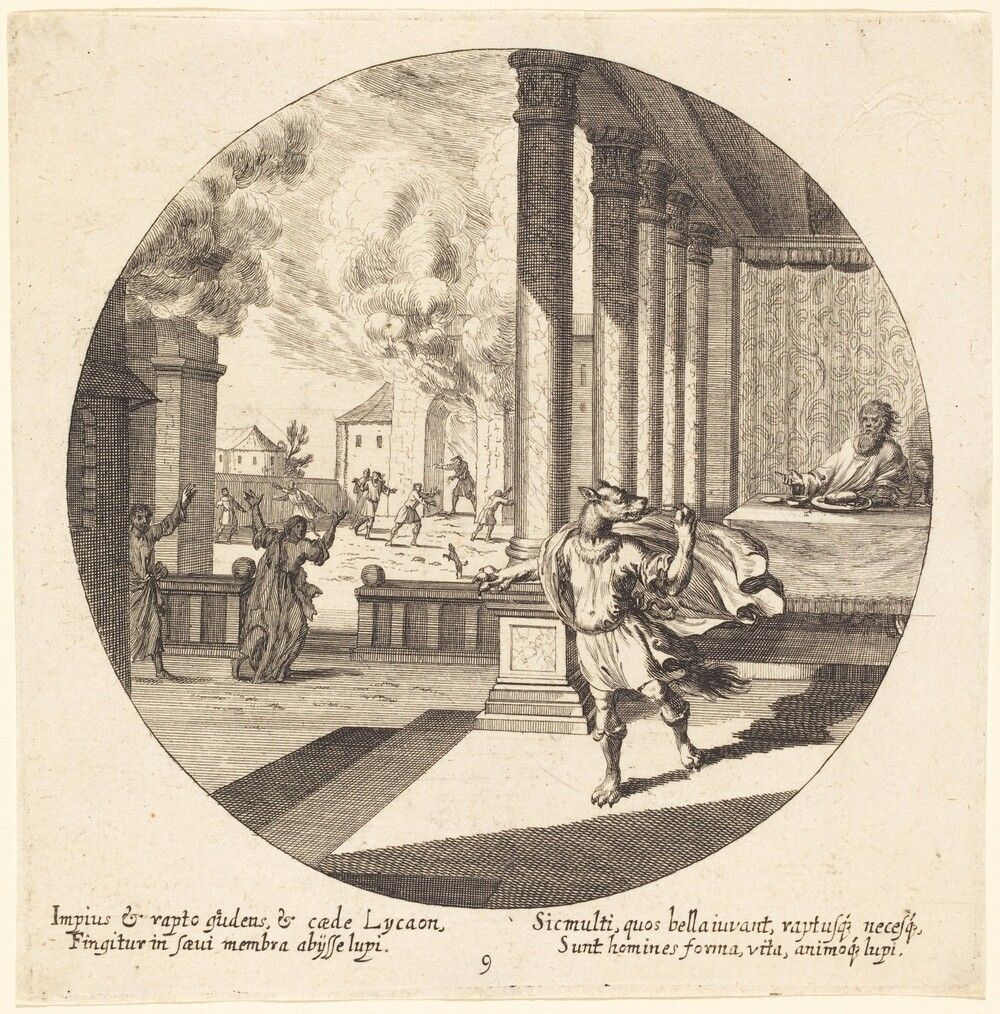
Jove Turns Lycaon into a Wolf - Georg Andreas Wolfgang the Elder, 1665, etching on laid paper
National Gallery of Art, Washington, DC, 2005.17.11. CC0
1 recorded relation, each with the ancient line behind it.
Children
-
disputed
Pausanias gives Lycaon a daughter Callisto, and Apollodorus says Eumelus and others agreed, while Hesiod made her a nymph.
Also Connected
1 recorded connection, each with the ancient line behind it.
Enemies
-

In Apollodorus Zeus tests the impious sons of Lycaon and strikes them with thunderbolts, and in Ovid Jupiter turns Lycaon into a wolf.
Where Accounts Differ
- lycaon-crime-and-punishment
- The sources give Lycaon's crime and its result differently: a child sacrificed on the altar of Zeus Lycaeus with a wolf transformation in Pausanias, a banquet for a disguised Zeus ended by thunderbolts in Apollodorus, and a murdered hostage served at table in Ovid. They also differ on whether the flood followed his sons' impiety or had another cause.
Read the full source verification →
Mythology
Appears In
Related Terms
Referenced By
Sources
- Apollodorus, The Library, trans. James George Frazer (1921), translator's notes to 3.8.1 and 3.8.2