Callisto
Callisto is a follower of Artemis who swears to stay a maiden, until Zeus wrongs her. In Ovid he takes Diana's form to reach her, and Juno then turns her into a bear. Apollodorus and Pausanias have Artemis shoot the bear. Zeus saves her son Arcas and puts her in the sky as the Great Bear.
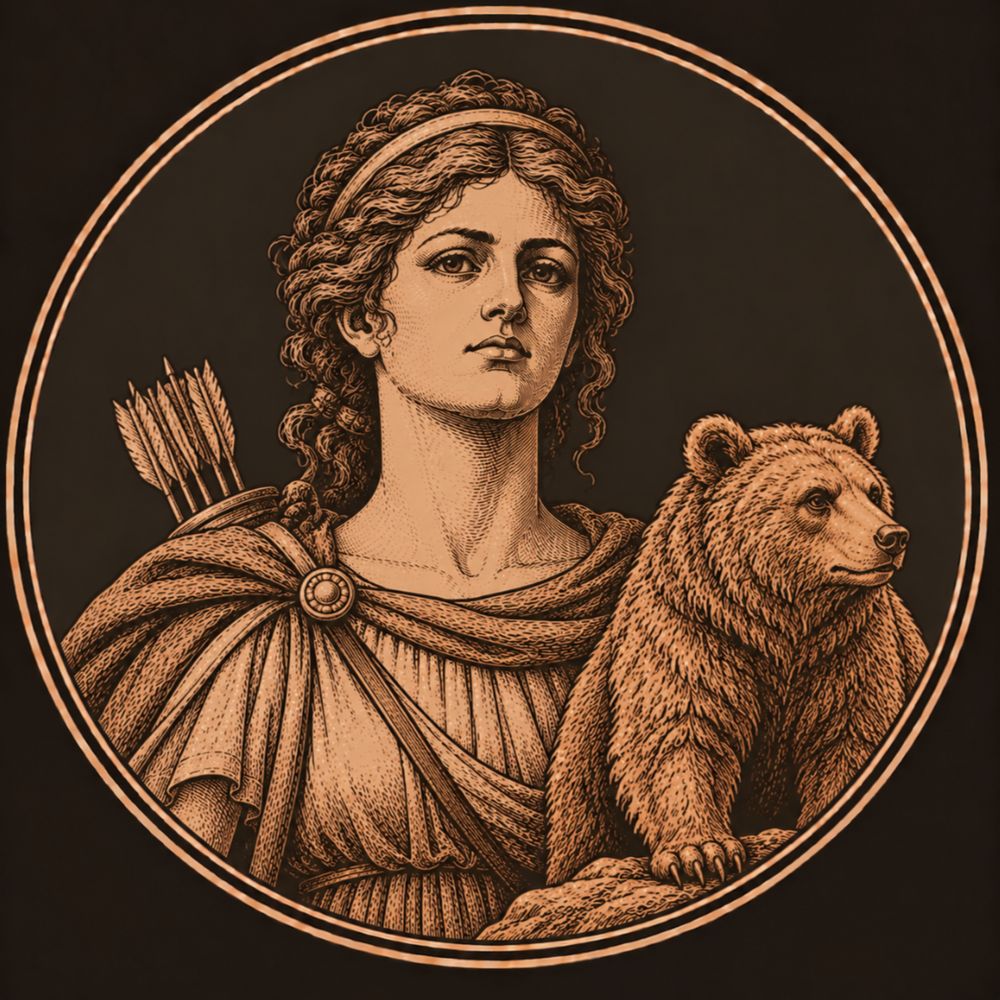
Callisto, bronze medallion illustration
Generated by AI from this page's own facts, not an ancient image or evidence of anything. How this site uses generated images
Sections on this page
Core Myth
Callisto was a huntress in the train of Artemis, and her parentage is told several ways. Apollodorus reports that Eumelus and others made her a daughter of Lycaon, but Hesiod said she was one of the nymphs, Asius called her a daughter of Nycteus, and Pherecydes a daughter of Ceteus. Pausanias, who gives what he calls the current Greek legend, makes her Lycaon's daughter. Ovid's Juno also speaks of Lycaon as her father-in-law. The setting is Arcadia in every version.
She hunted in Artemis's dress and swore to her to stay a maiden. Apollodorus says she wore the same garb as the goddess and took the oath. Ovid's Calisto carries a javelin or a bow, binds her hair with a plain white fillet, and is loved by Diana above every other huntress on Mount Maenalus. In the Fasti she touches the goddess's bow and asks it to witness her virginity, and Diana names her leader of her companions.
Then Zeus wrongs her, and the sources say plainly that it was without her consent. Apollodorus says that he shared her bed against her will, disguised, as some say, as Artemis, or, as others say, as Apollo. Ovid's Jupiter finds her asleep in a secluded thicket at midday and reasons that Juno might scold him but the gain is worth it. He takes Diana's form and asks where she hunted. Calisto answers that she greets a goddess greater than Jove, and Jove smiles, pleased at being preferred to himself. She struggles when she understands, but cannot resist him.
Ovid shows her shame before her fate. She goes back to the woods, almost forgetting her bow, and fears every figure until she sees the real nymphs of Diana's band. She cannot look up or walk beside the goddess. Nine months on, Diana proposes a bath in a cool stream. Calisto hangs back until the others have undressed, her condition shows, and the angry goddess drives her away. The Fasti has the same scene and says the goddess ordered her out of the band. Ovid comments that if Diana were not a virgin, she would pity her.
Her son is born, and the punishment follows. In Ovid, Juno hears that Calisto has borne Jupiter a boy called Arcas. She seizes her rival by the hair, throws her to the ground and vows to spoil the beauty that had dazzled him. While Calisto begs for mercy, black hair spreads over her arms, her hands turn to claws, and her voice becomes a growl. Ovid says she keeps her human understanding. The Fasti agrees that Juno, angry, changed the girl's form, and adds that Calisto suffered Jove against her will.
Ovid gives the bear fifteen years of flight, until Arcas is grown. She fears the hounds and the hunters, though she was once a huntress, and even the wolves and bears of the mountains. Her son Arcas becomes a hunter. In the forest of Erymanthus he sees a bear who stands and gazes at him, and he raises his spear against his own mother. Jupiter stops the blow. He carries mother and son up on a wind and fixes them among the stars. The Fasti gives the same rescue, and says Arcas was fifteen (three lustra) when they met.
What did Zeus do to Callisto?
He wronged her against her will. In Apollodorus he shared her bed disguised as Artemis or, as others say, as Apollo, and then turned her into a bear to hide her from Hera. In Ovid, Jupiter takes Diana's form and Calisto cannot resist him. Ovid's Jupiter later saves her and her son from Juno's rage, and Apollodorus has him set her among the stars as the Bear.
Apollodorus, Library 3.8.2
Were Artemis and Callisto lovers?
The sources do not say so. Callisto is a companion of the goddess who swears to stay a maiden, and Ovid says Diana loved her more than any other on Mount Maenalus. What Ovid gives is affection and trust, and his Jupiter uses that trust: he takes Diana's form to approach her. Apollodorus has Zeus take Artemis's form, or Apollo's, in some tellings.
Ovid, Metamorphoses 2.401-465
How did Zeus seduce Callisto?
The sources describe deception and force, not seduction. Ovid's Jupiter finds Calisto asleep, takes Diana's form and wakes her, and she resists him and cannot escape. Apollodorus says he shared her bed against her will, in the likeness of Artemis or, some say, Apollo. The Fasti says she suffered Jove unwillingly.
Ovid, Metamorphoses 2.401-465
What did Hera do to Callisto?
In Ovid, Juno seizes Calisto by the hair after her son is born and turns her into a bear, with claws, black hair and a growl for a voice. In Pausanias, Hera turns her into a bear and Artemis shoots it to please Hera. In Apollodorus, Zeus makes her a bear, and Hera persuades Artemis to shoot her as a wild animal.
Ovid, Metamorphoses 2.466-530
What happened to Callisto in Greek mythology?
She is wronged by Zeus, bears Arcas, and is changed into a bear. Ovid has her live as a bear for years, until her son almost spears her and Jupiter carries them both to the sky. Apollodorus and Pausanias have Artemis shoot her, and Zeus rescues the child and sets Callisto among the stars as the Bear.
Apollodorus, Library 3.8.2
What is Callisto known for?
She is known as the nymph turned into a bear and set in the sky as the Great Bear, and as the mother of Arcas. Her name is also on the fourth of Jupiter's large moons, which Galileo found in 1610. Pausanias notes that Arcadians also showed a grave for her.
Pausanias, Description of Greece 8.3.6-7
Later Traditions
The sources disagree on who made her a bear. In Apollodorus, Zeus turns her into one himself to escape the notice of Hera, and Hera then persuades Artemis to shoot her down as a wild beast. Pausanias says Hera changed her, and that Artemis shot the bear to please Hera. In Ovid, Juno changes her and nobody shoots her: Callisto is saved, and Arcas is stopped on the point of striking. Apollodorus adds a second reason for Artemis's shot: some say she killed Callisto because she had not kept her maidenhood.
What happens to the child also differs. In Apollodorus, when Callisto has died, Zeus snatches the baby, names him Arcas and gives him to Maia to raise in Arcadia. Pausanias has Zeus send Hermes to save the child from her womb. Ovid keeps Arcas with his mother until he is fifteen and can lift his spear against her.
Her place in the sky is the point of the story in Ovid. Juno, watching Calisto crowned with glory among the stars, flies over the sea to Tethys and Oceanus and asks them to bar the Seven Stars from the ocean. Ovid's Juno wants no concubine bathing in pure waters. The Fasti says that Saturnia still rages and asks white-haired Tethys not to let Maenalian Arctos bathe in her waters. Apollodorus says Zeus called Callisto's star the Bear.
Pausanias doubts the sky story. He says Zeus turned her into the constellation known as the Great Bear, which Homer names in the Odyssey, but adds that it may be named in her honor, because the Arcadians point out her grave.
Modern Influence
Her name is on the sky twice. The Great Bear of Pausanias, the constellation now called Ursa Major, is the bear she became. In 1610 Galileo Galilei discovered Jupiter's four largest moons, and NASA notes that Callisto is named for the woman Zeus turned into a bear. Simon Marius proposed the mythological names Io, Europa, Ganymede and Callisto soon after, saying Kepler suggested them. Galileo did not use them, and they stayed out of common use until the mid-twentieth century.
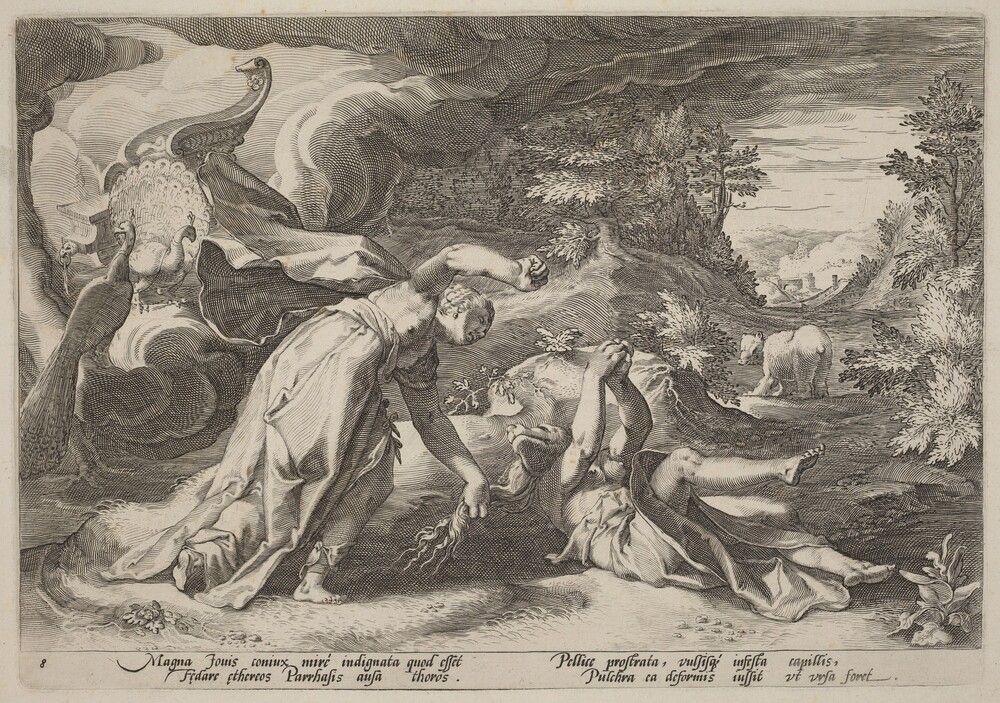
Juno Turning Callisto into a Bear - Workshop of Hendrick Goltzius, after Hendrick Goltzius, c. 1589, engraving on laid paper
National Gallery of Art, Washington, DC, 2011.139.144. CC0
Also Connected
7 recorded connections, each with the ancient line behind it.
Enemies
-

In Pausanias Hera turns Callisto into a bear, and in Apollodorus she persuades Artemis to shoot her.
-

In Ovid Juno seizes Calisto by the hair after Arcas is born and turns her into a bear.
Connected
-

Apollodorus makes Callisto Artemis's hunting companion, sworn to stay a maid, and has Artemis shoot her as a bear.
-

In Ovid Calisto hunts in Diana's band, and Jupiter takes Diana's form to approach her.
-

In Pausanias Zeus sends Hermes to save the child Callisto carried when Artemis shot her.
-

In Ovid Jupiter takes Diana's form to reach Calisto and later carries her and Arcas up to the stars.
-

In Apollodorus Zeus shares Callisto's bed against her will and later sets her among the stars as the Bear.
Where Accounts Differ
- who Callisto's father was
- who turned Callisto into a bear
- which form Zeus took
- whether Artemis shot the bear
- who saved Arcas
- whether the Great Bear is Callisto
- Callisto's parentage differs. Apollodorus reports Eumelus and others making her a daughter of Lycaon, Hesiod calling her a nymph, Asius a daughter of Nycteus and Pherecydes a daughter of Ceteus (Library 3.8.2). Pausanias makes her Lycaon's daughter (8.3.6). Frazer's note records that the Tegean historian Araethus made the mother of Arcas a granddaughter of Lycaon named Megisto.
- Who turns her into a bear differs. Apollodorus has Zeus do it to hide her from Hera (Library 3.8.2). Ovid has Juno do it after Arcas is born (Metamorphoses 2.466-530; Fasti 2.155-192). Pausanias has Hera do it (8.3.6).
- Whether she is killed differs. Apollodorus and Pausanias have Artemis shoot the bear, at Hera's persuasion, and Apollodorus adds that some say Artemis shot her for losing her maidenhood. In Ovid nobody shoots her, and Jupiter carries her into the sky alive before Arcas can strike.
- The form Zeus took differs. Ovid's Jupiter takes Diana's form (Metamorphoses 2.401-465). Apollodorus says the likeness of Artemis or, as others say, of Apollo (Library 3.8.2). The Fasti mentions no disguise.
- What becomes of Arcas differs. Apollodorus has Zeus snatch the baby after her death and give him to Maia in Arcadia. Pausanias has Zeus send Hermes to save the child from her womb. Ovid has Arcas born before the change, and meeting the bear at fifteen, when Jupiter saves both.
- Whether the constellation is her is a doubt in Pausanias, who says it may only be named for her, because Arcadians point out her grave (8.3.7).
- The Fasti passage is cited from the Latin text on Perseus. It is unmapped in the source registry, so the reference is not machine-checked. The Metamorphoses references were read in the Brookes More translation on Perseus, which spells her name Calisto; this page uses Callisto.
Read the full source verification →
Mythology
Related Terms
Referenced By
Sources
- Ovid, Metamorphoses 2.401-465
- Ovid, Metamorphoses 2.466-530
- Ovid, Fasti 2.155-192
- Apollodorus, Library 3.8.2
- Pausanias, Description of Greece 8.3.6-7
- James George Frazer, Apollodorus: The Library (Loeb, 1921), notes 2 and 3 on 3.8.2
- NASA Science, Callisto: Facts (science.nasa.gov/jupiter/jupiter-moons/callisto/facts/)
- Wikipedia, Callisto (moon), Naming (quoting Simon Marius on the names of Jupiter's moons)