Demodocus
Demodocus is the blind singer at the court of Alcinous, king of the Phaeacians, in Odyssey 8. The Muse loved him, took his sight and gave him sweet song. At one feast he sings three songs: the quarrel of Odysseus and Achilles, the affair of Ares and Aphrodite, and the wooden horse. Odysseus weeps at the third.
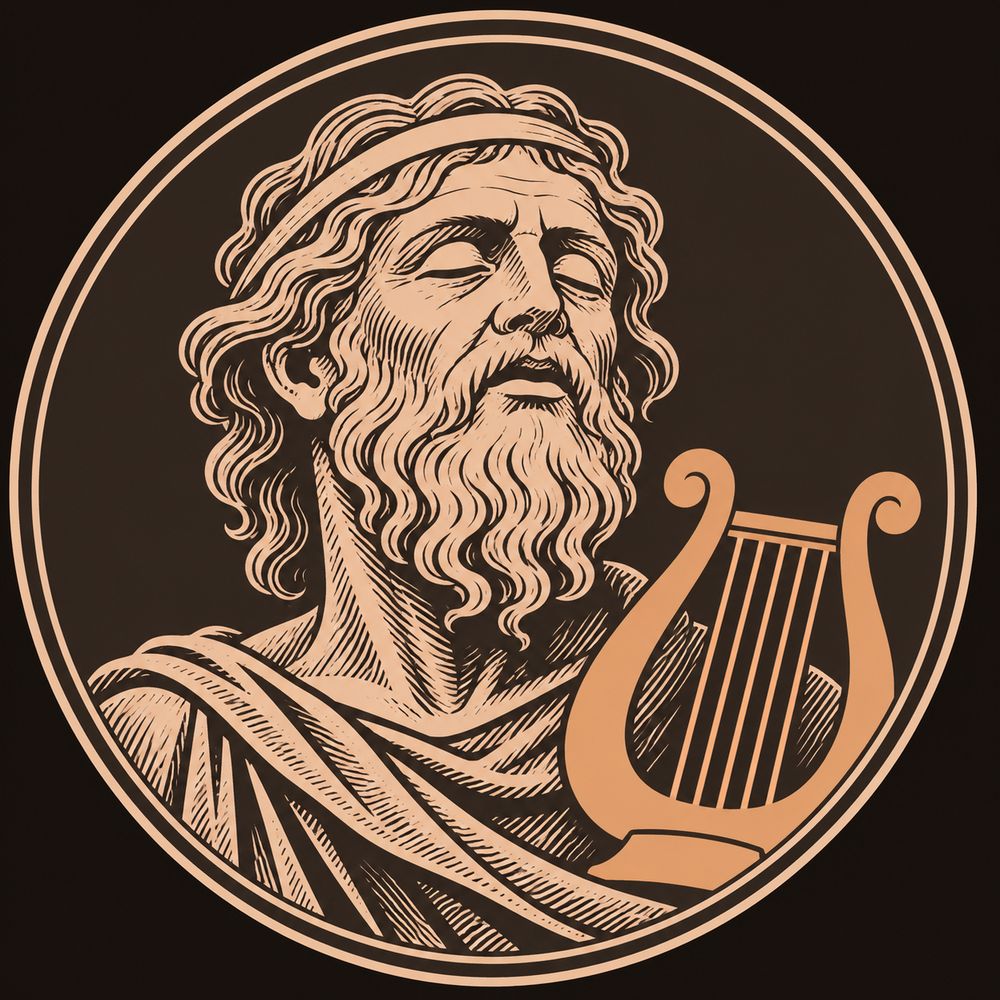
Blind singer Demodocus with his lyre
Generated by AI from this page's own facts, not an ancient image or evidence of anything. How this site uses generated images
Sections on this page
Core Myth
Demodocus enters the Odyssey as a summons. Alcinous orders a herald to fetch the divine singer Demodocus, because the god has granted him skill in song above all others, to give delight in whatever way his spirit prompts him to sing (Odyssey 8.43-45). He is a figure of the Phaeacian court on the island of Scheria. Homer gives him no father, no home city and no deeds outside the feast.
Homer says how he came by his gift. The herald leads him in, and the poem states that the Muse loved him above all other men. She took his sight and gave him sweet song instead (Odyssey 8.62-82). He is seated near a pillar with his lyre hung within reach, and when the meal ends the Muse moves him to sing. His first song is the quarrel of Odysseus and Achilles at a feast of the gods. Agamemnon is glad of it, since Apollo's oracle at Pytho had foretold it.
The second song comes while young Phaeacian dancers perform, and Odysseus watches them with admiration. Demodocus sings how Ares and Aphrodite first lay together secretly in the house of Hephaestus. Helios saw them and told Hephaestus. Hephaestus went to his forge, made unbreakable bonds and spread them invisibly round his bed. He then pretended to leave for Lemnos (Odyssey 8.266-366).
Ares came and invited Aphrodite to bed, and the bonds held them both. Hephaestus returned, stood in his gateway in fierce anger and called on Zeus and the other gods to see the laughable sight. He said he would keep the pair bound until her father repaid the bridal gifts. Hephaestus is the injured husband of the song, and Aphrodite is said to have scorned his lameness for Ares (Odyssey 8.266-366).
Poseidon, Hermes and Apollo came to the bronze-floored house. The goddesses stayed at home out of shame. The gods laughed at the craft of Hephaestus. Apollo asked Hermes whether he would lie with golden Aphrodite even if bound, and Hermes said he would, with three times as many bonds and all the gods watching. Poseidon alone did not laugh. He pleaded for Ares and promised to pay the debt himself if Ares fled. Hephaestus agreed and loosed the bonds. Ares left for Thrace and Aphrodite went to Paphos in Cyprus, where the Graces bathed and dressed her (Odyssey 8.266-366). Odysseus is glad at heart as he listens, and so are the Phaeacians.
The third song is one Odysseus asks for. He has a portion of boar's chine carried to Demodocus and says that minstrels earn honour because the Muse taught them the paths of song. He asks Demodocus to sing the wooden horse that Epeius built with Athena's help and that Odysseus led into the city as a trick. Demodocus sings of the Greeks sailing off after burning their huts, of the Trojans debating what to do with the horse, and of the sack, with Odysseus fighting at the house of Deiphobus beside Menelaus (Odyssey 8.472-541).
Odysseus weeps. Homer compares him to a woman weeping over her husband, who has fallen before their city. Only Alcinous notices, because he sits beside him and hears him groan. Alcinous asks Demodocus to stop, since the song does not please everyone alike, and asks his guest to stop hiding his thoughts and speak plainly (Odyssey 8.472-541). Demodocus does not appear in the passages checked here after that scene.
What story does Odysseus ask Demodocus to tell him?
He asks for the wooden horse. Once the herald has led Demodocus in and seated him among the banqueters, Odysseus cuts a portion of the chine of a white-tusked boar and sends it to him. Odysseus then asks for the horse that Epeius built with Athena's help. Demodocus sings it from the burning of the Greek huts to the sack of the city.
Did Ovid tell the Ares and Aphrodite story the way Homer does?
Only in outline. Ovid's Sol sees the lovers and informs Vulcan, who makes chains that are almost invisible, as in Homer. Ovid ends with Venus planning revenge on the Sun, where Homer ends with the lovers freed and parted, and no singer is part of Ovid's telling.
Is Demodocus mentioned outside the Odyssey?
Not in the sources checked here. The Odyssey is the only text checked that names him. There the herald leads in the good minstrel, Demodocus, held in honor by the people, and seats him in the midst of the banqueters. No competing version of his life or songs was found. The story of the net is told again by Ovid, but the singer is not part of that telling.
Why does Alcinous stop the singing?
He sees that his guest is in distress. When the famous minstrel finishes this song, the heart of Odysseus melts and tears wet his cheeks. Homer compares him to a woman who wails over her husband fallen before his city. Odysseus hides his tears from the others, but Alcinous sits beside him and hears him groan. He then asks Demodocus to stop, since the song does not please everyone alike.
Later Traditions
The sources checked here name Demodocus only in the Odyssey. No other ancient text checked gives a rival account of him, so his portrait is Homer's alone. The Ares and Aphrodite story has a life apart from him. Ovid tells it in the Metamorphoses with the Sun, called Sol, informing Vulcan, the Roman name of Hephaestus (Ovid, Metamorphoses 4.167-189).
Homer and Ovid agree on the informer and on the trap. Both have the Sun see the lovers and tell the smith god. Both have the smith god make fine, nearly invisible bonds. They differ in where the story ends. In Homer the gods gather, joke, plead and release the pair, and the song closes on the lovers' separate journeys. In Ovid the gods are called to see the pair, and Venus is left brooding on the Sun's betrayal and planning to repay him with the pains of love (Ovid, Metamorphoses 4.167-208). The Olympian gods of the Odyssey are an audience that laughs. In Ovid they are a witness to a grievance that continues.
Also Connected
5 recorded connections, each with the ancient line behind it.
Connected
-

Demodocus sings of Aphrodite and Ares caught in Hephaestus's bonds, and of Aphrodite's return to Paphos.
-

Demodocus sings of Ares lying with Aphrodite in Hephaestus's house and leaving for Thrace once released.
-

In Demodocus's song Helios sees Ares and Aphrodite together and tells Hephaestus.
-

Demodocus sings of Hephaestus forging the unbreakable bonds that trap Ares and Aphrodite.
-

At the Phaeacian feast Odysseus sends Demodocus a portion of meat, asks him for the song of the wooden horse, and weeps when he sings it.
Where Accounts Differ
- demodocus-homer-vs-ovid-ares-aphrodite
- Homer and Ovid tell the affair of Ares and Aphrodite with the same informer, the Sun, but they differ in the aftermath. Homer has the gods gather, laugh, and release the pair at Poseidon's pledge. Ovid has the gods called to see the pair and ends on Venus's plan to punish the Sun.
Read the full source verification →