Io
Io was a princess of Argos, usually called a daughter of the river Inachus, whom Zeus loved. Apollodorus and Ovid say Zeus turned her into a white cow to hide her from Hera; Aeschylus's Suppliants says Hera did it. Hera set many-eyed Argus to guard her, then sent a gadfly that drove her to Egypt, where she regained her form and bore Epaphus.
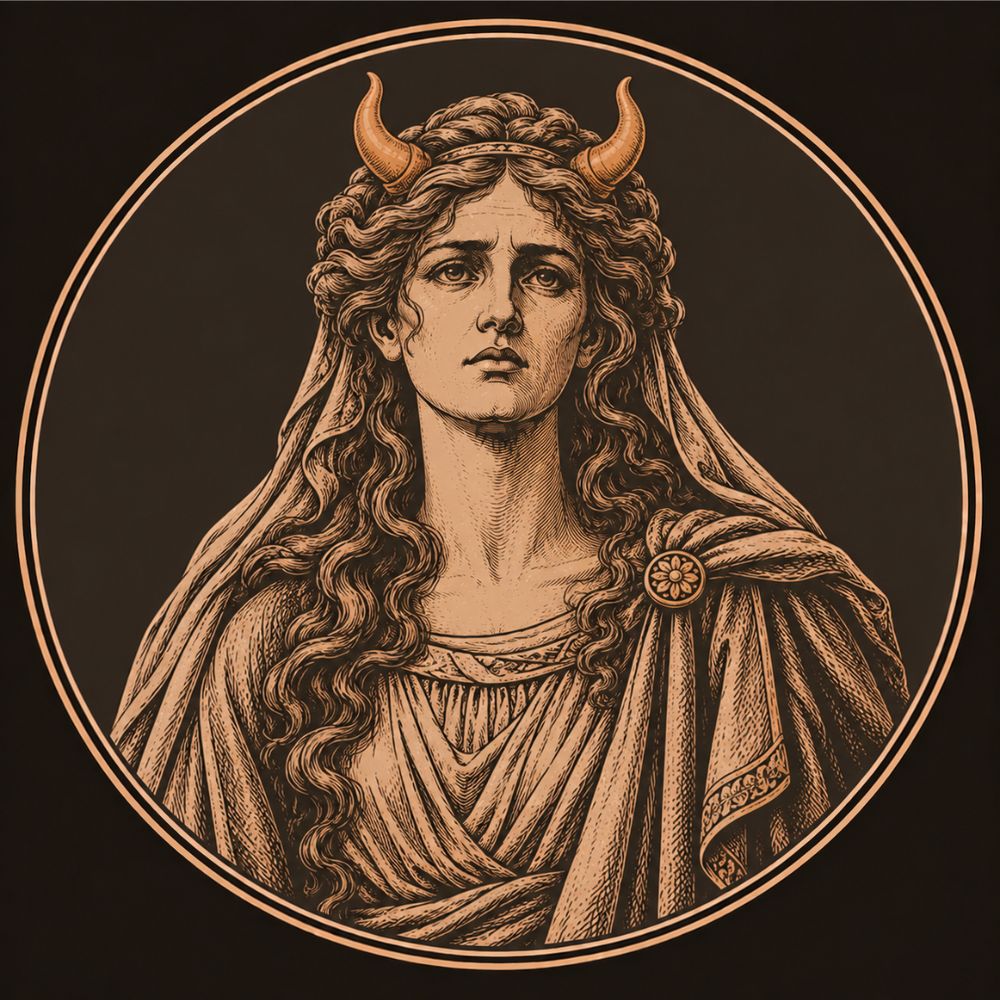
Io, bronze medallion illustration
Generated by AI from this page's own facts, not an ancient image or evidence of anything. How this site uses generated images
Sections on this page
Core Myth
Io was a woman of Argos, but the sources do not agree on her father. Apollodorus reports three answers. Some called her a daughter of Iasus, son of Argus and Ismene. The annalist Castor and many of the tragedians made her a daughter of Inachus, while Hesiod and Acusilaus named Piren. Aeschylus follows the Inachus line in Prometheus Bound. Apollodorus adds that Io held the priesthood of Hera when Zeus seduced her, and Aeschylus's Suppliants calls her a ward of Hera's house at Argos.
Aeschylus lets Io tell her own story in Prometheus Bound. Night visions urged her to go out to the meadows of Lerna and accept the bed of Zeus. Her father sent messengers to Pytho and Dodona. At last an oracle of Loxias ordered Inachus to drive her from home, or a thunderbolt would destroy his whole race. Once she was cast out, her form and mind were changed. Horns grew on her forehead, and a gadfly drove her on. Ovid tells it differently. Jupiter spoke to her as she came back from her father's stream, and when she ran, he covered the land in cloud and caught her.
Ovid and Apollodorus both make Zeus the one who changed her. In Ovid, Juno sees the cloud, comes down, and finds a white heifer that Jupiter claims was born from the earth. She asks for it as a gift, and he cannot refuse without betraying himself. Apollodorus says Zeus turned Io into a white cow by a touch and swore he had not known her. Hera then set Argus to guard the cow, and Apollodorus says Argus tethered her to the olive tree in the grove of the Mycenaeans. Ovid's Io tries to stretch out her arms to Argus and finds she has none. She tells her father who she is by tracing her name in the dust with her hoof.
Zeus sent Hermes to take her back. Apollodorus says Hermes could not steal the cow in secret, because Hierax had given the plan away, so he killed Argus with a thrown stone. Ovid's Mercury comes as a shepherd, lulls the eyes with his pipes and the story of Syrinx, and cuts off the sleeping giant's head with a curved sword. Juno then set the dead guard's eyes on the feathers of her bird, and Ovid later says her peacocks were coloured by the death of Argus. Aeschylus says only that a sudden death took Argus, and in Suppliants the King says simply that Hermes slew him.
Hera's anger did not end with Argus. Apollodorus says she sent a gadfly, and in Ovid it is a Fury whose invisible stings drive the girl across the world. Apollodorus traces the route. Io came first to the gulf later called Ionian after her, went through Illyria and over Mount Haemus, and crossed the Thracian strait, afterwards named the Bosporus for her. She then roamed Scythia and the Cimmerian land. The Suppliants chorus sends her through Phrygia, Mysia, Lydia and the mountains of Cilicia and Pamphylia. In Prometheus Bound, Prometheus foretells a wider road, past the Scythian nomads, the Chalybes, the Caucasus and the Amazons, to the Graeae, the griffins and the Arimaspians. In Ovid, Juno recalls how Jupiter changed Io from a heifer when she rages at the nymph Callisto, set among the stars.
Every account ends in Egypt. Prometheus Bound places her healing at Canobus, at the mouth of the Nile, where Zeus restores her mind by the touch of his hand. She bears Epaphus, named from that touch, and the Suppliants tells the same story. Ovid has Jupiter swear by the Styx that Io will trouble Juno no more, and Juno allows the change back. Apollodorus adds a sequel. Hera had the Curetes make away with the child, and Io searched Syria, learned that the wife of the king of Byblus was nursing him, and found him. Back in Egypt she married Telegonus, then king of the Egyptians.
Who is Io in Greek mythology?
Io is a princess of Argos whom Zeus loved. Apollodorus says she was a priestess of Hera, and he records three fathers for her: Iasus, the river Inachus, or Piren. Changed into a white cow, she was guarded by Argus until Hermes killed him. Hera then drove her across Europe and Asia with a gadfly. In Egypt she recovered her form and bore Epaphus, ancestor of Danaus, Aegyptus and the house of Agenor.
Apollodorus, Library 2.1.3; Apollodorus, Library 2.1.4
Why did Zeus turn Io into a cow?
To hide the affair from Hera. In Ovid, Juno sees an unnatural cloud over the fields and comes down to look, and Jupiter changes Io into a white heifer before she arrives. He claims the animal was born from the earth. Apollodorus says Zeus changed her by a touch once Hera had caught him, and swore he had not known her. Not every source blames Zeus. In Aeschylus's Suppliants, the King says the goddess of Argos herself turned the woman into a cow.
Ovid, Metamorphoses 1.583-649; Aeschylus, Suppliants 291-315
Why did Hera torment Io with a gadfly?
The sources present it as Hera's anger at Zeus's love for Io. In Apollodorus, the gadfly comes straight after Hermes kills Argus on Zeus's orders. Ovid makes the torment Juno's revenge once Argus is dead: she plants a Fury's invisible stings in the girl and drives her across the world. In Prometheus Bound, Prometheus tells the chorus that Io's sufferings come at Hera's hand. He also blames Zeus, whose desire for a mortal girl has imposed these wanderings on her.
Aeschylus, Prometheus Bound 700-740
How did Io return to her human form?
Zeus restored her in Egypt. In Prometheus Bound, Prometheus foretells that at Canobus, by the mouth of the Nile, Zeus will bring her back to her senses with the mere touch of his hand, and she will bear Epaphus. Ovid gives a fuller scene. Io collapses by the Nile and bellows to the stars, and Jupiter swears by the Styx that she will trouble Juno no more. Juno relents, and the heifer's hair, horns and hooves give way to a woman's body.
Aeschylus, Prometheus Bound 846-850; Ovid, Metamorphoses 1.712-746
Who were the descendants of Io in the myths?
Her son Epaphus ruled Egypt and fathered Libya, Apollodorus says. Libya bore Agenor and Belus to Poseidon. Belus fathered the rival brothers Danaus and Aegyptus, whose fifty daughters and fifty sons carry the story of Aeschylus's Suppliants. Agenor went to Phoenicia and fathered Europa and Cadmus. Prometheus Bound adds that one of the Danaids would found a royal line in Argos, from which the bowman who frees Prometheus would come.
Apollodorus, Library 2.1.4; Aeschylus, Prometheus Bound 846-875
Later Traditions
Herodotus opens his Histories with a version that leaves the gods out. Persian learned men, he says, blamed the Phoenicians for the first quarrel between Asia and Greece. Phoenician traders at Argos seized Io, daughter of Inachus, from the shore and sailed her to Egypt. Greeks later carried off Europa from Tyre and Medea from Colchis, and answered the Colchian demand for Medea by pointing to Io. The Phoenicians, Herodotus adds, denied the abduction. In their account, Io slept with the ship's captain at Argos, found herself pregnant, and sailed away with them of her own accord.
Greeks also saw Io in the gods of Egypt. Herodotus says that images of Isis show a woman with cow's horns, exactly as the Greeks picture Io. He also says that Apis, kept in a court at Memphis, is Epaphus in Greek. Apollodorus goes further. He says Io set up an image of Demeter, whom the Egyptians called Isis, and that the Egyptians gave Io the name of Isis as well. Ovid says the linen-wearing crowds of Egypt worship her as a goddess, and that Epaphus shares her temples.
Her line runs through much of Greek myth. Apollodorus traces it from Epaphus to his daughter Libya, whose sons by Poseidon were Agenor and Belus. Belus fathered Danaus and Aegyptus, and Agenor fathered Europa and Cadmus. Aeschylus's Suppliants is built on that descent: the daughters of Danaus flee to Argos and claim it as the land of their ancestress, the heifer of Zeus. In Prometheus Bound, Prometheus tells Io that a descendant of hers, the third after ten generations, will free him. Apollodorus names Heracles as the archer who shot the eagle and released Prometheus.
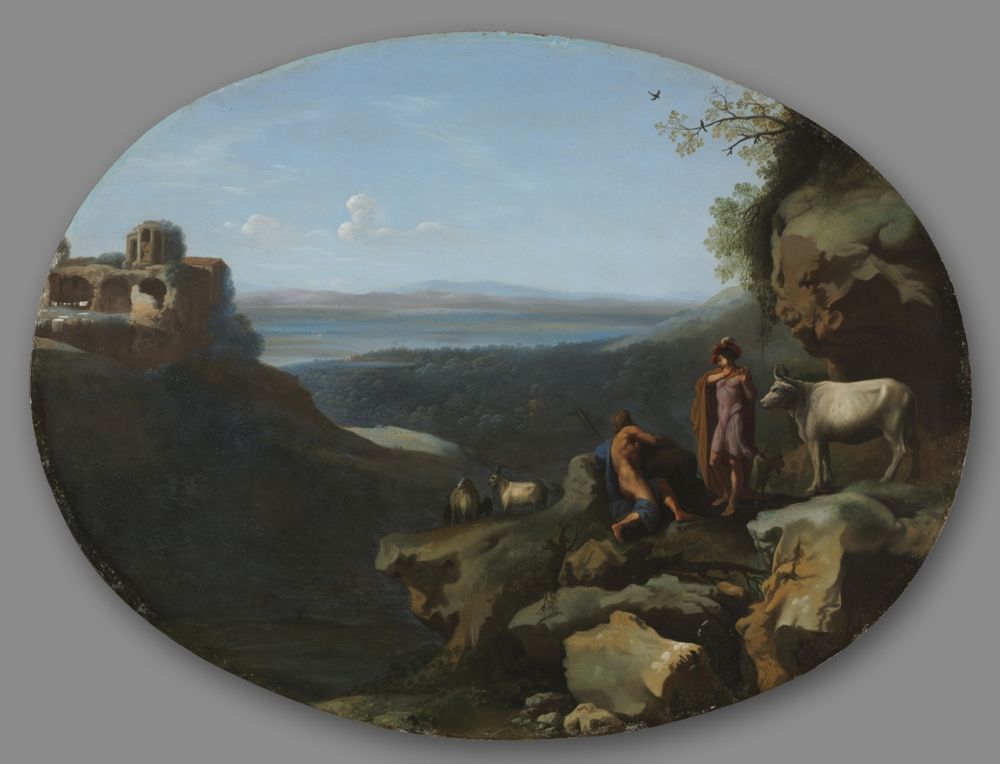
Mercury and Argus in a Landscape - Netherlands, c. 1635, oil on copper
The Cleveland Museum of Art, Cleveland, OH, 1989.248. CC0
Also Connected
5 recorded connections, each with the ancient line behind it.
Allies
-

Zeus ordered Hermes to steal Io back from Hera, and Hermes killed her guard Argus.
Enemies
-

Hera persecuted Io as Zeus's lover; in Aeschylus's Suppliants she herself turns Io into a cow, sets Argus over her and sends the gadfly.
Connected
-

Argus was set by Juno to guard Io in her heifer form, watching her with his hundred eyes.
-

Chained on his rock, Prometheus foretells Io's wanderings and her end in Egypt, and names a descendant of hers as his deliverer.
-

Zeus seduced Io while she was Hera's priestess and turned her into a white cow to hide her from Hera.
Where Accounts Differ
- who Io's father was
- whether Zeus or Hera turned Io into a cow
- how Argus died
- whether a gadfly or a Fury drove Io
- the route of Io's wanderings
- whether Io was abducted or left willingly
- Io's father differs by source. Apollodorus (Library 2.1.3) records Iasus, son of Argus and Ismene, then says the annalist Castor and many tragedians made her a daughter of Inachus, and that Hesiod and Acusilaus named Piren. Aeschylus (Prometheus Bound 663, 705), Ovid (Metamorphoses 1.583-649) and Herodotus (Histories 1.1) all make her the daughter of Inachus. The Hesiodic account is known here only through Apollodorus.
- Who changed Io into a cow differs. Apollodorus (Library 2.1.3) and Ovid (Metamorphoses 1.583-649) make it Zeus, hiding her from Hera. In Aeschylus's Suppliants (291-315), the King says the goddess of Argos transformed her. In Prometheus Bound (640-685), Io says only that her form and mind were distorted after Inachus drove her out on the oracle's command.
- How Argus died differs. Apollodorus (Library 2.1.3) says Hermes killed him with a thrown stone because Hierax had betrayed the plan. Ovid (Metamorphoses 1.650-711 and 1.712-746) has Mercury lull all his eyes to sleep with pipes and the tale of Syrinx, then behead him with a curved sword. Aeschylus (Prometheus Bound 680) speaks only of a sudden, unexpected death, and in Suppliants (291-315) the King says Hermes slew him.
- What tormented Io differs. Apollodorus and Aeschylus name a gadfly sent by Hera. Ovid (Metamorphoses 1.712-746) describes a Fury planted in her mind by Juno. Aeschylus (Prometheus Bound 566-570) has Io see the gadfly as the ghost of the dead Argus still pursuing her.
- Her route differs. Apollodorus (Library 2.1.3) takes her to the Ionian gulf, Illyria, Mount Haemus, the Bosporus, Scythia and the Cimmerian land. Aeschylus's Suppliants (538-589) leads her through Asia Minor. Prometheus Bound (700-740, 786-815) foretells a route east past the Caucasus and the Amazons, then to the Graeae, the griffins and the Arimaspians before the Nile, and (823-845) recalls an earlier passage by Dodona and the gulf named Ionian after her.
- Herodotus (Histories 1.1-1.2 and 1.5) gives two rationalised accounts with no gods: the Persians say Phoenician traders carried Io off to Egypt, while the Phoenicians say she left willingly after becoming pregnant by the ship's captain. Herodotus reports both without deciding between them.
- The identification of Io with Isis and of Epaphus with Apis is Greek interpretation. Herodotus (Histories 2.41) notes only that Isis was pictured horned like Io, and names Apis as Epaphus (2.153). Apollodorus (Library 2.1.3) says the Egyptians called Io Isis.
Read the full source verification →
Mythology
Appears In
Related Terms
Referenced By
Sources
- Apollodorus, Library 2.1.3
- Apollodorus, Library 2.1.4
- Apollodorus, Library 2.5.11
- Apollodorus, Library 3.1.1
- Aeschylus, Prometheus Bound 566-570
- Aeschylus, Prometheus Bound 640-685
- Aeschylus, Prometheus Bound 700-740
- Aeschylus, Prometheus Bound 757-780
- Aeschylus, Prometheus Bound 786-815
- Aeschylus, Prometheus Bound 823-845
- Aeschylus, Prometheus Bound 846-875
- Aeschylus, Suppliants 15-20
- Aeschylus, Suppliants 291-315
- Aeschylus, Suppliants 538-589
- Ovid, Metamorphoses 1.583-649
- Ovid, Metamorphoses 1.650-711
- Ovid, Metamorphoses 1.712-746
- Ovid, Metamorphoses 1.746-750
- Ovid, Metamorphoses 2.531-533
- Herodotus, Histories 1.1-1.2
- Herodotus, Histories 1.5
- Herodotus, Histories 2.41
- Herodotus, Histories 2.153
- Ovid, Metamorphoses 2.466-530